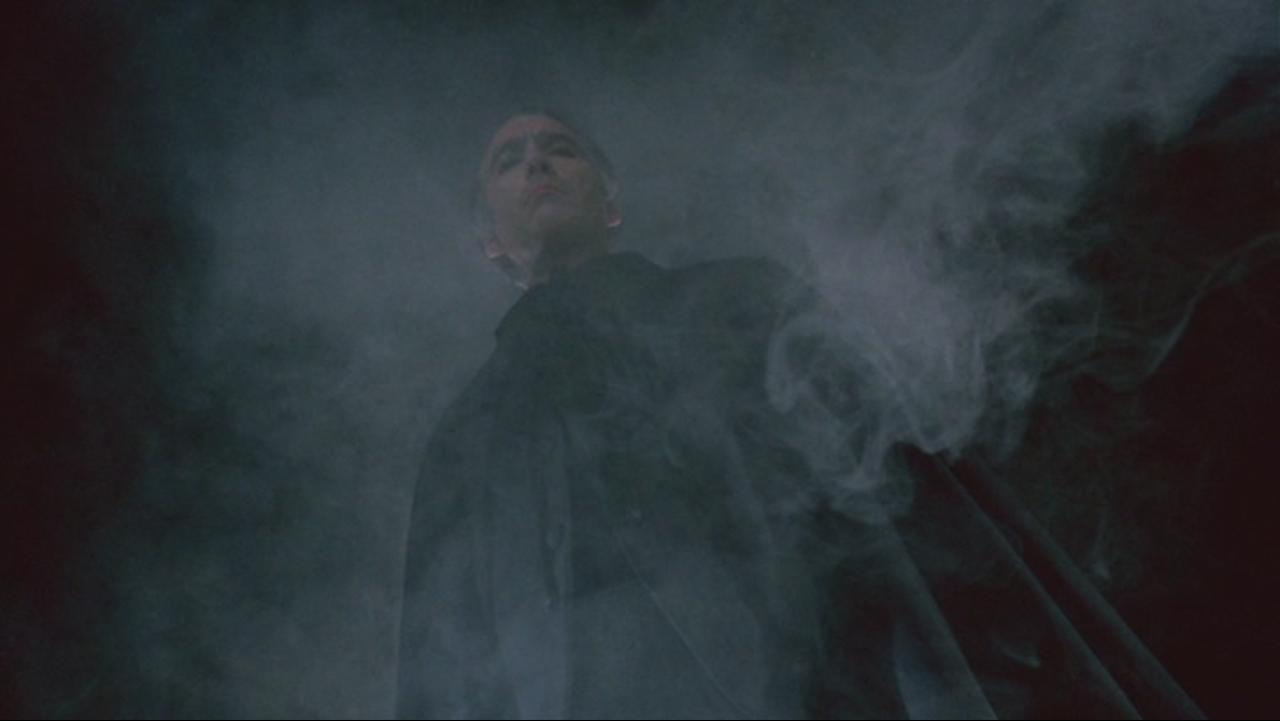
Considering what I know now, it's a little bit hard for me to recommend Dracula: Prince of Darkness to people. The first sequel to Horror of Dracula that brought Christopher Lee back to the franchise is slightly infamous due to Lee's attitude toward the production. But I still kind of love the movie, and I don't really feel bad about that. I suppose I could use the term guilty pleasure, but I feel no guilt for disagreeing with one of my favorite actors on this one. Instead, I find that Dracula: Prince of Darkness works as something of a case study into how a film can succeed despite all of the troubling things that happen along its journey through production.
(RANDOM TANGENT: By the way, I'd never use the term "guilty pleasure" anyway. It's one of those things I wish we could disinvent. There is no reason you should feel guilt over liking a movie. If you take things so seriously that you have guilt....you probably have some personal problems and you might wanna talk to somebody. Life's too short, be happy about movies.)
It's widely documented - I posted an interview in which Lee confirms it just last week - that the star was so disappointed by the film's script that he refused to speak any dialogue in this film. The result is that there are some moments where we briefly forget that this is a Dracula movie, because the film is forced to spend a lot of time on other characters who vary from the very bland to the interesting-only-as-a-caricature.
One of my favorite theories about sequels that a friend and I once came up with - and this is gonna veer in a non-horror direction, so stay with me - is that you often find sequels scrambling to replace one or two major parts of the first film's success with a larger number of smaller parts. If you saw Moneyball you can think of it as the same thing Brad Pitt did in that movie, but apply it to movies. For example, The Fast and The Furious had Vin Diesel as a criminal/cohort of Paul Walker who was undercover. Vin left and Walker became the criminal, so they had to add Tyrese as a cohort, Cole Hauser as a criminal, and Eva Mendes undercover. Simple math dictates that they needed three people to make up for the loss of Vin Diesel and for the change in Paul Walker's character's profession.
The same thing happened with Dracula: Prince of Darkness, which meant that Hammer Films' stable of writers and director Terence Fisher - who, by the way, does not get enough credit for holding together some standard horror productions and making them better than the sum of the parts (He might have been the Billy Beane of horror movies!) - had to think of new ways to make the movie go. Without Peter Cushing or the Van Helsing character (because you don't just replace Cushing!) and without Dracula as more than a silent force, Fisher and company added some unique characters to the mix and took a step even further away from Bram Stoker's novel. (That last step might be a negative to some people - Lee particularly - but for the rest of this article I'm going to accept it. Again, life's too short.)
My favorite development in this sequel is the focus on what most vampire mythology refers to as "familiars" - the humans who serve Count Dracula for reasons unknown to most men. At the front of this development is Klove, played by Philip Latham, a pale and grey-haired servant who maintains Dracula's castle and is responsible for the ritual that allows the previously perished Count to return and terrorize the family that wanders into his home. Klove fascinates me thanks to Latham's quiet and assured performance, and the sequence in which he carries out the blood ritual that resurrects Lee is one of the highlights of the franchise. There's a methodical, religious aspect to the character - watch how the actor pauses and slightly bows before the altar which holds Dracula's ashes - that builds up Dracula's power over the week. If nothing else, Dracula: Prince of Darkness does a really good job of making us recognize the power that Dracula can have over the weak. (Klove would randomly return two sequels later in Scars of Dracula, but in this version the character is more desperate and pitiful while being played by The Omen's Patrick Troughton.)
Aside from the few familiars involved, this sequel offers a couple of other notable additions to the cast. Barbara Shelley does double duty, spending the first half of the film as an uptight and skeptical member of the group that enters the castle before becoming Dracula's female companion after a mid film bite. She does a good job of selling both aspects of the character, cementing the fact that this movies is going to spend its time showing Dracula's impact on others. This is also hammered home by co-star Andrew Keir, whose addition to the film as a monk that knows all about Dracula and vampirism is clearly covering for some of the things we'd expect to hear from Van Helsing. It's a one-note character, but Keir's strong presence helps give the film a little more weight.
I probably shouldn't find Dracula: Prince of Darkness to be as interesting as it is, especially when I look at some of the obvious flaws in the production, the biggest of which is being a Dracula movie that doesn't have much Dracula in it. And yet, the way the movie has been put together and the amount of effort that appears to have been expended is somewhat infectious. I gain a lot of respect for everyone involved - even Lee, despite his objections - when I watch this movie because it's such a large challenge to replicate what Horror of Dracula did eight years earlier. Yet you can still see the wheels churning and no one seems to be resting on the name value of the film, and the final result is a vampire tale that is far from perfect but still good looking and a bit charming.
You guys, I'm tired of being boring. I feel like 2013 has been one big long boring year here at FMWL. And that sucks. I could make a bunch of excuses - work sucks, writing about horror movies four days a week exhausts a lot of topics, I'm just lazy - but none of them would actually matter. It's not why I don't do things that's important, it's that I do something about it.
Totally unrelated, yet important, checklist.
When thinking about my own writing and what the heck I'm doing, I came to a realization. I love writing reviews and being as serious as I can be (which isn't that serious, but that's beside the point), but the most fun I've ever had writing about movies - save a few of my favorite posts here at FMWL - was more than ten years ago when a friend asked me to write a DVD column on his site and I turned it into a random series of thoughts that I slapped together off the top of my head while doing what I call "winging it." It wasn't high art and it wasn't always important, but it was carefree and fun and it always put a smile on my face. And, as you might have guessed, that's what I'm doing right now.
That's not to say I plan on getting rid of reviews or the Midnight Movie of the Week or any of the other stuff I do when I'm feeling inspired. But there are so many times when I just want to put some thoughts out there and I get caught up in the how and the what and then I'm like HEY THE MIKE JUST FREAKING TYPE IT. So that will be what I do every once in a while in posts like this one, which will carry the simple title "Today's Things."
(Yes, I thought of that name all by myself. I'm a gosh darn Einstein.)
(Oh, and I might ramble on a bit here. Just roll with it. Or go read something else. Your move, creep.)
Thing I'm Loving on Blu-Ray
I'm not sure if I've said it enough over the last year, but Shout Factory's horror centric new wing, Scream Factory, is one of the best things to happen to horror fans in ages. Case in point: This week's release of the R-rated Hammer Films offering The Vampire Lovers. Released in 1970, this Dracula-less film is a showcase for the voluptuous and talented Ingrid Pitt, a horror star who must be seen by all fans of romantic vampire tales.
While the film itself is not one of Hammer's best offerings, it stands up as a nice adaptation of the classic tale of Carmilla, which predated Bram Stoker's Dracula and pretty much invented the lesbian vampire stereotype that became a staple of European horror in this era. Pitt is the primary reason to check the film out, and its use of nudity and sexuality - while mild by modern standards - is out of character and risque for hammer. Advertising for the film that has been reproduced (twice on the blu-ray packaging and once as an on-disc disclaimer) boldly states "Not for the mentally immature!", which to me seems like a reminder that there's artful desires behind this surprising film.
(By the way, I always give a movie extra kudos if a villain uses a fake name that is an acronym of their infamous name. Here we get Carmilla pretending to be someone named Mircalla, and me smiling a lot due to this fact.)
As has been the case for most of their releases, Scream Factory put a lot of effort into this release. The blu-ray package (unlike many of their releases, this is NOT a blu/DVD combo pack) offers plenty of extras - I'm stoked to see the commentary by director Roy Ward Baker, even though I'm pretty sure it's carried over from the old DVD release - and the price is even a bit lower than most of the other Scream Factory titles. Fans of Hammer or European vampire flicks of the '70s should definitely find this one.
Thing That's Not Horror That I'm Watching While Writing
Broken Arrow. Look, I know there's a good John Woo and a bad John Woo, and I know that this is bad John Woo. But I still find a lot of enjoyment in just how ridiculously macho this showdown between John Travolta and Christian Slater - neither of whom are often charged with being ridiculously macho - is. There was a place and a time in the '90s when this was comfort cinema to me, and it's still welcome now - it's just not welcome as often
Bonus points for Samantha Mathis. Redheads, man.
(By the way, I dog on the '90s all the time - but I gotta admit they've grown on me. I even like a lot of '90s music now! And I even hated '90s music then. Today a teenager I know called Pearl Jam classic rock and it took every ounce of my being to stop me from shouting "WHOA YOU JUST BACK THE FRAK UP!" and going on a rant. Restraint - Thy name is Mike.)
So yeah, Bad John Woo still has its moments. Unless it's Mission Impossible II. Then it just makes me sad.
Thing I'm Not Sure About Yet, But Which Makes Me Chuckle
When a movie's called Manborg, I take notice. And production crew Astron-6 already had my attention thanks to Father's Day, one of the most obscene and ridiculous (and also fun) movies released in 2012. But Father's Day was one of those movies that I never managed to write a review of, because it's just kind of difficult to piece together a legitimate commentary on such a random movie. You know how sometimes you see something bizarre and you're like "Well...that happened." and you know you had fun but all attempts to explain why you had fun don't make sense? That's where I was at when I saw Father's Day.
That's kind of where I'm at after Manborg too, although it's a different kind of feeling this time. Manborg - the tale of a man who is reincarnated as a cyborg, naturally - is a more cartoonish and less vulgar animal than Astron-6's first film. It's still bloody and gory and inappropriate in its own ways, but it's more playful and maybe even more fun than Father's Day was. Maybe. I'm not really sure. Father's Day was more...ummmm....artistic? Maybe? Heck, I don't know. The point is that explanations of Astron-6 films are really pointless - if you like low-budget retro/grindhouse goofiness, these movies are for you. If you don't, you'll hate 'em. Regardless of your opinion, in ten years we'll be talking about Astron-6 the same way we talk about Troma films now.
Back to Manborg - I might review it soon, but I'm not sure that review will make much sense. I will say that Mina - the blue-haired anime-inspired heroine - and #1 Man - the poorly dubbed martial arts expert who's presumably from the far east - had me cackling all the time and made the 72 minute film worthwhile. That might be all I need to say for a review, actually. Let's move on...or you could watch the Manborg trailer and catch up with me in a minute.
Thing That's A Random Rant
Those of you who know me or follow me into the social media world probably know that I'm a pretty big sports fan at times. And I was randomly thinking about horror movies today and how lots of horror movies promote lots of stereotypes and I was surprised by how I never thought a lot about athletes in horror movies.
The catch, of course, is that horror movies don't often give us much to think about when a character is written as an athlete. For starters, "idiot male who womanizes often" is often synonymous with "football player" in horror scripts, a distinction that is occasionally deserved but a bit of an oversimplification. I mean, I was a teenage football player, but I still learned how to read and write and how to not treat women like objects and how to never have a girlfriend - all of which are completely the opposite of what we see from "athletes" in horror movies. I am not the norm, and I'm proud of that, but I really don't think that the type of football guy shown in these movies is the norm either.
I always assumed this guy died because of his hairstyle.
But hey, let's leave football out of this right now. Why is that always the example? Where's the hockey players and the basketball players and the golfers? And where are all the female athletes? American schools have laws which require equal amounts of sports programs for males and females, but how often does a female character in a horror movie mention their sports experience? Now, there are naturally some outliers - would you believe that PIECES, which features a character who's a female tennis star, is one of the more progressive horror movies in this regard???? - but I'm struggling to pull them off the top of my head. In fact, this topic might require more thought and its own post.
What say you, dear readers? Got any examples of athletes in horror that stick out to you? Have similar complaints about this stereotype or similar stereotypes in horror films? I know it's one of the least important ones out there - we should probably deal with how terrible women get treated in slasher films before we focus on football stars - but it's something that caught my attention and inspired me to ponder. What do you think?
Thing That's A Random Shout Out
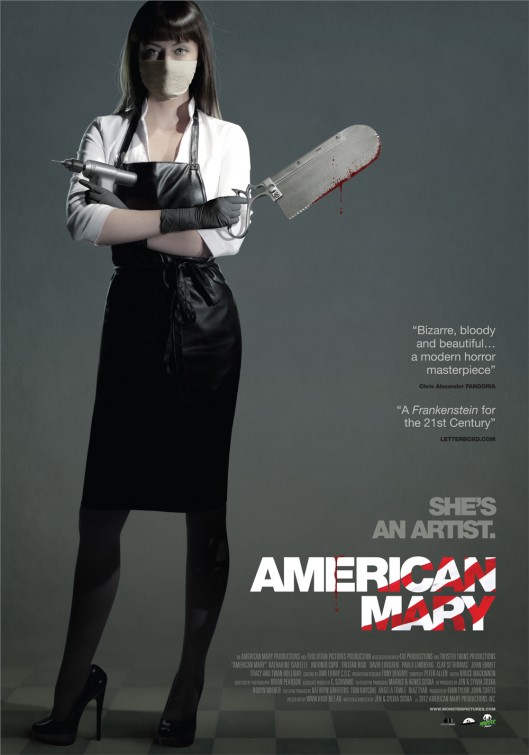
Belated happy birthday to Jen and Sylvia Soska, better known as the Twisted Twins, who celebrated a birthday on Monday. They were the team behind Dead Hooker in a Trunk, which was one of the first indie horror films I reviewed for this site and a goofy favorite that still makes me laugh. Their follow-up, American Mary, will make its US debut on home video in June, and if you don't think I've got that pre-ordered than you don't think my name is The Mike. Can't wait to see what these talented ladies have up their sleeve next!
Thing At The End
Coming soon to FMWL - William Friedkin's new memoir, a yet-to-be-named Midnight Movie of the Week, and a review of the Guillermo Del Toro produced Mama on blu-ray. Plus I've got a stack of Pam Grier DVDs sitting next to me that are just begging for some one on one time. So, until next time, here's a thing from YouTube. Be well, Midnight Warriors!
Hammer Films' Dracula tales are most remembered as vehicles for Christopher Lee, so some people are surprised to find out that the first sequel to Horror of Dracula was a film in which Dracula is already dead, Lee did not appear, and a rather unintimidating little man named Baron Meinster serves as the main masculine vampire. Alas, it's all true. The film in question is Hammer's 1960 vampi-rama The Brides of Dracula, in which Peter Cushing picks up where the 1958 film left off and takes on a new vampire threat, none of whom are actually wed to the Count.
The film primarily follows the exploits of a French babe schoolteacher named Marianne (played by Yvonne Monlaur, who is actually the daughter of a Russian count), who takes a job in the Transylvanian countryside (because, well, WHO WOULDN'T?) and ends up spending the night in a big old castle where a mother has her son chained up by the ankle. To some that might seem like a relatively normal night in Transylvania - I've seen enough horror flicks to know someone is always chained up to something - but the pure and innocent Marianne is pretty freaked out and this, along with the craziness of the house's servant (Freda Jackson, getting to play what's basically a female version of Renfield!), convinces Marianne that she's safer booking it through the forest than staying the night.
And that's when the hero returns in the form of Doctor Van Helsing, as played by the great Peter Cushing. Cushing would play "Van Helsing" five times for Hammer, but it's worth noting that he actually portrayed three different characters in five different films in three different timelines during his time with Hammer. This is (at least in Hammer's universe) the only continuation of the "original" version of Cushing asVan Helsing, while his performances in the Dracula films of the 1970s are relatives of this character. So, next time someone tells you Cushing played Van Helsing five times, you can prove them wrong by saying he only played this Van Helsing twice. Isn't that a great feeling?
Now back to the film, which strikes me as one of Hammer's more beautiful vampire films. The sets are pretty recognizable - we must remember that this was a relatively low budget studio and they did reuse plenty of their sets and props - but there's something vibrant and wonderful about their presentation by director Terence Fisher here. Horror of Dracula was not a dull film from a visual standpoint, but it seems Fisher attempted to cover up some of this film's issues with a little more color and a lot of feminine beauty. That's not a bad choice for a film that loses Christopher Lee and gains a looker like Monlaur, and the director's vision of the film helps The Brides of Dracula keep our attention for 85 minutes.
The tone of the film loses much of the romanticism that carried Hammer's first Dracula endeavor, and The Brides of Dracula certainly feels like a cheesy spin-off at times. A few of the sequences with the vampire women - especially the ones in which they interact with Jackson's manic servant/familiar - play out in bizarre fashion, yet the film strides forward with confidence that the viewer will forgive some of the sillier bits. There are moments when the film could have lost me - like an unconventional scene in which Van Helsing deals with a bite wound to his own neck - but there's something to be said for this film's slightly random, slightly nightmarish approach to Marianne and Van Helsing's battle against evil.
The Brides of Dracula isn't the most dramatic vampire film from Hammer studios, and it's not even close to being the most unique. But it's an abstract vampire tale that hits me as a perfect diversion, a new chapter in a familiar story that enhances my appreciation of Fisher as a filmmaker, Cushing as an actor, and the whole of Hammer Studios as a titan of terror. The Brides of Dracula is widely forgotten, but it deserves more attention for its place in horror history and its unique relationship to the studio's other Dracula films.
The Devil Rides Out (given this less grandeur title The Devil's Bride in the USA) is unknown by many and considered second tier in the Hammer Films filmography by others. The cult-based plot handles demonic rituals in a grand manner, and Christopher Lee - who is of course known for playing on evil's team - knocks it out of the park as the righteous and upstanding occult expert who aims to stop these servants of Satan. It is definitely a curio from another time - Lee has talked about wishing he could remake the film with modern special effects - but it still works if you can suspend disbelief and just enjoy the Satanic melodrama.
The Moment That Changes Everything:
There are plenty of high spots throughout Terence Fisher's film, and the script (by none less than the great Richard Matheson) seems to relish any opportunity to crank up the music and get all operatic. The tension probably hits its highest peak when Lee and his acquaintances hold a seance that leads to lots of wind, a back-to-back staredown with evil and a whole heaping load of awesome.
It Makes a Great Double Feature With:
Jacques Tourneur's Night of the Demon is probably the most loved cousin to this film, and it's a pretty wonderful choice to double feature with this one. A recent find that I would also place alongside The Devil Rides Out is the also (co-)written by Matheson occult thriller Burn, Witch, Burn. Like Devil, this one pitches its ideas as fact and never takes the foot off the gas. For good old fashioned occult horror, you can't do better than these three films.
What It Means to Me:
From Midnight, With Love was just over a year old at the time, but in my mind, the day that I named The Devil Rides Out as the first Midnight Movie of the Week was the day this little blog of mine became a passion project. The Devil Rides Out is exactly the kind of genre movie I want to find as a lover of film, and it's exactly the kind of movie I hope to inspire you to find by writing this useless drivel in my free time. In a way, The Devil Rides Out is why I do what I do for the genre films that I love.
First of all, can I just have this poster? It's like the awesomest thing I've ever seen, and I don't even speak Dutch.
(OK, stop rolling your eyes. I was kidding about the Dutch thing.)
Hammer Films are an acquired taste to modern horror audiences. The studio produced movies that were essentially remakes - though no one ever seems to call them that - of Universal's classic monsters, and struck gold when they cast Christopher Lee as Dracula and Christopher Lee as Van Helsing. The first film that offers this collaboration, Horror of Dracula, shines despite a meticulous pace and a lack of abrupt shocks. This is dramatic - heck, even melodramatic - horror, but it's the kind that keeps me riveted.
The Moment That Changes Everything:
Lee's Dracula career - which went through a lot of ups and downs - began with a bang. The opening seduction of Jonathan Harker by a gorgeous vampiress is ended quickly by the menacing figure of the actor, who stakes (no pun intended) his claim to the role with passion.
It Makes a Great Double Feature With:
As I mentioned, Lee's tenure as Dracula was not completely positive. He refused to speak in the first sequel he appeared in, and has lamented many of the later films openly. But among some of the slips is Freddie Francis' Dracula Has Risen from the Grave, which features the keen eye of one of my favorite directors and my favorite Lee-as-Dracula moment of biting on film. I wrote a bit about the scene in a guest piece for The Bloodsprayer one time, and I'm still pretty sure that scene makes the movie.
What It Means To Me:
Hammer films have always been the kind of films that inspired me to love horror. They're not just here to get to the viewer on a visceral level - though they did offer vibrant colors, excellent music, and a lot of blood for their era - they're interested in telling an old fashioned horror tale. And no film shows just how much they respect horror standards as Horror of Dracula does. Some see it as slow and bloodless, I see it as horror poetry.
There are two kinds of people that will want to see The Woman in Black. There are those who dig good old Gothic horror, and there are Harry Pottheads. The two groups aren't always as far a part as you'd think - there's a heavy helping of horror goodness in the couple of Harry Potter flicks I've seen - but I'm definitely not the demographic that's checking out the film due to Daniel Radcliffe taking the lead. I lean more toward being the demographic who struggles to see the film's title and not sing it to the tune of 'Lady in Red' - but that's a personal problem of mine.
The Woman in Black - a remake of a British TV movie that was based on a novel by Susan Hill - is the latest effort from the reborn Hammer Films, and it's a full-blown return to their roots in horror. The period ghost story - I don't think the date is given, but I place the film around the 1930s by guessing - features plenty of scenes that feel like they jumped right out of a classic Hammer film - like disagreeable and ominous innkeepers or carriage drivers who won't go to certain remote places at certain dangerous times - and is certainly the most impressive of the new Hammer films in recapturing the spirit of the brand name. The things I love about Hammer films - minus Lee, Cushing, and an abundance of well-placed corsets - are all over this film from the ominous start.
The film immediately warns us about the title spectre in the opening scene, which shows three young girls who are coerced to turn a tea party into a triple suicide by the woman's appearance. Shortly after, Radcliffe's character - an aspiring lawyer who's tasked to go through a considerable amount of paperwork at an abandoned mansion - arrives in town and heads to the secluded (and we're talking surrounded by marsh that floods the road secluded) home and starts to witness odd things and, eventually, the lady herself.
You probably don't have to guess to hard to figure out the ghastly woman's intentions - hauntings like this generally seem to go back to the same kind of causative circumstances - and Radcliffe's investigation weeds out the truth of who the woman is and why she's angry from beyond the grave relatively early in the film. But the film maintains tension by visually manipulating the viewer. There are more shadows in this film than you can possible imagine, and as the woman's appearances begin to increase I found myself increasingly wary of every odd black shape on screen and every movement I thought I saw. The musical score (which is pretty well done by horror music maestro Marco Beltrami) adds to the unease well at most times, but there were a few moments when musical cues provide a warning to the viewer when perhaps we didn't need one. The film's sound design also aggressively sells the scares, but has a few too many false stingers (like when birds fly by or a friendly hand surprises a character) for my liking.
The former Mr. Potter is on screen for pretty much the entire film, and does an admirable job of keeping the story afloat. The character is still struggling with the loss of his own wife and a disconnect with his four-year-old son, which means Radcliffe spends a lot of time sulking and being mopey. The actor's attempts at these scenes were slightly off-putting - maybe because his physical appearance is just so odd at this stage in his career and it seems like he's trying to model his head after that of a young Patrick Dempsey - but in total the performance gets across what it needs to. There are a couple of fun additions to supporting cast - primarily Ciaran Hinds and Janet McTeer as the couple who take the lead character in - but the film primarily relies on Radcliffe and he doesn't drop the ball too often.
As the plot moves toward a conclusion, I unfortunately couldn't help feeling that some of the steam that was provide by the early part of the film had been released. The final act feels more like a modern Insidious/Don't Be Afraid of the Dark type fright fest than a Hammer tale, and the uptempo pace and overbearing imagery as Radcliffe works to vanquish the woman were a little disappointing to me. An obvious example is the woman in black, who sent chills down my spine when shown at a distance, but who looks like nothing more than another hollywood ghost when her visage is actually revealed. The film also goes a little bonkers when focusing in on animatronic toys for sections of the film, and I don't think that milking these little critters and their odd faces creates as much unease as director James Watkins wants it to.
The film all boils down to a final confrontation which, to be honest, is a big mess. After the lead leaves the creepy house for the last time things go straight off the rails, with everything from ghastly voiceovers to abrupt changes in tone and even a groan worthy final "scare" making me shake my head in disappointment. It's rather unfortunate that the film didn't cut the ending up just a little bit - I believe there's a good ending inside what the film offers - but what we get seems muddled and rushed and just a bit silly. I look at a film like Sam Raimi's latest, Drag Me To Hell, as a good example of how to pull off an ending of this type, because the ending that's presented here has too many attempts to wow the viewer - each of which takes power from the last.
I want to like The Woman in Black, because I was legitimately enamored with the film for most of the first hour, but it's hard to be as enthusiastic as I'd like to be based on the final act. I still recommend checking this one out - it's the closest thing to a traditional haunting film or a classic Hammer film I've seen in a long time - but don't be surprised if some of the plot's latter turns leave you scratching your head. Quibbles aside, I want to see more new horror movies like The Woman in Black, horror movies that offer atmospheric settings and classic chills, and I'm sure I'll gladly give this one another go sometime down the road when I want a dose of old-school horror.
There's something that's just not right about Wake Wood.
I mean, we can certainly see that this is a production of the legendary Hammer Films studio - which has long been one of my favorite things in the world - and there are moments throughout the film that meet our expectations about Hammer horror completely. And yet, as I watched Wake Wood unfold in front of me, I couldn't help getting this feeling in my gut that what I was seeing just....wasn't right.
That feeling becomes a bit of a contradiction when you consider that the film's plot - in which a couple makes a devilish deal to restore their deceased daughter to life - focuses heavily on its characters having that same gut feeling. As we watch the couple - played by The Wire's Aidan GIllen and The Children's Eva Birthistle - struggle with their emotions as they spend time with their formerly dead daughter (Ella Connolly), we probably shouldn't be struggling with our own emotions about the film's tone.
Perhaps the film's tagline - which proclaims that 'The Dead Should Never Be Woken" - should have been something the filmmakers thought about the studio backing their film. Wake Wood certainly feels like the most Hammer of Hammer's new breed of films, since it's rooted more in horror traditions than the remake Let Me In or the modern thriller The Resident. But calling the film a Hammer production and making the film seem kind of like a Hammer production is a recipe for trouble to dedicated horror fans, as the similarities seem to enhance the differences. It's kind of like meeting another horror fan and being really excited to hear they like zombie movies too, until you find out that their favorite is House of the Dead and they just can't stand George Romero's first three zombie flicks. And then you're like "Oh, yeah, we do both love zombie flicks...but we don't really love the same things about zombie flicks at all."
And though Wake Wood walks and talks like a classic horror tale from the Hammer studios, the manner in which the film is presented created a distance between it and myself. I liked ideas the film had - like Connolly's uneasy performance as the reborn daughter and the images of the residents of Wake Wood gathering to keep their community (and its supernatural forces) strong - but the presentation of the events didn't meet what I'd expect to see from a Hammer film. I was probably too judgmental of the film to be truly fair, as I was judging everything from the camera angle to the lighting to the actors (who, aside from the great Timothy Spall, were just to shiny and new to be Hammer stars), but when I hear Hammer and gothic horror in the same sentence my mind fills with images of times gone by and old fashioned sound effects and wonderful music. And the people that made Wake Wood had an entirely different vision of what their film was going to be than what I expected.
So, when the film pulls up to a dramatic climax, I was left annoyed by an intrusive wind turbine and the fact that I didn't think there were enough rustling leaves and was just nor sure that the heroine's hair was thick enough to blow perfectly in the wind that fills this wooded setting. (Which is ridiculous, I know.) And then when the film negated that climax with two more twists that were both handled with absolute silliness, I was ready to rant and roll like I am now.
I'm guessing I'm gonna have to watch Wake Wood again someday when I know that it's not REALLY a throwback to what Hammer used to be. There were a lot of things I liked about the movie, like Spall and Connolly and some surprising scenes in which the undead youngster is involved in bloodshed, but I couldn't get past that feeling in my gut that the story of Wake Wood was wasted in a modern setting that didn't allow the Hammer magic that I love to really shine through. I know that I hold Hammer to a higher standard than most, but I still feel like the film could have been a little bit more than what it was.
I might be way off base. There was a scene shortly after the couple had their daughter returned to them that took my breath away, as some slick editing showed how the parents' exaltation evolved into romantic fervor once they put their daughter to bed for the first time in nearly 12 months. I can't deny that the story within Wake Wood doesn't have its perks, but I think the film got stuck in a cinematic dead zone between modern horror and gothic horror. Wake Wood would have been better off sliding one direction or the other, because it's the dual nature of the film that distracted me from really finding my way to the heart of Wake Wood.
One of the great things about horror movies - and I'm trying to say this seriously - is that they're so darn repetitive. I'm not saying remakes and sequels and not being original are good things in and of themselves. What I am saying is that a great terror comes in many shapes and sizes. Something that scared us as a child can still scare us as an adult - but the way it scares us or the thing about it that scares us or the intensity of the scare changes with time. And the fact of the matter is that horror movies have been asking us to be afraid of the same things for decades, they just do it in different ways.
So, when the friends of FMWL over at Pussy Goes Grrr - a one of a kind blog that often brings the goods - introduced me to their "Juxtaposition Blogathon" (and after I looked up juxtaposition at dictionary.com to make sure I didn't say something dumb), I started thinking about just how often some of the horror movies we see these days share traits with horror movies that have come before them. And how, a lot of the time, the older horror movies seem to have fallen by the wayside. The result? Five unique "Double Feature" pairings that just might rock an evening in your future.
Despite the absence of a traditional devil, the hooks that bring the films together include big ol' houses filled with Satanists, some moon mumbo jumbo, and a fresh faced young girl (Jocelin Donahue in the latter, Nike Arrighi in the former) who is the key to completing some kind of ceremony. A lot of people say that men have advantages over women in this world, and if it's true then it certainly seems that not being the target of a Satanist cult is one of the more posh advantages us dudes have. Sorry ladies.
The biggest difference between the films - besides the more than forty years that passed between them - is that one offers a tall veteran actor (Christopher Lee) as a powerhouse hero, while the other offers a tall veteran actor (Tom Noonan) as a subdued catalyst of evil. But hey, I still love both films to death - and anyone looking for a couple of cult-based chillers could do worse than starting with these two.
Feast & The Being
I'm not sure if a lot of other people do - I rarely hear anyone talking about it - but I love the heck out of Feast. It's a totally ridiculous and over the top gorefest that normally wouldn't even cause me to look twice, but there's something about it that just stops me every time. It doesn't subscribe to any kind of reason, Hollywood expectations are certainly thrown out with the bath water, and it's the rare film where you really feel like any of the characters could die...except you really don't, because there's one girl who's way too hot and way to prominent in the film to die. Pretty sure there's a graph out there that proves being high on those scales is the best way to survive a splatter flick. If not, there should be.
It should be noted that Feast does slightly break from this with the character played by my favorite Twitter Crush, Jenny Wade. I'll let you see what I mean in the flick.
Though Feast is pretty one of a kind in its madcap lunacy, its mixture of slimy creatures and and off the beaten path setting makes me want to pair it up with another splattery flick, the barely known 1983 flick The Being. Despite the presence of some known names - Martin Landau and Jose Ferrer show up - this small town Idaho based tale of toxic mutation is pretty forgotten these days. Which is totally sad when you consider the fact that bearded/flannel shirted producer William Osco takes center stage while using the alias Rexx Coltrane. He's worth the price of admission alone.
Neither of these films will really scare you too much - though there's a fantastic scene with a toddler, and Easter Egg Hunt, and a mutant in The Being - so get ready for plenty of monster based silliness, some horrible acting, and a whole lot of splatter. If you're prepping for a gore-based cheese movie night, these two should bring the thunder.
Rogue & Alligator
Yes, I realize that Rogue is a movie about a crocodile and Alligator is (obviously) a movie about an alligator. Go ahead and tell me the difference, I'm gonna forget it soon (again) anyways. The point is that these two fellas have big chompers, are greenish, and can take a man down faster than he can say "Hey, what's the difference between an alligator and a crocodile?" So you gotta pay respect.
Greg McLean's Rogue seems to teeter between getting more or less respect (based on who you talk to) than his debut feature Wolf Creek. That's more of a statement about just how divisive that film is (I dug it, if anyone cares), but Rogue suffers from no such schism. This is a very competent and very consistent thriller that pits man against nature, and the director does a great job of pitting folks who didn't plan on an adventure against the toothed killer.
Someone else who didn't expect to face off with a reptilian killer is the always fantastic Robert Forster, who stars in Alligator as a detective who investigates the possibility that a 36 foot gator lives in Chicago's sewers. Since the streets of Chicago don't provide as much watery goodness as the Australian outback, Alligator is a more talkative film than Rogue, complete with a script from indie darling & Piranha/The Howling scribe John Sayles. But both movies provide maximum teeth gnashing, and they should be good friends despite their killers' scientific differences.
Snakes on a Plane & Venom
If gators/crocs aren't your thing - I'm not sure why they wouldn't be, but whatever floats your raft, man - then perhaps you'd be more interested in some cheesy snake action. It boggles my mind that it's been more than five years since Snakes on a Plane happened, and I'm still kind of sad that the movie has fallen through the cracks a bit in the years since its release. I'm not exactly sure why the people who were so excited about a movie called Snakes on a Plane were so quick to turn their backs on a film that acted like it was called Snakes on a Plane, but I still think it's a ton of fun.
Some have complained that Snakes on a Plane spent too much time setting up the silly reasons for the snakes being loose on the plane, and I will give them a bit of a pass on that one. Aside from the unstoppable Samuel L. Jackson and that lady from ER - who stand out mostly because of their experience in the spotlight - most of the people in Snakes on a Plane just aren't that interesting. But, then again, the movie has a ton of SNAKES on a PLANE.
If you're looking for something more ambitious (just take a look at the movies mentioned on that poster!) which features more characters and less snakes, there's always the 1981 chiller Venom. It offers only one snake - a black mamba that's super crazy - but gives us one of the best b movie casts ever. Klaus Kinski, Oliver Reed, Michael Gough, Sterling Hayden, and Susan George all become pawns in this tale of a kidnapping gone wrong via snake, and the film is better thanks to their presence. In the end, Venom (like Snakes on a Plane) is a pretty silly affair - but if you put the two together you should have enough interesting characters and more than enough snakebit action to make for a fulfilling evening.
Drive Angry & Race With The Devil
In cinema, you simply can not keep a good devil down. Earlier in this list we were worried about the houses he was in, then him riding out, and now we have two films that involve getting away from Beelzebub and his followers on the open highway.
I've already written a biased and glowing review of Drive Angry here, but I should repeat just how fun it was to see a modern film take on such a grindhouse idea with such disregard for Hollywood expectations. Nicolas Cage teams up with writer Todd Farmer and director Patrick Lussier to present a film that recognizes how cheesy it can be (William Fichtner's performance as "The Accountant" should prove that entirely), but the plot's usage of Satan as an omnipresent force and willingness to juxtapose what Fichtner and Cage know against a silly southern cult of "Satanists" puts Drive Angry in an interesting horror related spot.
If you want to see more reputable actors take driving around a cult landscape seem more serious, I recommend pairing Drive Angry with the 1975 hit Race With The Devil. Though the film is most famous to me for being used in The 'Burbs and features a supremely anti-climactic ending, Race With The Devil is almost certainly what Drive Angry would have looked like 35 years ago in a RV - except that Peter Fonda and Warren Oates are running from the cult and not toward it. And if Drive Angry is a little too self aware for y'all, then Race With The Devil's super serious tone should be plenty pleasing.
And there you have it. 10 movies for the price of five. Maybe you don't want to watch them as double features - I suppose I could have nominated the likes of Venom and Race With the Devil as substitutes - but I hope you'll at least consider some of these films that preceded their more famous recent counterparts. If nothing else, they should remind you that the same horrors can come at you from all sorts of different angles.
When you put about half of my favorite things (like Christopher Lee, Caroline Munro, Hammer Films, and horror movies) together in one place, you're probably going to get my attention. It's kind of science. There was a study - I think it was in Norway - that proved unequivocally that putting these things together is 100% guaranteed to get my attention. I'm not sure if any animals were harmed during the study, but that's not the point. The point is that Dracula A.D. 1972 is kind of a Mike taunter.
The film opens with what you'd expect from a Hammer Dracula film - Lee battling Peter Cushing in the olden England countryside. Nevermind the fact that Cushing hadn't appeared as Van Helsing since 1960's Brides of Dracula, nevermind the fact that Lee wasn't even in that movie: that's the image of Hammer horror we all remember. The catch is that, by 1972, ticket buyers didn't really remember it. To them, Lee & Cushing as Dracula and Van Helsing was an old thing. Horror had changed throughout the 1960s thanks to the likes of Psycho, Rosemary's Baby, and Night of the Living Dead, and the only way Hammer could survive was to update. It's the same thing that happened to the slasher genre in the late '90s.
The slasher genre became self aware when it needed to change, but that wouldn't really work for Dracula in the 1800s. You can't have Van Helsing start quipping about how people need to watch more movies or how the director created Dracula because of his own nightmares. So, Dracula A.D. 1972 does the next best thing - it kills off the characters in the opening scenes, then brings them back 100 years later in modern day.
As much as I love the old Hammer, I gotta say that this switch in time and place is probably the second most charming thing about Dracula A.D. 1972. While I'm being honest, I can admit that some of those Gothic Dracula films run together in my head at times. On the other hand, Dracula A.D. 1972 stands out like a shiny lighthouse, because it's the one with the '70s and a creepy relative of Drac named Johnny Alucard and that awesome band The Stoneground in an early film party scene. Amidst all the changes, we still get a bit of the same, as Lee's Dracula is resurrected. As the old saying goes, "You can't keep a good vampire down".
Cushing also returns to the new century as a descendant of Van Helsing, but the movie brings plenty of fresh blood to the scene too. Stephanie Beacham (complete with an unfortunate '70s mullet and a slew of chest revealing tops) co-stars as this Van Helsing's granddaughter, who becomes the main target of Alucard and Dracula. She's joined by a bunch of hip London friends who enjoy things like crashing old peoples' parties and sitting around and being hip. The group includes a bunch of goofy looking guys, who must be cool to hang out with ladies like Beacham, the fetching Marsha Hunt, and the most charming thing about the film - my dearest beloved Caroline Munro.
The film doesn't capitalize on its new setting entirely, and Hammer could have taken a cue from another horror icon who was adapting to the early '70s scene at the same time. In making films like The Abominable Dr. Phibes and Theatre of Blood, Vincent Price and the filmmakers he was working with worked to add humor to their films to complement their horror trademarks. Despite A.D. 1972's updated setting and the silly party scene at the beginning, the film is very direct and straight-laced throughout the rest of the film, which leaves the final product a lot closer to the outdated Hammer films it wanted to escape from. The result is still pleasing to a fan of those films, but it's easy to see why just moving the film to modern times wasn't enough to rejuvenate Hammer Films.
There's still a lot to like about Dracula A.D. 1972, despite the missed opportunity in tone and a few lulls in the action. The film still manages to provide a lot of fun scenes and new twists on the Dracula movie, and the mixture of veteran performers Lee and Cushing and young stars and starlets provides some unique scenes that we wouldn't expect from other Hammer films. I think 1970's Scars of Dracula did a slightly better job of integrating young characters into the Hammer world, but that's not the point. If you've got the choice between this one or Hammer's follow up - The Satanic Rites of Dracula - which replaces the modern young folks with a modern Satanic cult - I have the feeling you're gonna pick Dracula A.D. 1972 every time.
If you blow up this picture, you'll be creeped out by the hairy nerdy glasses guy trying to sneak dance with Caroline Munro on the left side of the frame.
Maybe I like Dracula A.D. 1972 more than I should, but I dig the heck out of it's idea to merge London's wild scene of the early '70s and Hammer's classic tales of Dracula and Van Helsing. With the likes of Munro and the music of The Stoneground helping out, Dracula A.D. 1972 continues to be an interesting statement on where Hammer was going at the end of their first reign of terror (which ended a few films later with To The Devil, A Daugher....) and a cheesy distraction for fans of its era's style.
If you have questions or suggestions not regarding a specific review, or would like to recommend a movie to The Mike, feel free to email him at frommidnightwithlove(at)gmail(dot)com!
Also, please leave feedback at the bottom of reviews by checking one of the boxes, or by leaving a comment! Any feedback that can help improve the site or reviews is much appreciated!






 Posts