Search this blog and The Mike's favorite blogs!

Showing posts with label Exploitation. Show all posts

July 7, 2012

The Mike's Top 50 Horror Movies Countdown: #25 - The Texas Chain Saw Massacre

Previously on the Countdown: Number 50 - Happy Birthday to Me  Number 49 - Prince of Darkness  Number 48 - House on Haunted Hill  Number 47 - The Monster Squad  Number 46 - Hellraiser  Number 45 - The Fog  Number 44 - Creature From the Black Lagoon  Number 43 - Zombie  Number 42 - Tales from the Crypt  Number 41 - Bubba Ho-Tep  Number 40 - Phantom of the Paradise  Number 39 - Dog Soldiers Number 38 - Pontypool  Number 37 - Dark Water  Number 36 - Army of Darkness Number 35 - The Legend of Hell House  Number 34 - Poltergeist  Number 33 - The Abominable Dr. Phibes  Number 32 - The Phantom of the Opera  Number 31 - The House of the Devil   Number 30 - Evil Dead II  Number 29 - Dead of Night  Number 28 - Carnival of Souls  Number 27 - Nosferatu  Number 26 - Candyman
The Texas Chain Saw Massacre
(1974, Dir. by Tobe Hooper.)
 Why It's Here:
Too low? This is probably too low, right?  You can say it, I won't blame you.

One of the most intense films ever made, The Texas Chain Saw Massacre is one of those movies that you could throw at someone who doesn't know what a horror movie is and say "Here, watch this. This is a horror movie."  An unrelenting and unpolished opus of terror, Tobe Hooper's film features several of the best shocks you'll find and pairs them with memorable (and sometimes terribly annoying) interactions between the characters and moments of pure torture.  It might be the horror film that is most taxing to watch...which is actually a good thing.

The Moment That Changes Everything:
All I need to say is "the part where he slams the steel door". And if you've seen it, you know. Seriously, I can't think of a single moment in horror that has as much shock value as that one does.

It Makes a Great Double Feature With:
This is one of many films loosely based on the exploits of Wisconsin serial killer Ed Gein.  Most famously, Psycho and The Silence of the Lambs borrow from the same case.  But a film released a couple of years prior to Massacre, Deranged is a lesser known companion to Hooper's film.  It's dark in it's own ways - though it'll probably play like Shaun of the Dead next to Leatherface - and it features a one-of-a-kind performance from Roberts Blossom (aka, old scary guy who's actually nice from Home Alone) as the killer.

What It Means To Me:
If I had to guess why I rank a movie that I know is so important and I know shocks me to my core so low on this list (then again, it's not like 25 out of every horror movie I've ever seen is "low"), it's probably because this film is truly a chore to watch sometimes.  It's so brutal and it's so unforgiving and sometimes it's even a bit shrill and...well, sometimes that's just not as fun to watch as something else.  Of course, that just means it's doing its job really well.  When it's time to bring horror at its most vicious, The Texas Chain Saw Massacre is the movie I turn to.

January 6, 2012

Midnight Movie of the Week #105 - The Candy Snatchers

Back by popular demand (from myself, but who's counting) is that blonde bombshell of the sleazy seventies, Tiffany Bolling - who's quickly become a veteran in the Midnight Movie of the Week canon.  This time, I'm taking a look at the 1973 kidnap-xploitation flick (Did I just make that genre up? Maybe.) The Candy Snatchers, which has long been one of Ms. Bolling's films that eluded my eyes.
The film features Bolling and two male conspirators - the smaller and hornier Alan (played by Brad David) and the bigger and dopier Eddy (Vince Martorano) - who snatch up a 16 year old Catholic school girl - named Candy, of course - and set off a chain reaction of violence and mayhem that barrels out of control quickly.  The trio have a kidnapping scheme in place, but we all know that things never really go as planned in this type of situation, don't we?
For starters, the girl's stepfather (played by the creepily Andrew-McCarthy-looking Ben Piazza) is a bit more worried about the money - and a lot more worried about having an affair with a fine young woman - than he is about the fate of Candy or her millionaire mother.  He's always got that distant look in his eyes, and his unwillingness to go along with the trio's treacherous plan is just another splash of gasoline on their criminal fire.
Meanwhile, poor Candy (played by 20 year old Susan Sennett, who would later become the wife of Crosby, Stills & Nash's Graham Nash), gets abused by the men and ignored by Bolling's Jessie, who seems to grow a little jealous of the attention that's paid to Candy by her male companions.  She's buried alive, she's beaten, she's raped (this was the '70s, somebody had to get raped), and she's pretty much tossed around like the plot device she is throughout the film.  Ms. Sennett/Nash quit acting in the mid '70s - allegedly walking out on an audition for TV's Three's Company - because she was tired of doing "racy" material.  So, basically, the character is abused so thoroughly that it made the actress feel abused four years later.
Which brings us to the real star of The Candy Snatchers - the only witness who has any chance of helping Candy - a mute, autistic child named Sean.  Sean is played by Cristophe, the real-life son of director Guerdon Trueblood, and he bumbles through the film in his bib overalls while doing his best to communicate with those around him.  Unfortunately, his parents hate him and abuse him because he can't talk, leading to a couple of late film scenes that had me gasping in fear for the little trooper.  Sean's pretty much the cutest kid hero ever - particularly for such a sleazy film - and I spent much of the movie just wanting to jump through the screen and help the kid out. And maybe give him a high five for being awesome.
With this many volatile characters in one place - the only people we can really root for are a kid who can't communicate and a girl who's bound and gagged for most of the film - the heavy turns that occur throughout the film's journey cover a wide range of exploitation standards. Disagreements between the criminals and cat-and-mouse games between the sleazy stepfather and the sleazier kidnappers are predictable, but still carry dramatic weight thanks to the performances of the actors and the script's ability to make us sympathize with the abused characters.  The antagonists are drawn pretty well too, particularly Martorano's Eddy, a part that was written specifically for the actor because he was a college friend of Trueblood.  His character is seen as sympathetic at times and brutal at others, which keeps things tense when we don't really know what to expect from the character.
This is yet another production by Arthur Marks - who also was behind Bolling films Bonnie's Kids and The Centerfold Girls - and after seeing all three films in which he used her talents it's very clear why Marks kept bringing her back to his films.  Bolling is once again given the chance to play a strong and occasionally fierce character, and her pretty face quickly fades away when we realize just how vicious she can be.  I don't think her role here is as bold as she was in Bonnie's Kids, nor does she reach the primal rage that she released late in The Centerfold Girls, but it is another testament to how strong this Playboy magazine could be without relying on her physical attributes. (Though she does show them off anyway.)
The Candy Snatchers is another vicious little film from the Marks/Bolling machine - I'm glad there's only three of these, because I'm not sure I could keep seeing this kind of dark thriller every week - but it's got a lot of interesting twists and turns thanks to well developed characters and one wonderfully brave little boy.  It's pretty good at what it does, and should be an interesting find for fans of '70s drive-in sleaze.

December 8, 2011

Midnight Movie of the Week #101 - The Centerfold Girls

I'm pretty sure I didn't get enough of Tiffany Bolling last week.  So, consider this a case of her being "held over" in the MMOTW spotlight for a second week.  I can't promise there won't be a third...
Unlike last week's Bolling feature - Bonnie's Kids - which borrowed heavily from pulp novels and film noir, The Centerfold Girls (obviously) borrows inspiration from the pages of "gentleman's" magazines.  It's a segmented film - I'm not ready to call it an anthology, but it's pretty clearly divided into three unique tales - that is tied together by one cold and calculated killer, a seemingly proper gentleman in a suit and sneakers named Clement Dunne, played by veteran character actor Andrew Prine.
Clement seems to be a man of strong moral fiber, if you think wanting to systematically kill off young women who pose as nude centerfolds represents "strong moral fiber".  His quest places the film in the vicinity of the blooming slasher genre of film, but the 1974 production has more in common with exploitation fare of the early '70s like The Last House on the Left - and probably a bit in common with the pornography of the era too.
The film's first segment sets the tone for us all, with the kind of sleaze you'd expect from the decade's top sexploitation titles and brutality on par with the controversial Wes Craven film listed above.  After the film introduces Clement - while he dumps a naked model's body on a beach - we follow him as he tracks a model-turned-nurse named Jackie (played by Jamie Lyn Bauer, a former swimsuit pageant winner), who has about the worst luck I've ever seen on film. 
 After breaking down due to harassing phone calls from Clement, Jackie picks up a seemingly innocent hitchhiker and heads away to a secluded cabin for the weekend.  Trouble follows her there, but it's not Clement she has to worry about - yet.  Jackie's story takes some wacky turns - most notably the one involving her helpful neighbors, a husband and wife played by veteran character actor Aldo Ray and Paula Shaw (who would go on to play Pamela Voorhees in Freddy vs. Jason) - and by the time Clement gets to it's almost a relief to the viewer.  Jackie certainly gets abused worse than anyone else in the film, and she's a contender on the all-time abuse list too.
Clement's second pursuit is the least interesting segment of the film, but does provide some intrigue by putting his victim - this time it's a pin-up played by Jennifer Ashley who happens to be away on a shoot with more potential victims/models - on an island setting with the kind of old home we'd expect to see in a Mario Bava film. This story has some great visuals, but the characters don't have much to offer us - aside from their exposed breasts.  (Just so we're clear, I'm relatively sure at least a dozen different girls show off their "talents" in the film. The title isn't just a metaphor.)
The final sequence brings Clement face to face with Ms. Bolling, who plays a centerfold turned stewardess (it was the '70s, I don't have to say flight attendant!) that is tracked across the coastline by our determined killer.  She spends the most time with Clement of the multiple centerfolds, and her interactions with him pick the film back up after the brief lull in the middle sequence.  It's not a strong role like she was given in Bonnie's Kids (whose writer/director Arthur Marks also produced and help write this film) for most of her time on screen, but the final conflict between her and Clement is an exciting conclusion to the film.
Despite how much I enjoy Ms. Bolling's charms and the several interesting side characters who are spread throughout the film, make no mistake about the fact that Andrew Prine's performance as Clement is the reason to see The Centerfold Girls.  With the voice of a TV host from the 1950s and his bible salesman appearance, Prine creates one of the most unique killers in the annals of exploitation cinema.  We know he's the killer from frame one, but every time we see him step into a phone booth, dial up one of the girls, and tell them that he's "only trying to help them" it adds a bit more intrigue to the film.  Prine has stated that he wanted to make his character a man who only sees things in black-and-white, and the performance that he gives clearly meets that goal.
Random horror connection - Yes, that is a copy of The Exorcist on Tiffany Bolling's bedside table.  Rowr.
Like other great killers in cinema, Clement Dunne represents a force of nature.  His actions are based on beliefs instead of emotions, and he moves through the film with a confidence that never wavers. The film plays his unwavering confidence against the victims' own problems perfectly - is it a coincidence that the two sequences that really work feature a former beauty queen and a former Playboy playmate? I think not. - and creates discomfort that would make any exploitation filmmaker proud along the way.
The Centerfold Girls is certainly not a fun movie and I'm not even sure it's a good movie - the lull in the middle is really kind of sad - but it's got some really fantastic moments.  There are moments of incredible unease and a performance by Prine that lifts his killer above the material.  It sounds like a sensationalized film that wants to capitalize on the male love of naked bodies - and it is to an extent - but The Centerfold Girls has a pretty shrewd dose of exploitation psychology in store for a viewer, and it's that edge to the film that has me heartily recommending it to any fan of bloody '70s sleaze.
Best killer shoes ever? Maybe.

December 1, 2011

Midnight Movie of the Week #100 - Bonnie's Kids

From the obscure corners of the 1970s comes Bonnie's Kids, an exploitation drama that has been ignored by most people who aren't named Quentin Tarantino.  Directed by Arthur Marks, who's probably most known for blaxploitation flicks Friday Foster and Detroit 9000, the film follows the adventures and misfortunes of Myra and Ellie, the daughters of the now deceased Bonnie who are left to face the world together.
The opening scenes make it perfectly clear that the girls' strength lies primarily in their attitude and their appearance.  The elder sister, Ellie, is a waitress who does her best to fend off the advances of every male in town despite her skimpy work outfit.  Myra, who struggles with the condition known as "being a teenager", seems too innocent to even notice her physical gifts as the film opens.  As she dries herself off after a bath with the window wide open, one of her stepfather's friends remarks with redneck sincerity that "there oughta be a law against that".  In his words, a body like that can be a deadly weapon.
Which makes it really dangerous when a "body like that" possesses a shotgun.
Immediately after that astute observation by a character we'll never see again, drunken step-father Charley decides that Myra's sexuality means that he can throw himself upon her.  Ellie returns home just in time, unloading both barrels of her stepfather's shotgun into his chest.  Since "justifiable homicide" wasn't a term that exists in this case, Ellie and Myra dump the body and quickly head out of town (as shown in the title screen above), escaping to the big city where they can stay with their rich Uncle Ben (who's not related to Spider-Man....I think).
Myra literally has them eating out her hands.
The differences between Myra and Ellie are established pretty easily.  Ellie is very comfortable flaunting her body, taking a modeling position in Uncle Ben's agency, while Myra seems content to hang out on her Uncle's ranch where she can hang out with his young trophy wife (a gorgeous redhead who leads Myra into one of the film's sleazier twists) and have a romping relationship with a young man.  At the same time, Ellie agrees to help her Uncle out by delivering a package, which sets the film's noirish plot spiraling into plenty of conflicts.  Double Indemnity, which is considered by many to be the Alpha noir, is referenced by one of the film's more blunt characters; a not-so-sly nod to the pulpy tales that inspired writer/director Marks.
Cardboard Ex Machina.
Speaking of pulp, Uncle Ben is in business with two well-dressed and brutally efficient criminals, whose purpose is clearly to intercept the package and stop anyone who tries to get in its way.  The deadly duo is played by The Godfather's Alex Rocco and former Green Bay Packer running back Timothy Brown, and this pair of white-and-black "business associates" who are searching for a suitcase should clue most viewers in on why I mentioned Quentin Tarantino in the opening paragraph.
We didn't discuss foot massages in the '70s.
Though its effect on Pulp Fiction may draw some viewers (I only learned of the film while reading about films that influenced Tarantino), viewers of the film will find much more to respect about Marks' film, primarily due to the actresses who play Ellie and Myra.  Seventeen year-old Robin Mattson - who went on to a long career in soap opera television - is perfectly cast as Myra, and the ease with which she wavers between innocence and rage should connect with any viewer who's ever had to deal with an angry teenage girl.  When Mattson is allowed to let her anger out she shouts and shakes and grits her teeth, all effectively, which leads to some memorable outbursts.  Most notable is definitely the final confrontation between her and her "kinda Aunt" played by Lenore Stevens, a vicious scene that ends with a bang and helps cement how dangerous Myra can be.
I really don't understand the purpose of the fluffy bikini.
And then there is Ellie.  Oh my.  Ellie is played by one of my favorite beauties of the '70s - Tiffany Bolling.  A graduate of Playboy magazine, Bolling would go on to assist William Shatner in the all-too-awesome Kingdom of the Spiders and to stare down the maniacal killer of The Centerfold Girls.  But her turn as Ellie puts most B-movie roles to shame, allowing her to heat up the screen with her blonde hair and long legs while she manipulates the men with ease.  Unlike her younger sister, Ellie understands the weapon of a body that she possesses and tries to use it wisely - which settles her firmly into the classic role of the femme fatale.  The men that surround her - primarily the ones played by Steve Sandor and Max "Grandpa Fred from Sixteen Candles" Showalter - quickly follow the lead of whatever she says, and it's easy to understand why when we see how she acts around men.  
Here are Bolling and Showalter, more than 10 years before Long Duk Dong.
One of the most telling scenes in the film comes early on, when Uncle Ben discusses Ellie's modeling career - while looking at very nude photos of his niece - and a smirking Ellie replies to repeated suggestions from him with a monotone "I'll do anything that you say".  The distracted male doesn't quite know what he's up against, and the smirk on Bolling's face quietly tells the viewer that she's got more control over he situation than her Uncle thinks.  Other males in the film are more vocally caught up in Ellie's charms, with my favorite moment possible coming when Sandor's character proclaims that Ellie has "the bitchinest legs I've ever seen".
They definitely aren't bad legs.
Bonnie's Kids sounds kind of sleazy - and it is kind of sleazy, to be fair - but there's something about this drive-in version of a pulp noir novel that elevates the material above simple exploitation fare.  As far as dramas go, It's a movie that exists somewhere in the area between The Maltese Falcon and Showgirls. I'm not entirely sure what that means, but I like the balance that Marks' film strikes between classic crime story and sleazy sex movie.  Plus, there's really not much sex in it at all.  You don't need the sex when you imply as much sex as Tiffany Bolling does.
This is not Tiffany Bolling, but it is implied sex.
Bonnie's Kids probably wasn't the best thing to play at a grindhouse in the '70s, but I feel like it's criminally underrepresented in the discussion of cult cinema.  This is an artistic movie with some great visuals, some terrific performances, and a nice little stamp on pop culture of the future.  And it's got Tiffany Bolling, and if she can't melt your defenses then I'm not sure there's hope for you.  Bonnie's Kids has everything from calculated hitmen to lesbian accusations to pet rats to the Grandpa from Sixteen Candles (pretty sure I mentioned him already, but it needs repeated), and when you add that all to everything else I love about it, it leaves me proclaiming it to be a total blast.

September 8, 2011

FMWL's Best of Summer 2011 (Part Two)

Last night we covered my favorite theatrical and blu-ray finds, which was a blasty, but tonight FMWL's Best of Summer wrap-up digs just a little bit deeper.  It's time to talk about the movies you won't find in your multiplex and wouldn't spot on the shelves at your local megastores.  It's time to look back at my favorite "finds" of the summer...which always leaves me giddy. :)

(See that? I used a damn tootin' emoticon in a post....THAT's how giddy these finds make me!)

Best of: The Indie Horror Scene
Absentia: And we're starting off day two of our adventure with the one film I saw this summer that really scared me.  I'm not talking "guy behind you screaming boo" scares either, I'm talkin' real, effective emotional and physical "I don't want to go to sleep tonight" scares.  Mike Flanagan's tale of two sisters haunted by different demons is a truly original horror film, and his slick direction kept me on my toes throughout.  With a couple of effective twists and some fantastic acting, this might just be the best horror movie of the year.  (Read The Mike's Review)

Ghost From The Machine: A more subdued horror tale, Ghost From The Machine offers plenty of family drama while leading the viewer into an intriguing paranormal plot.  The few images of the film's more haunting spirits sent some good chills down my spine, but I'll remember this one more for its Frankensteinian look at the dangers of playing with things man can't understand.  It's the rare ghost tale that builds tension using human emotion instead of sound effects or moody lighting or editing tricks.  A Hollywood remake of this one is on the way, but you can find the DVD of this one out now. (Read The Mike's Review)

Best of: Everything Else I've Randomly Loved
Bitter Feast (2010, Dir. by Joe Maggio): The Food Network meets Theatre of Blood in Bitter Feast, a fun offering from Glass Eye Pix that combines plenty of comedy and drama.  James Le Gros gives a fantastic performance in the lead, which outweighs a lot of the film's flaws.  Some good gore, but the drama and the characters were what kept me involved with this one.

Blue Thunder (1983, Dir. by John Badham): Roy Scheider goes rogue in a super helicopter in this 1983 actioner, and he's joined by a fantastic cast that includes Warren Oates, Malcolm McDowell, Candy Clark, and everyone's favorite Wet Bandit Daniel Stern.  This is one of those flicks I'd read about for years and always wanted to see, and it didn't disappoint.  The final scene is one of the most badass things ever put on screen.

The Boys From Brazil (1978, Dir. by Franklin J. Schaffner): Gregory Peck and a slew of child Hitlers is pretty much all you need to know about this one.  It's a little long and a little silly and I've just never been that fond of Laurence Olivier when he was old and extraordinarily hammy....but it's got Peck going berserk and the creepy children played by Jeremy Black.  Like other classics based on Ira Levin novels (including Rosemary's Baby and The Stepford Wives) there's also a lot of fun in watching the plot unfold around the actors. 

Bucktown (1975, Dir. by Arthur Marks): Fred "The Hammer" Williamson shows off his iconic persona in this simple story of a man who takes justice into his own hands.  The simple story of corruption in a small town reminds of films like Walking Tall, but the presence of The Hammer, Pam Grier and Carl Weathers (in a supporting role) give it it's own life.  Blaxploitation that works well.

The Centerfold Girls (1974, Dir. by John Peyser):  As brutal, foul, and distasteful as can be, The Centerfold Girls is a chore to watch.  I also found it endlessly fascinating as a unique twist on the giallo and slasher genres, and Andrew Prine's weird killer is very memorable.  The three segments of the film vary in quality, but I couldn't turn away from the film's odd and violent images.

Demon Seed (1977, Dir. by Donald Cammell): I had seen Demon Seed once upon a time, but I wasn't ready for its "possessed computer vs. Oscar winning actress" plot at that time.  Revisiting the film made me really appreciate this Hollywood oddball gem, which takes itself really seriously despite the plot.  Though it's terribly dated - a film about a sentient computer controlling a house might just work these days - it's still a fascinating horror attempt. (Read The Mike's Review)

The Initiation (1984, Dir. by Larry Stewart): Ambitious slasher that combines mommy/daddy issues and nightmare research, plus sorority pledging hijinks and late night in a closed shopping mall.  Clu Gulager and Vera Miles get top billing as the parents with a secret, but it's a young Daphne Zuniga - well before Spaceballs or Melrose Place that carries the film to its twist ending.  Suffers from a lot of the normal slasher problems, but still manages to feel unique.

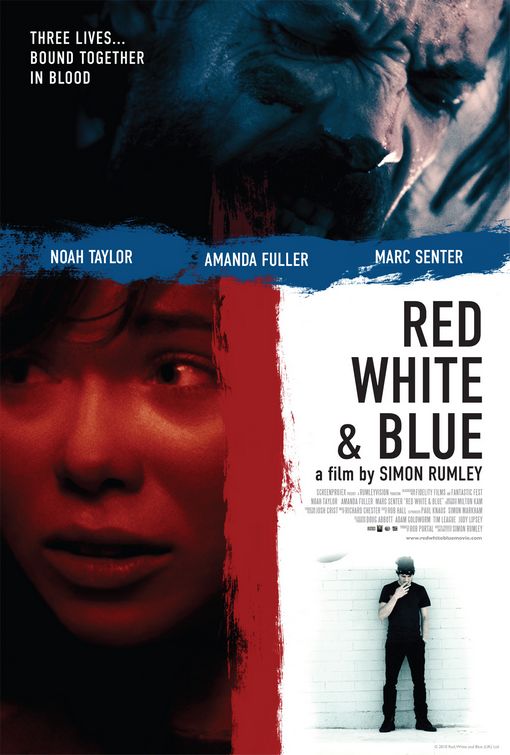
Red White & Blue (2010, Dir. by Simon Rumley): I called The Centerfold Girls words like "brutal" and "violent" a bit ago, but compared to Red White & Blue, that movie is a cake walk. (What exactly is a cake walk, anyway?)  This tale of sex, revenge, disease, love, and everything else in life takes a while to pull us in, but once it has our attention it never relents.  Amazing performances by Amanda Fuller and Noah Taylor lead to a mind-blowing conclusion.

Rituals (1977, Dir. by Peter Carter): The always awesome Hal Holbrook and the also cool Lawrence Dane carry this low budget Deliverance clone, which sends a group of doctors into the woods, where they soon find they're being tracked by someone who knows all about them and their profession.  The in-fighting between the characters adds to the drama, primarily when Holbrook and Dane throw down against each other.  A fine film that's never gotten its proper due.
---------------------------------------------------------
And, there you have it.  I wouldn't say I've found the best movies ever this summer, but these unique treats are more than enough to keep me going.

What say you, Midnight Warriors? Got opinions on these? Favorites you've found of late that you want to recommend?  Bring it in the comments below!

July 5, 2011

Hobo With a Shotgun

(2011, Dir. by Jason Eisener.)

I really didn't think I'd be a big fan of Hobo With a Shotgun.  Yeah, I know what you're thinking.  You're thinking 'Hey, uh, The Mike....you know that Hobo With a Shotgun is kinda like a movie totally made for people like you, y'know?"  And you'd be right.  But the hype machine on this one made it seem like the Titanic.  Too much hype, too much talk of goodness, too much "Wow, you've never seen anything like it!"...and I simply couldn't believe there wasn't gonna be an iceberg that would sink it before it reached my heart.  It was too good to be true.

Now lock up your pawn shop, fill your shopping cart, look out for bears, and lend me your ears...because I'm her to tell you that I, like a fool, was completely wrong.  Hobo With a Shotgun hits the screen exactly as advertised, and the film you'll be seeing just might blow your mind. 

If you don't know the tale behind this Hobo, allow me a minute to recap.  Way back in the dark ages of 2007, Robert Rodriguez was on the promotional trail for Grindhouse and hosted a competition in which directors could enter their own fake trailers for exploitation flicks.  The winner of said competition would get a chance to play as part of Grindhouse - even if it was only in some Canadian theaters.  The winner of that contest was a trailer by a few Canadian filmmakers called - you guessed it - Hobo With a Shotgun.  The popularity of the trailer grew, Machete happened, and suddenly director Jason Eisener was making a full film out of his trailer - and had cast Rutger Hauer in the lead.  It's the stuff that dreams are made of.  Demented and twisted dreams - but dreams nonetheless.

The story of the actual film is pretty simple. A nameless Hobo (Hauer) rolls into a decrepit town that's ruled by a criminal and his spoiled sons, helps a hooker with a heart of gold, finds out the law isn't going to stop them, and takes matters into his own hands.  (And by matters, I mean a shotgun.)  The film does allow the Hobo a few slow moments to throw out a dramatic anecdote or two - moments that Hauer, reaching back to the skills of his Blade Runner and The Hitcher days, dominates with ease - but the blood splatter to minutes on screen ratio is kind of astronomical.

Among other things, Hobo With a Shotgun's got decapitation, shotguns to the crotch, stabbings with skates, blowtorchings, neck sawing, the use of a toaster as a weapon, and snap bracelets.  Then again, the snap bracelets don't really play into the violence of the film, but there's a moment when our hooker with a heart of gold (played by Molly Dunsworth) snaps one onto each of her wrists - and instantly makes me want to fall in love with her.  I mean, who doesn't miss snap bracelets? Those things were one of the Top 5 things to come out of the '80s, easily.

Speaking of the '80s, Hobo With a Shotgun certainly mimics the great decade well.  Particularly tubular is the musical score, which is credited to three composers - Adam Burke, Darius Holbert, and Russ Howard III.  I'm not sure why it took three dudes to come up with this musical score - but if that's what it takes to make the film sound so good, I'm all for every film having three composers.  The music reminds of films like Carpenter's Escape from New York, and really kept me interested during the action sequences.  The film also offers a lot of visual treats, with Eisener and crew using sharp colors to light most scenes, giving the film a retro look as the gold, blue, and even pink tints of the film add to the unique feel of the proceedings.  And I'd be ashamed if I didn't mention that there's also some decent humor mixed in to the film.  A newspaper headline that read "HOBO STOPS BEGGING, DEMANDS CHANGE" had me laughing loudly and heartily for several minutes.

You're probably not going to watch Hobo With a Shotgun for the music or color palette or the snap bracelets or the surprising supporting turn by Dunsworth, but these were the touches that really sold the film to me.  Anyone can make violence happen, and most can make violence inventive.  We've all seen that, and I didn't care to just see it again.  Thus, I'm more than ecstatic that Eisener, Hauer, and the rest of the cast and crew went out of their way to bring more to the table, because each scene in the film made me increasingly certain that the people behind this film cared about what they were doing and knew what it took to do it well. The resulting film is more than a pleasant surprise - it's one of the most fantastic genre films I've seen in years.

June 9, 2011

Midnight Movie of the Week #75 - Bloody Birthday

We all know, deep down inside, that there's an inherent evil somewhere inside every child out there. Usually they don't know any better and are just evil because they can be - but other times it's their destiny.  At least that's how it works in Bloody Birthday, in which three children who share a birthday - June 9th, to be exact - turn into murderous freaks because they happen to have been born under some sort of dangerous astrological conjunction of the universe.
Led by creepy blonde girl Debbie (Elizabeth Hoy) - the ten year old trio spends most of the film deciding they don't like someone. Whether it's their teacher who threatens to assign homework on their birthday or Debbie's father, the sheriff, who might find out that they killed some sexing teens in a graveyard - no one is immune from their wrath.  Debbie, blonde kid Steven (Andy Freeman) and Coke-bottle glasses wearing Curtis (Billy Jayne) are pretty inventive in their kills, but they have a bit of trouble with classmate Timmy (played by KC Martel) and his older sister Joyce (played by one of those dime a dozen short-haired survivor girl actresses from the early '80s named Lori Lethin). 
(BTW, I spent like my whole life as a June 9th baby wishing I actually did have school on my birthday, and it never happened - so I'm not quite sure why these kids were in school.  But, it got Susan Strasberg into the film as Miss Davis, so I guess the movie knew what it was doing.)
I mentioned the astrological edge of the script (Has anyone ever done real world research on children born during an eclipse?  It seems like the movies love this angle, maybe it's real!), but the film spends most of its time showing just how evil these three kids can be.  They lock Timmy in an old deep freeze, they set traps they wield bows and arrows and revolvers that are bigger than their heads....they do it all.  It sounds like overkill, and it is at times, but the children do a surprisingly good job in this one.  I'm notoriously opposed to child actors - I'd replace them all with CGI if I had the power - but both the evil and good kids working through Bloody Birthday are pretty excellent.  Hoy and Jayne are the true stars as Debbie and Curtis - I kind of get the feeling that Steven's duties in the film shrunk once the director realized how good they were - and there are moments when they are honest-to-goodness creepy to me.  Debbie certainly reminds me of the infamous Rhoda Penmark of the classic demon child film The Bad Seed, and Curtis has a strange bit of glee in his eyes as he does terrible things that is quite unsettling.  These child performances certainly carry the film to heights that you simply wouldn't expect from this type of low budget story.  (In fact, the adults that support them - including Strasberg and Jose Ferrer in a cameo - are almost forgettable opposite this interesting little devils!)
When the creepy child factor is mixed with the "Did that ten year old girl really just charge her friends to peep on her naked older sister?" creepy actions factor, Bloody Birthday becomes memorable for plenty of sleazy reasons, and it exists today as a throwback that shows how horror films managed to shock audiences before the gory hands of Rob Zombie and the Saw folks got ahold of the genre.  It's an exploitation film, sure, but it still manages to get under our skin without being overly gory. 
 Bloody Birthday shows us things we don't expect to see on screen, takes plenty of chances with what is and isn't expected, and manages to haunt without slipping into some of the traps that early '80s horror often fell into.  It's smartly scripted and, while things are spelled out for us pretty clearly, there are a couple of smart turns in the script that keep us involved.  Inventive is a word I've probably already used here, but it's worth repeating that director Ed Hunt and his co-writer Barry Pearson get a lot of mileage out of three children harassing their neighborhood.  Bloody Birthday checks in at a brisk 85 minutes, and the willingness to put the characters through unique situations keeps it fresh years later.
Bloody Birthday (which is due for a DVD re-release by the awesome Severin Films this month!) survives as one of the 1980s' most enjoyable bits of sleaze, an exploitation horror film that manages to send chills up our spine.  It should be a great pick for any horror fan's next Bloody Birthday party too, so check it out soonest!
 

May 19, 2011

Midnight Movie of the Week #72 - Escape 2000 (aka Turkey Shoot)

It's been a while since a movie's come into my life and been as entirely cool as Brian Trenchard-Smith's Escape 2000.  Originally titled Turkey Shoot, the 1982 film is an Australian concentration camp film with a The Most Dangerous Game style hook; as a bunch of rich folks who run the camp and what appears to be a real life wolfman (named Alph, which is pronounced like Alf!) stalk inmates that they've released into a secluded bit of forest. 
Utilizing Trenchard-Smith's unique vision of dystopia - and no doubt playing off the success of Mad Max a little bit - Escape 2000 is a brutal, gritty film that seems to be all about sticking it to your oppressors.  Steve Railsback and Olivia Hussey star as inmates in the prison camp who become potential victims in their captors' game, and the opening scenes - which follow a brief montage of chaos and rioting - establish how these two peaceful protesters ended up in yellow jump suits.  There are plenty of parallels being made to World War II and the death camps we've all heard about - which is a bold statement to be made by a pulpy b-movie.  that's not to say Trenchard-Smith is exploiting Nazi death camps entirely, you can rest assured that the shower scenes in this movie feature far more nudity than they do genocide.
Then again, the camps aren't a nice place to be.  There are beatings, rapings, attempted rapings, and even a bit of genital-stuck-in-zipper action. Women and children are certainly not exempt from the violent guards, and the rich warden (Michael Craig) and his friends aren't doing the inmates any favors either.  In fact, it's the rich folk who decide to loose some of the more difficult inmates into the jungle for a bit of sport - the "turkey shoot" that the original title warns us of.
Though Railsback and Hussey's characters get top billing and early introductions, the rest of the hunted crew are given a bit of time to shine as well.  Most prominent is Rita, played by Lynda Stoner, who a suspected sex worker who - like Hussey - has a bit too much make up on for the camp to be too called too sadistic.  Joining the chaos are Griff, a defiant and tall fellow who factors into one of the film's bigger overkills, and Dodge, a mousy redheaded fellow with Coke bottle glasses who provides a smidgen of comic relief.  I think it's only a smidgen, because the rest of the movie is seriously about different ways people can die.
I'm a little surprised to find that Escape 2000 is listed among the most brutal of Ozploitation films (read as: Australian Exploitation films).  I mean, there's some brutal stuff in here, but I found a lot of the kills to be tame in comparison to other things I've seen from the era.  This certainly isn't something like a Fulci film, which preaches gore for the sake of gore, and most of the kills are a little bit comical, like bloody versions of a Looney Tunes cartoon.  Maybe I'm just desensitized - in fact, I know I am - but I rarely found myself being exploited by what Trenchard-Smith put on screen.  (Then again, I was one when the film came out and am American, so what the hey do I know?)
What I did find was that I was having a ton of fun watching this story play out.  Railsback - who's long been a favorite over-the-top actor of mine - and Hussey are likeable as the leads, the supporting cast does a great job of diving into their roles (especially Roger Ward as the well-mustached head guard), and the musical score by Brian May (who I JUST NOW learned was NOT the guy from Queen!) is on par with his excellent work on the Mad Max films and Roadgames.  Trenchard-Smith has a ton of fun with the simple story, and Escape 2000 succeeds in a way few Dangerous Game inspired films have.  I'm pumped to watch this one again, and that's more than enough for me to quickly add it to a list of flicks I want on my side when midnight comes around.  With BMX Bandits and Stunt Rock showing up before it, 2011 is quickly becoming the year Brian Trenchard-Smith and I became good cinematic friends.