Search this blog and The Mike's favorite blogs!

Showing posts with label Classic Monsters. Show all posts

June 14, 2013

Midnight Movie of the Week #180 - The Howling

I will admit that I am often far too dismissive of The Howling, which is one of the better horror movies that was released in the 1980s. The biggest faults I have with the movie - which are faults that only exist within myself - is that it doesn't work for me in the same manic and exciting way that similar films of its era do. The Howling is a great werewolf movie, but it doesn't stand above An American Werewolf in London for me; and it's a great film by director Joe Dante, but it doesn't stand above Gremlins or The 'Burbs for me. This shouldn't be a problem - there's plenty of room in the world for very good werewolf movies - but I still find myself occasionally forgetting how good The Howling is anyway.
I open with all of that because I wanted to make myself aware of it as I sat down to revisit The Howling this week. As much as I want to compare The Howling to movies I like more, there's really not a lot of reason to compare what is actually on screen to anything else made in the '80s. Dante's film, co-written by the brilliant John Sayles, pushes the boundaries of werewolf legends and manages to create a new and modern tribute to The Wolf Man without sacrificing its place as a serious horror film. All of those films I mentioned earlier offer their horror with a heavy dose of comedy, but The Howling maintains a straight face in almost every scene.
Dee Wallace stars as a television reporter who gets too deep in an investigation of a killer and finds herself face to face with a madman who doesn't seem entirely human. She is unharmed, but the trauma of the event leads her psychiatrist (named after Wolf Man director George Waggner and played by the fantastic Patrick Macnee) to recommend some time away at a secluded colony down the coast. This colony isn't exactly calming, and Wallace finds herself surrounded by odd and devious characters and deeper in legends about good old fashioned werewolves.
Dante is more well known for making his films playful about their darkness, and the biggest difference between The Howling and what we expect from the director is that the dark side of his story gets preferential treatment this time out. There are some humorous moments and a few macabre and ironic events, but The Howling is first and foremost a cruel horror film. The best example of this comes in the form of Eddie Quist, the antagonist played by a nearly unrecognizable Robert Picardo. In what might be the film's best sequence, a nosy friend of the lead, played by Belinda Balaski, is pursued by a creature that reveals itself to be Eddie and transforms before her eyes. Picardo is a Dante favorite who has been primarily used in comedic or light hearted roles, but his performance as Quist is unhinged and devilish. Sayles and co-writer Terence Winkless give him a couple of gems in the one-liner department as well - after being called crazy he snarls "Oh, I'm much more than that!", for example - which helps Eddie stand out as a neat new twist on the werewolf legend.
Picardo isn't the only shining star in the supporting cast, as the inhabitants of the colony make up one of the more memorable horror clans this side of The Texas Chain Saw Massacre. Elisabeth Brooks is the visual standout as Eddie's sister who seems to be in heat, while classic names like Slim Pickens and John Carradine add a little bit of fun to the community.  Perhaps the biggest treat of the film is another Dante regular, Dick Miller, reprising his "Walter Paisley" character name as the owner of a book store who happens to know as much about werewolves as his books tell him. It's a neat little twist to have Miller filling in the pseudo-Van Helsing role, and his few scenes help establish the film's balance between modern horror cynicism and classic horror reverence.

Near the end of the film, Carradine's elder member of The Howling's community proclaims "You can't tame what's meant to be wild...it just ain't natural" and does a pretty great job of summing up what this movie does for the werewolf subgenre. Wallace is a perfect foil to this big bad wolf tale, and her ability to emote from opening scene to her big finale reiterates that this sect of werewolves is wild and dangerous. Horror movies that are more tame can work and work well, but there's something pretty great about The Howling's willingness to be wild and primal as it offers it's tribute to werewolves of the past.

October 27, 2012

The Mike's Top 50 Horror Movies Countdown: #4 - The Wolf Man

Previously on the Countdown: Number 50 - Happy Birthday to Me  Number 49 - Prince of Darkness  Number 48 - House on Haunted Hill  Number 47 - The Monster Squad  Number 46 - Hellraiser  Number 45 - The Fog  Number 44 - Creature From the Black Lagoon  Number 43 - Zombie  Number 42 - Tales from the Crypt  Number 41 - Bubba Ho-Tep  Number 40 - Phantom of the Paradise  Number 39 - Dog Soldiers Number 38 - Pontypool  Number 37 - Dark Water  Number 36 - Army of Darkness Number 35 - The Legend of Hell House  Number 34 - Poltergeist  Number 33 - The Abominable Dr. Phibes  Number 32 - The Phantom of the Opera  Number 31 - The House of the Devil   Number 30 - Evil Dead II  Number 29 - Dead of Night  Number 28 - Carnival of Souls  Number 27 - Nosferatu  Number 26 - Candyman  Number 25 - The Texas Chain Saw Massacre  Number 24 - Horror of Dracula  Number 23 - The Wicker Man  Number 22 - Suspiria  Number 21 - The Omen  Number 20 - Spider Baby or, The Maddest Story Ever Told  Number 19 - Rosemary's Baby  Number 18 - The Devil Rides Out  Number 17 - The Blob  Number 16 - Gremlins  Number 15 - Targets  Number 14 - Fright Night   Number 13 - Frankenstein  Number 12 - Alien  Number 11 - The Shining  Number 10 - An American Werewolf in London  Number 9 - The Thing  Number 8 - Dawn of the Dead  Number 7 - The Evil Dead  Number 6 - Night of the Living Dead  Number 5 - The Innocents
The Wolf Man
(1941, Dir. by George Waggner.)
Why It's Here:
Most people don't list The Wolf Man at the top of the list when it comes to Universal's "classic" monster movies.  I disagree with most people. I think I get too caught up in the tragic drama aspect of this film, because I really buy in to the whole father/son/tortured family thing that we get from Claude Rains and Lon Chaney, Jr. here. And Rick Pierce's magical makeup effects, transforming the lovable Chaney into a wonderfully creepy monster, are a thing of nightmares.

The Moment That Changes Everything:
I don't know much about Maria Ouspenskaya, but I want to give her great grandchildren a hug some day.  The actress who plays the gypsy fortune teller that explains the curse of the werewolf has pretty much the best delivery of an ominous warning in the history of cinema.  It feels so darn real, and sends chills down my spine.

It Makes a Great Double Feature With:
Speaking of Claude Rains and things that aren't at the forefront of the Universal Monsters discussion, let's talk about The Invisible Man.  It has the annoying comic relief of Una O'Conner, which is a problem, but it also has Rains eating up the scenery while occupying none of it.  These two movies are often lost in the shuffle when it comes to Universal Monsters, but both have a lot of drama and some fantastic special effects.

What It Means To Me:
There's not a scare to be found in The Wolf Man today, but it's the story behind this man-turned-wolf tale that represents everything I love about horror movies.  Some belittle the film and think I have it rated about a billion spots higher than it should be, but it's like comfort food to me.  I love the actors and the script and the effects, and that ending is just one of the all-time best "hammer your point home" moments ever. I'll never tire of The Wolf Man.


October 23, 2012

How The Mike Met Horror, Volume 3 - The Movies


While the first two parts of this series may have been familiar to most horror folks of my generation, the movies that sent me to where I am as a horror fan will be more familiar to the kind folks that read this here blog.  Most of the movies I'm about to talk about have been covered here numerous times, so coming up with something relevant and useful to say in what follows has been a strong challenge for me.  But as I look at this list of horror movies that inspired me in my path toward horror, I am taken aback by how totally random these movies seem to be. 

I've covered some of the movies that inspired me in my currently running Top 50 Horror Movies Countdown - and I've chosen not to repeat my position on many of the films on that list.  I'd be completely wrong to negate the impact films like The Shining, Fright Night, Happy Birthday to Me, and others had on me, but there's something about each of the movies I'm about to mention that just feels incredibly special to me.  I know I'm not the only person that likes them, but it's kind of like these movies just happened to be in the right place at the right time for me.  And that time and place was, for lack of a more intellectual word, awesome.

(If you missed the explanation behind this series, you should know that all credit for this idea belongs to the wonderful Mrs. Christine Hadden over at Fascination With Fear, who does lists better than anyone in the Western Hemisphere. For that, I salute her.)
The Mike's Horror Trinity
In January of 2009, From Midnight, With Love was born. And when I started putting this little blog together, dreaming that someday someone might read the ramblings I had to offer and maybe even consider an opinion of mine as a reason to check out a genre film, I put together a simple bio for the sidebar of the site that explained what I stood for as a genre fan.  That same bio still sits in the right hand column of this site - and you can still see these three films listed there as the movies that awakened the monster that I now am.

I can't remember all the details, but I'm pretty sure Phantom of the Opera came to me first.  I remember being told about silent movies and realizing that this was kind of like reading a book with pictures, and I don't know if I had the attention span to finish the whole movie, but I do remember getting to the part where the unmasking happens and I remember being really freakin' excited.  Whenever people ask me about my first horror movie, I mention this one.

Creature from the Black Lagoon came next, I think.  I remember being in awe of the green dude on the cover when I first had the VHS tape brought to me, and I remember taking it to a friend's house when I was in second grade to watch during a sleepover. It didn't go as well as I wanted it to - I'm pretty sure I watched the whole thing alone - but at least I was in love with it.  Was this the first time I tried to push someone I know to watch a horror movie against their will? It may very well have been.

Considering that it's the one of these three that I mention the most, it's slightly funny to me that I don't have any vivid memories of my childhood encounter with The Blob outside of the question mark that pops on screen at the ending.  I didn't fall as in love with The Blob as I am now until a little later in my life - but I do remember thinking it was a ton of fun and talking about The Blob all the time whenever I had a reason to make a reference to it. (And sometimes when I didn't.)

As I look at these three VHS tapes now - and that's them, in their original glory, as they look tonight - I am completely in awe of how much what these three movies meant to me before I was even 10 years old. Maybe it was a brilliant design by my parents, or maybe it was just dumb luck - but whatever the reason, I can't help feeling that they gave me the three perfect films to push me to the love of horror I have today.
The Monster Squad
Remember that time in part one of this series when I talked about "those orange back monster books from the library?  (If not, you should go read it and stuff.) Well, The Monster Squad was the film adaptation of those books - and the library had it too.  Again, this was one of those things that kind of got lost in my memory except for parts - "Wolfman's got gnards!" is part of my philosophy on life, obviously - but it was my gateway to the monsters that I hadn't really seen outside of those books.  Fred Dekker got me in the door with his monsters-for-kids film, which is probably exactly what he wanted to do - and I applaud him for that.
Pumpkinhead
There's a very simple and not very exciting reason that Pumpkinhead is on this list.  When I was 8 or 9, I was ready for all the "scary" movies I could get.  I'd seen the trinity, I'd seen the Monster Squad, I'd seen Dracula, and I wanted more. And I thought a monster with a pumpkin for a head sounded like a creepy idea, for reasons that I will elaborate on next week.  Well.....

It was NOT a good idea for little me.  I have a vivid memory of about 12 seconds of Pumpkinhead carnage when I was a kid.  And I remember being instantly shocked and terrified and completely uninterested in seeing any more of that. Did I act cool? Yeah, I was a cool little pimp. But I was terrified. I went away from the screen and I did not come back.  I wasn't completely ready to go where I wanted to go, but I learned from the experience.
Clownhouse
There it sits, alongside the plastic protector from Freedom Video Superstore in Marshalltown, Iowa that protected it (poorly, as you can see) for over 10 years in store and over 10 years in my hands.  On sentimental value alone, this would be the absolute first thing that I would grab and run to safety if my lair was on fire. 

I've long ago written a detailed rant about how much Clownhouse meant to my sister and I as we became old enough to watch horror movies.  But I couldn't talk about movies that contributed to my horror love without Clownhouse. I must have watched it 50 times between the ages of 10 and 15, and I always knew it wasn't a good movie.  But I loved it.  And it led to every bad horror movie I've loved, and every horror movie I've watched and shouted at with friends, and every stupid grin I've ever given during a stupid movie.  All of that can be traced back to how much fun I my family had with Clownhouse.

When that Freedom Video store went out of business, my mother rushed to town and ran through the store to grab it before anyone else even had a chance.  You know how that watch was Bruce Willis' birthright in Pulp Fiction? Clownhouse is like that to my sister and I.
Dr. Giggles
Speaking of stupid and bad, there's Dr. Giggles.  I have to list Dr. Giggles here, for similar reasons to Clownhouse.  We didn't watch this movie religiously, nor did we necessarily like the movie, but Dr. Giggles became a cult figure in our house very quickly when we first encountered him.

And so it came to pass that my father would torture my sister by cackling like Dr. Giggles. And it's still funny.  Heck, I'm pretty sure he somehow mentioned Dr. Giggles while she was in the hospital after giving birth a couple of weeks ago.  Dr. Giggles was our home's Freddy Krueger or Jason Voorhees or Cropsey, and that still makes me smile. 
Night of the Living Dead
The VHS Tape shown above demands your attention.  First of all, anyone who's worth their weight in horror immediately realizes that the image that has been chosen - completely spoils the final moments of the movie.  Then they might notice that they even spelled Duane Jones' name wrong on the cover.  I'm laughing about that little yellow spot that denotes the guarantee on the 1986 VHS release of Romero's film, and the back of the box promises a "lifetime commitment" that you can call 1-800-VHS-Tape for details of.  Oh, and the blurb on the back of the box reads EXACTLY as follows:
"Possibly the greatest low-budget film of all time filled with non-stop action. From the opening sequence, in which Judith O'Dea is terrorized by the first living corpse in the twilight cemetery, to the last slow dissolves and pans of still pictures, depicting the hero's death, the film is filled with ghoulish undertow that pauses only now and then on the thread-line to reality."
I'm sorry you guys, but I just got really distracted by that blurb. It's....so bad.  Does that make sense to anyone else?

OK, back on topic.  This VHS tape.  This VHS tape may have been in my parents' VHS cabinet as long as the rest of the trinity.  Yet I was strictly told that I COULD NOT watch it. So I didn't. I told you guys I was a good kid. Now do you believe me?  I'd like to say that I didn't watch it because I was that respectful of my parents - never mind the fact that I snuck several viewings of my dad's copy of Brian De Palma's Body Double as soon as I realized what boobs were - but honestly I was kind of terrified of this movie. If they were that adamant that I couldn't watch it - it must be the scariest thing ever, right?

I'm pretty sure I saw the remake on Monstervision before I finally got the guts to put this VHS tape in the player. The spoiler on the video cover wasn't a big deal, because my dad had already explained the differences in the endings when we watched the remake with Joe Bob Briggs.  Heck, when I finally did put in the VHS, I'm pretty sure I was like 16 and my parents came home with groceries with like 6 minutes left in the movie and started yelling for help and I had to pause right when it was about to blow up.  Night of the Living Dead and I were just not meant to have a perfect meeting.

Did I love the movie anyway? Of course I did! It's bloody brilliant, and the hype and the distractions and the stupid VHS package only make me love it more.  The anticipation was worth everything that followed, and watching Night of the Living Dead for the first time was a key moment in my life as a horror fan no matter how it happened.
-----------------------------------------------------------
Did I got long winded there? Man, I got long winded there.  Apologies to those who don't like rambling incoherence, but these are the memories of horror that give me goosebumps.  It wasn't the introduction to horror films that most had, and it wasn't always the best way to meet horror.  In fact, those last three experiences would almost push most people to avoid horror movies.  But these movies got to me at the right moment and it all just came together perfectly for me.

And now it's your turn - what movies got you in to horror?  How did you learn to love cheesy goodness or overwhelming zombies or big green gill-men?  Hit up the comments below, and then comeback next week for a the How The Mike Met Horror finale, in which i will present a "grab bag" selection of the other stuff that helped me fall in love with horror films.  

Until then, keep watching horror movies and having an awesome October!

September 26, 2012

The Mike's Top 50 Horror Movies Countdown: #13 - Frankenstein

Previously on the Countdown: Number 50 - Happy Birthday to Me  Number 49 - Prince of Darkness  Number 48 - House on Haunted Hill  Number 47 - The Monster Squad  Number 46 - Hellraiser  Number 45 - The Fog  Number 44 - Creature From the Black Lagoon  Number 43 - Zombie  Number 42 - Tales from the Crypt  Number 41 - Bubba Ho-Tep  Number 40 - Phantom of the Paradise  Number 39 - Dog Soldiers Number 38 - Pontypool  Number 37 - Dark Water  Number 36 - Army of Darkness Number 35 - The Legend of Hell House  Number 34 - Poltergeist  Number 33 - The Abominable Dr. Phibes  Number 32 - The Phantom of the Opera  Number 31 - The House of the Devil   Number 30 - Evil Dead II  Number 29 - Dead of Night  Number 28 - Carnival of Souls  Number 27 - Nosferatu  Number 26 - Candyman  Number 25 - The Texas Chain Saw Massacre  Number 24 - Horror of Dracula  Number 23 - The Wicker Man  Number 22 - Suspiria  Number 21 - The Omen  Number 20 - Spider Baby or, The Maddest Story Ever Told  Number 19 - Rosemary's Baby  Number 18 - The Devil Rides Out  Number 17 - The Blob  Number 16 - Gremlins  Number 15 - Targets  Number 14 - Fright Night
Frankenstein
(1931, Dir. by James Whale.)
Why It's Here:
There are few things in this world that actually give me goosebumps and make me crazy jealous.  One of them is when I hear those stories about how people of 1931 freaked out and passed out and rioted when they saw Frankenstein on screen.  Like, if there was one place in history I had a chance to time travel to, I'd be there to see it happen. I'd be chomping on popcorn and laughing from the back row.  I might even join in for fun. It'd be a blast. 

The Moment That Changes Everything:
There are two moments that stand out completely in Frankenstein - one when "It's alive!" gets shouted, and one when the big ol' monster meets a little girl.  The former is perhaps the greatest announcement in horror history, while the latter is still one of the most shocking moments on film more than 80 years later.  But for me, the most interesting exchange in the film is the brief encounter between creator and created while a mob is on the prowl in the final act. There's more that I wish was said - especially after I read Mary Shelley's beautiful novel - but the simple showdown gives the film's conflict that little extra push over the edge that it needs in its final moments.

It Makes a Great Double Feature With:
Easiest choice on the list.  Follow this up with the sequel, Bride of Frankenstein. A lot of people - maybe even a majority of horror fans - will tell you that Bride surpasses the original.  I am not of that mindset (some of the comedy bugs me a little, and I think it misses on a few attempts to link to the book), but I won't deny that Bride of Frankenstein is still a fascinating piece of horror history and a must see for any lover of this film.

What It Means To Me:
I generally moan about any adaptation of Frankenstein - one of my favorite books - and I'll even go so far as to throw Whale's film in with other adaptations that missed some of my favorite parts of the book.  But this vision of Frankenstein has become something truly iconic, creating a visage of horror that is still recognizable to most any person on the planet.  With Karloff's performance and scenes that still have great power, this film deserves its own place among horror's most fantastic achievements.

May 27, 2012

The Mike's Top 50 Horror Movies Countdown: #32 - The Phantom of the Opera

Previously on the Countdown: Number 50 - Happy Birthday to Me  Number 49 - Prince of Darkness  Number 48 - House on Haunted Hill  Number 47 - The Monster Squad  Number 46 - Hellraiser  Number 45 - The Fog  Number 44 - Creature From the Black Lagoon  Number 43 - Zombie  Number 42 - Tales from the Crypt  Number 41 - Bubba Ho-Tep  Number 40 - Phantom of the Paradise  Number 39 - Dog Soldiers Number 38 - Pontypool  Number 37 - Dark Water  Number 36 - Army of Darkness Number 35 - The Legend of Hell House  Number 34 - Poltergeist  Number 33 - The Abominable Dr. Phibes
The Phantom of the Opera
(1925, Dir. by Rupert Julian.)
Why It's Here:
Age hasn't been incredibly kind to most silent films. Most of the blame for this must fall on modern viewers, who have been spoiled by bright colors and loud noises.  But if you were to give me the choice between most modern Hollywood horror films and the works of the silent icon Lon Chaney, I know exactly what I'd pick almost every time.  Which brings us to The Phantom of the Opera, which tells the ageless tale on a grand (especially for its time) scale, and Chaney's turn as the title "monster".  Technology has progressed, yet Chaney's performance works just as well today as it did almost 90 years ago.
The Moment That Changes Everything:
This is an easy one, because everything I love about horror stems from the unmasking sequence and Chaney's contorted face that is revealed to us.  It sends chills straight up my spine.
It Makes a Great Double Feature With:
If you want to see Chaney get real crazy and less made-up, check out his 1927 flick The Unknown - in which Chaney plays an increasingly deranged circus star who is obsessed with wooing a peer played by a young Joan Crawford.  The man shows of at least a couple dozen of his "thousand faces", and the finale is silent cinema gold.
What It Means To Me:
This is a sentimental pick for the list in a lot of ways, because The Phantom of the Opera was my introduction to horror as a child.  It opened my imagination to the possible horrors of the world, and I haven't looked back since. Though it would be easy to shun it in honor of newer and flashier films, that vision of Chaney as the Phantom still pops into my head and reminds me why I love horror all the time. I respect the heck out of that.

March 29, 2012

The Mike's Top 50 Horror Movies Countdown: #44 - Creature from the Black Lagoon

Previously on the Countdown: Number 50 - Happy Birthday to Me  Number 49 - Prince of Darkness Number 48 - House on Haunted Hill  Number 47 - The Monster Squad  Number 46 - Hellraiser Number 45 - The Fog
Creature from the Black Lagoon
(1954, Dir. by Jack Arnold.)
Why It's Here:
Though Universal likes to lump it in with movies that are 15-25 years older, Creature from the Black Lagoon is not really the same kind of film as Dracula, Frankenstein, or The Invisible Man.  What it is, however, is a prime example of the monster horror that filled the 1950s.  Pretty much everything in the movie takes a backseat to the title creature, a good old fashioned man-in-suit that still manages to send chills up my spine.

The Moment That Changes Everything:
Late in the film, the creature advances toward the camera, eyes wide open.  Though it's easy to see now that this was just a gimmick for the film (which was shot in 3-D back when 3-D was cool), that one shot etched itself into my mind at a young age.

It Makes a Great Double Feature With:
Director Jack Arnold is one of the heroes of '50s genre cinema - The Incredible Shrinking Man is pretty much one of the best movies ever - and it only seems fair to pair Creature with another of his monster flicks.  I think the giant spider epic Tarantula sounds like a good pick here.

What It Means To Me:
One third of what I like to call my "Horror Birth Trilogy" (actually I just made that term up to explain the first three horror movies I was exposed to as a kid), Creature from the Black Lagoon and I went through a dry spell when I was in my teenage years.  But when I went back to the film as a young adult, I couldn't help finding myself right back in that state of wonder that kept me glued to the screen as a kid.  Sure, it's easy to point out the flaws in the film, but there's something truly iconic about this monster flick that keeps it near and dear to my heart at all times.

March 17, 2012

The Mike's Top 50 Horror Movies Countdown: #47 - The Monster Squad

Previously on the Countdown: Number 50 - Happy Birthday to Me  Number 49 - Prince of Darkness Number 48 - House on Haunted Hill
The Monster Squad
(1987, Dir. by Fred Dekker.)
Why It's Here:
For a child of the '80s or beyond, there's no better introduction to what horror is than The Monster Squad.  It's often been compared to The Goonies due to its battle between a squad of kids and evil forces, but it's really not fair to either film to make such comparisons. (Besides, they're both awesome.)  Dekker's film comes with a surprisingly adult edge for such a child-centric flick (which may have been enhanced by Lethal Weapon/The Last Boy Scout/Kiss Kiss, Bang Bang scribe Shane Black helping with the script), including references to Nazi death camps, the slasher craze of the '80s, and even - you guessed it - NARDS.  The result is a film that's endlessly watchable, even to the older version of those kids who learned horror from it.

The Moment That Changes Everything:
As I alluded to above, there's some odd stuff going on in The Monster Squad that's above many kids' heads.  Perhaps the most haunting moment in the otherwise tongue-in-cheek film is the first encounter between the Squad and "Creepy German Dude" which ends with the reveal of his wartime past.  Amidst all the goofy moments - like the standoff with the Wolfman and a lot of hammy Dracula action - it's this kind of reveal that really adds depth to the film for me.

It Makes a Great Double Feature With:
Dekker's other '80s classic, Night of the Creeps.  While the aliens/zombies/frat parties/Tom Atkins epic is a bit more adult than this Squad, both films offer a great balance of humor and action for fans of all genres.  And you could watch both films in under three hours, which means you could even triple up with something else from the goofy '80s like Night of the Comet

What It Means To Me:
As you might have guessed, I'm one of those kids who learned a lot about horror from The Monster Squad.  It's pretty hard for me to take an unbiased look at the film, but that doesn't change the fact that I can still watch it today and feel like I'm enjoying something that's more than just a blast from the past.  This is an important piece of horror to me, and I hope it will live on as a nice supplement to the classic monsters that I believe are the foundation of horror cinema.

September 5, 2011

Book Review - Monsters: A Field Guide to Blood-Thirsty Beasts

It's football season again in America, which means there's an extra spring in The Mike's step.  More annoyingly, it also means that The Mike's Lair - which lies just down the road from his alma mater's football stadium, needs to be cleaned a little more often.  As I started to sweep up the remnants of the offseason from my living quarters this weekend, I couldn't help noticing how many books on genre flicks I happened to have lying around as reference materials.  Normally I only bring books to FMWL when some kind soul offers me an interesting and free piece of literature, but it's not fair for me to keep all these sources of knowledge to myself now, is it?

Enter Monsters: A Field Guide to Blood-Thirsty Beasts, a glossy 200 page handbook which - according to an introduction written by Abraham Van Helsing in 1898 - "could save your life".  The publisher's information inside the book states that it was first published in 2004, so I'm slightly confused as to what occurred in the 106 years between the fictional character's foreword and the publication of the book.  I mean, there were generations of potential monster victims in that time span - I sure hope that they had something like this to help them out.
After the introductions and some brief instructions - including a tutorial on "Monster Behavior" and some information on the classification and location of these creatures - the book is broken up into several sections that segregate a horde of cinematic terrors into "classes" of sort.  I guess that authors Dave Elliott, C.J. Henderson, R. Allen Leider didn't want to get all the monsters mixed up, so they've broken things up in to categories like "Mutated Lizards, Fish and Dinosaurs", "Monster Men", "Manufactured Monsters", and even "Mutated Vegetables".  Each section offers a wide variety of creatures and villains that spans the history of film (and television, briefly), most of which receive a full page of the book that focuses on their traits and how us humans can deal with them.
With only part of a page available due to the large images, the authors keep their commentary on each creature brief, yet still cover a bit of information.  There's a "tale of the tape" on each page, which breaks down things like the monster's size, habitat, intelligence (via a 1-5 brain rating scale), and film of origin.  The location and size are also illustrated in diagrams on the page, which are summed up in other sections of the book.  The text includes a description of the monster and comments on four key traits - Behavior, Lethality, Weaknesses, and Powers.  Though the book is less thorough than many online bloggers (this is where I could shamelessly plug my own budding "So You Want To Be a Monster?" series), it provides a nice introduction that should help less experienced viewers to find some horror classics.
It should be noted that the book is not all horror either, as villains from many sci-fi classics and even a few comedies (including the really weird inclusion of 2000's The Little Vampire, which was released near the end of the Jonathan Lipnicki craze of the late '90s).  It's interesting to see these characters included next to some of the classic horror and sci-fi stars we're used to reading about, yet the book still seems to miss a few rather important fellas.  I'm not gonna name names, but let's just say that there's a certain amorphous pink killer from outer space who showed up in 1958 and terrorized Steve McQueen and who has become very near and dear to me who DOESN'T appear in the book.  Yeah.  I know.  Sadness.
This field guide definitely proves it's not the most in depth resource for potential opponents of monsters out there - I gotta believe there's a full Oxford Dictionary sized reference book out there somewhere that really gets down to the nitty gritty of things - but it's a fun little "pocket guide" of sorts.  Full-time horror fans might not learn much new from it, but the well-designed and visually appealing book is at least good for those who want to learn a little more about monster cinema.  I've had the book - which I found on one of those tables at Borders where they put the marked down books they don't want any more - for over a year, and it's still good for a couple of reminders of movies I love or movies I meant to see every once in a while.
This book may have been a life saver in Professor Van Helsing's day, but today's horror fan has a lot of other resources at their fingertips too.  I'm not sure I'd trust my life to the book, but it's still a fun little horror handbook that's well designed and provides some good lauhghs.  If I ever run into Godzilla or Dracula or The Grim Reaper (as played by Bill Sadler in Bill & Ted's Bogus Journey), at least it won't take me long to read up on them.  If you want that comfort - or if you know someone who could use the help - it's a super cheap pickup on Amazon.  If the good professor is right, it's a solid investment in your future.

August 23, 2011

The Horrors of Ken Griffey Jr. Presents Major League Baseball

When I was 13, my world was changed in a new and exciting way that surpassed anything young teen The Mike had seen since Tecmo Super Bowl happened in 1991.  That change was precipitated by nothing less than the Super Nintendo system and the classic sports game Ken Griffey Jr. Presents Major League Baseball.
You could probably guess that this version of The Mike was a bit of a sports nut, and you'd be right.  Ken Griffey Jr. Presents Major League Baseball - or, as I like to call it GRIFFEY! - took the league's biggest star and put him front and center so every young buck who loved baseball (which was still cool at the time, before the strike) would buy this game.  And we did.  But there was a catch - the makers of the game didn't have the rights to anyone else in the Major League Baseball Players Association's names.

Despite this, the makers of Griffey Baseball put real statistics of every MLB player and real jersey numbers and real attributes and relatively real appearances (plus a bit of a G.I. Joe effect, in some cases) into their game.  What wasn't named Nolan Ryan still hurled fastballs like Nolan Ryan, what wasn't named Todd Hundley was still a couple years away from his supper-slugging season for my dear 'ol Mets, and what wasn't named Mark McGwire still looked like he'd taken a few performance enhancing drugs.  All the makers of the game needed....were names.
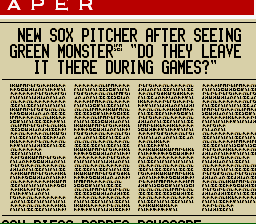
It also had funny headlines during the post game recap.
So it came to pass that every team in the game picked up 25 fake names that fit a certain theme.  Members of the Kansas City Royals were named after U.S. Presidents.  Members of the Boston Red Sox took on the names of the characters from Cheers.  The Baltimore Orioles players were partially named after John Waters movies - with Waters' name being used for legendary shortstop Cal Ripken, Jr. And the Colorado Rockies - well, the Colorado Rockies roster was filled with famous names from horror movies.

Let's take a look at the starting lineup....
Yes, you're reading that right. Dracula himself, Bela Lugosi, is the pseudonym of lead off hitter and center fielder Alex Cole.  He's followed in the number two spot by Peter Lorre, who sits in for catcher (and current New York Yankee manager) Joe Girardi.  The meat of the order consists of Boris Karloff (doubling for slugging right fielder Dante Bichette), Lon Chaney (as first baseman Andres Galarraga, the team's representative on the National League All Star team), and Christopher Lee.  Lee subs for veteran third baseman Charlie Hayes, who was one of my favorite "grunts" in baseball at the time.  It's funny that little 'ol The Mike - who probably didn't really know who Christopher Lee was at the time - ended up playing with this team just because of Hayes a few times.

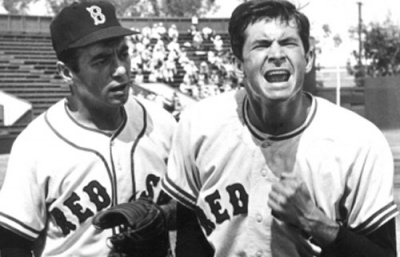
The rest of the starters are Peter Cushing in left field (replacing Jerald Clark), Oliver Reed at shortstop (for Freddie Benavides) and "Tony" Perkins at second base (for a young Eric Young, who went on to a long MLB career).  Perkins bats last among position players - even though the actor once played a baseball star in the 1957 psycho-thriller Fear Strikes Out.
The bench is a conglomoration of behind the scenes and A-list names.  The top bat of the bench is the oddly named "M. Ripper", which is the one member of the Rockies batters that confuses me. Is this supposed to be a Jack the Ripper reference, or am I missing something?  Other backups include American International Pictures schlockmaster Samuel Z. Arkoff (who's from Iowa, BTW), the legendary Roger Corman, Stephen Freakin' King, KURT RUSSELL! (who is the team's worst hitter, sadly), and Hammer maestro Terence Fisher.  Oh, and some guy named H. Alfred.  Hmmmm....I wonder who that is.  The suspense has mastered me.

As if that's not cool enough, let's check out the team's pitching staff, which includes some great names and some surprising obscurities....
The biggest surprise is the team's top starters, which include Ray Dennis Steckler, who is most famous for directing The Incredibly Strange Creatures Who Stopped Living and Became Mixed-Up Zombies, and Ted V. Mikels of The Astro-Zombies fame.  They're joined by gore master Herschell Gordon Lewis, George A. Romero, and Wes Craven in the starting rotation.
You have to kind of wonder why the likes of Steckler and Mikels are given the top spots above those more loved filmmakers, and I have two theories on this.  The first, and more optimistic, theory is that the people who made the game just happened to really like the films of these two men.  Heck, it's possible. Nerds like video games, nerds like B-movies - it makes sense.  My second theory, which also kind of makes sense, is that the Rockies - due to their mile high altitude and expansion team status at the time - are generally known as the team where pitchers really, really stink.  So maybe the makers wanted stinky filmmakers atop the Rockies' pitching staff? The world may never know.

But hey, check out our bullpen!  Available for relief duty are Tom Savini, William Castle, T. Hopper (who I assume is supposed to be Tobe Hooper), and Sam Raimi (who had just made Army of Darkness at the time the game was being made). Oh, and our closer....the incomparable Vincent Price.
I don't get why the Colorado Rockies - who went a less than stellar 67-95 in their first year as a team - were chosen to represent horror in Ken Griffey Jr. Presents Major League Baseball.  But hey, I also don't get why it's still frickin' impossible to hit the ball well consistently with my beloved Mets
I'm not entirely sure what the point of this post is...except that the fact that these horror icons (and some who aren't so iconic) were immortalized in this manner just gives me a nerd buzz.  You never know when your horror heroes are gonna cross the streams with some other cool thing in this new world of cyber nerdiness. And the fact that Ken Griffey brought them into my home years before the world was this nerdy - at least to me - is pretty freakin' cool to The Mike.

And if you disagree, I've got one thing to say to you.....

May 23, 2011

The Universal Horror Experience - Dracula's Daughter

Man, Dracula's Daughter is something else.  For starters, it's one of the Universal Horror sequels that I - despite my love for all things monstrous - had never gotten around to seeing.  Until last night, that is.  And now that I have seen it, I'm pretty sure it's one of the more unique horror sequels ever made.
It was merely 1936 when Dracula's Daughter was released, as Universal was riding the wave of success from Dracula and Frankenstein in 1931 and 1935's Bride of Frankenstein had established just how profitable a sequel could be to the studio.  I guess the feminine side of Bride was an inspiration to the people behind Dracula's Daughter, but the tone of the two films couldn't be more different.  That's not a big surprise, because Dracula and Frankenstein were different in tone as well, but the gap between their sequels is gigantic.
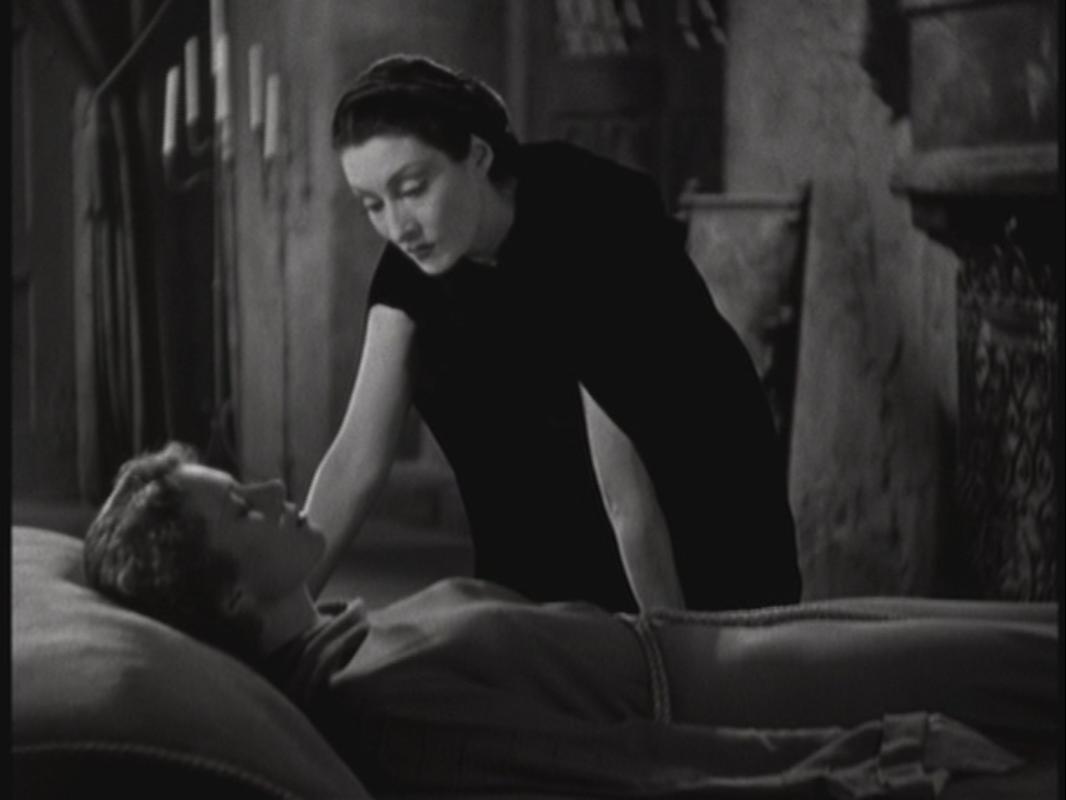
Actually, Dracula's Daughter might be the darkest movie of its era that I've seen.  Gloria Holden - the grandmother of The Mist and The Walking Dead co-star Laurie Holden - seems to float around the screen as the title character. Holden also uses her distant stare and rounded eyebrows to make Countess Marya Zaleska a hypnotic femme fatale, and the power of her presence in the film can't be denied.  The performance has certainly been an influential one in the horror scene, and is referenced as an inspiration for future female vampires like the ones created by author Anne Rice.
But, if we want to get to the part of Dracula's Daughter that involves Ms. Holden, we need to start at the beginning and the film's kind of genius set up.  In the opening scene we see the aftermath of the unseen finale of Dracula, as Professor Von Helsing - played again by Edward Van Sloan - deals with the police after putting a stake through the heart of Count Dracula (played here by a wax version of Bela Lugosi).  Watching the two patrolmen try to fathom why this distinguished old man has just put a stake through someone's heart is actually a pretty humorous opening, but it also leads into a unique discussion of the vampire curse.  As Von Helsing (seriously, that Von sooooo bugs me) puts it, you can't be charged with murder when someone's been dead for 500 years.  I think he has a point
The old doctor's pleas lead to the involvement of a psychiatrist/former student played by Otto Kruger, but also leads Countess Zaleska to London, where she uses her hypno-skills to acquire her father's corpse.  She promptly burns the corpse, because she's convinced that doing so will end her vampire curse.  Unlike her Romanian ancestor, the younger Dracula doesn't feel very comfortable in her role as a child of the night.  She still avoids wine and she still craves blood, but the diabolical edge of her father is replaced with a sad indifference in her eyes.  It's like she knows that what she is simply can not exist peacefully in our world.
Speaking of "what she is", I'd be foolish not to mention the sexual implications of the film.  Despite the strict regulations on films of the era, Dracula's Daughter is filled to the brim with some shockingly obvious lesbian undertones.  The Countess primarily sets her sights on female victims, and her intimate gaze at these women had to be a bit risque for the era.  A mid-film scene in which she offers to paint a young girl from the shoulders up shows a shocking amount of skin for the era, and the studio was very hesitant to approve the scene due to its homosexual subtext.  By today's standards it's impossible to miss the gaga-eyes Holden gives these young women - after all, I am the guy who used to think Mac and Blaine in Predator might have been gay lovers - and it's interesting to me that many people of the era weren't taken aback at all by the Countess' interactions with her victims. Wikipedia even cites that one critic advised viewers to "Be sure to bring the kiddies"!  (And if it's on Wikipedia it MUST be true!
I'm not really sure how anyone of the era would assume this was family fare anyway, because Dracula's Daughter features a lot of dark and foggy scenes that create more tension than anything in the Dracula film that preceded it.  Holden's dark performance is also accentuated by her creepy henchman Sandor (played by Irving Pichel), who lurks in shadows like an imposing mixture of Boris Karloff and Humphrey Bogart.  His relationship with the Countess is also an interesting one, as he seems to understand both her disdain for her condition and her unstoppable need to feed upon the innocent. 
I'm talking up Dracula's Daughter pretty well, though I'm not sure I really felt I liked the film that much.  It suffers from pacing problems that are similar to Lugosi's Dracula, and the connecting scenes that don't involve Holden or Pichel often fall pretty flat.  But Dracula's Daughter is at least a thought-provoking sequel that is its own movie, and it earned my respect quickly by being so willing to take chances that buck what viewers would expect from it.  Though seventy-five years have passed since its release, Dracula's Daughter still feels like it's kind of a rebel in the Universal Horror scene - and I respect that greatly.

April 11, 2011

Scream Week Midnight Top Five: The "Before Scream There Was..." Edition

With Scream 4 (or Scre4m, if you're mentally disturbed and don't like grammar) due out in theaters Friday, I figured there was no better time to take a look back at the film that is undoubtedly the most popular and socially relevant horror film to come out of the 1990s.  Thus, I present FMWL's Scream Week - an entire week dedicated to that movie and the legacy it has in horror.
We all know what Scream wanted to copy - it name drops most of the films it is inspired by - but what we don't often look at are some of the films that indirectly paved the way for Wes Craven's self-referential slasher film.  I want to take a look back at some of the films that looked at horror cinema in their own ways in the days before Scream.  Here are five of my favorite (mostly) horror films about horror films, and why they're important as we look at Scream itself.

Mark of the Vampire (1935, Dir. by Tod Browning.)
If you thought remakes were a new thing, you'd probably be surprised to know that this 76 year old film is actually a remake of the director's own (no-longer-in-existence) 1927 classic London After Midnight.  (Sure, I have no way of knowing that this lost film is a classic, but...duh people!  It is.)  In the film, a murder where a father and daughter team of "vampires" - played by the legendary Bela Lugosi and the haunting Carroll Borland (pictured below) - are the main suspects is investigated, and a wise Professor/Vampire Expert - played by Lionel Barrymore - is called in to investigate.  The film is a relatively modest story that lacks punch and is a bit dated - Browning had little ability to block studio interference after his now iconic film Freaks flopped at the box office - but it features a few haunting visuals and, most importantly to this article, a one of a kind twist that set the tone for future films.

Of course, to tell you what that means, I have to use some of those dreaded SPOILERS - so read the next paragraph at your own risk!

The trick of the film - which is revealed in future Scooby Doo fashion in the final minutes - is that the vampires and the professor are actually just playing a part to weed out the real murderer.  The professor is actually the chief of police, and Lugosi and Borland's vampires (who were written as incestuous before the studio blocked Browning from filming this subplot) are actually real life everyday ACTORS.  That's right.  The director and actor who made everyone terrified of Dracula four years earlier - had made a film which revealed on-screen that the man who terrified millions was actually a jovial actor who got a kick out of wearing a cape and scaring people.  Though the plot is a far cry from Scream, this is one of the first films to ever blatantly wink at the audience before implying that these monsters aren't always as ominous as they appear.

By the way, if you don't want my commentary on Mark of the Vampire, Trailers From Hell has some commentary on it...from the legendary John Landis!

Arsenic and Old Lace (1944, Dir. by Frank Capra.)
I know.  Dudes, I know.  It's not really a horror film, it's a madcap comedy adapted from a play.  It also happens to be one of my favorite films, and it also happens to be a film about a family of feuding insane people who have combined for at least 26 murders. 

While Mark of the Vampire took its shots using Lugosi and Dracula, Arsenic and Old Lace uses Boris Karloff and the Frankenstein monster to create its torture.  Before Raymond Massey's Jonathan Brewster is even introduced Aunt Martha remarks about how she was taken to one of those "scary pictures" a few weeks earlier, and when we do meet Jonathan, she confirms our suspicions - Jonathan's face resembles that of Boris Karloff. 

Karloff is name dropped a couple of times throughout the film - though I don't believe the Frankenstein name is - and several scenes hinge on Jonathan Brewster flying off into a monster-esque rage when compared to Mr. Karloff.  The joke is even funnier when you learn the back story - that the role was originated by and made famous on stage by none other than - you guessed it - Boris Karloff.

The incredibly dark comedy - especially for the early 1940s - is also notable because Cary Grant's Mortimer Brewster is a dramatic critic, who spends part of the film explaining murderous acts that he's seen acted out - which then are acted out upon him.  Though Frank Capra's adaptation - and the play before it - aimed to create laughs - it's one of the first indications that characters who are wiser due to the things they've watched (like Scream's Randy Meeks) would be coming to cinema screens.

Targets (1968, Dir. by Peter Bogdanovich.)
Speaking of Boris Karloff, let's talk about Targets.  I've talked about Targets before, but I ain't gonna stop talking about one of my favorite films that easily.  But truthfully, Targets is kind of the Anti-Scream.

An aging Karloff stars as aging horror icon Byron Orlok, a man who spent his life playing the kind of characters Boris Karloff would have played.  In fact, the film features real works of Mr. Karloff, primarily featuring a few minutes of Roger Corman's 1963 film The Terror (that first-time director Peter Bogdanovich was required to use by Corman) as Orlok's latest film, which has pushed him over the edge toward requirement.  In the picture below, Karloff as Orlok watches himself on TV in 1931's The Criminal Code, and laughs about the things he's done to scare innocent people from behind a screen.

But Orlok knows something that most real world viewers were already realizing.  Real world horrors were a lot more frightening than gothic castles and the ghosts of the past.  These fears are personified in Targets not by Karloff, but by young Tim O'Kelly - who kind of looks like a mini 1960s version of John Cena - who plays a trained sniper who decides he's sick of the ordinary and heads off on a senseless killing spree.  The paths of the old ghost and the new killer path in the final scenes of the film, and the result is one of the most telling statements about horror cinema that's ever been filmed.  Like Scream, Targets knew that audiences were sick of the status quo in horror cinema.  And like Scream, the film dared to point out the flaws in the horror system that were holding the genre back.

Popcorn (1991, Dir. by Mark Herrier.)
I've also covered Popcorn before, but the 1990s' first horror-about-horror must be mentioned here.  Though it primarily connects to films of the '50s and '60s for inspiration, Popcorn blazes its own trail by mimicking cinematic kills, and also happens to connect with Scream by making the "survivor girl" be connected to the killer through her parents.  The result is one of the most fun horror films of the '90s, and a nice little piece of counterprogramming to offset Scream's shiny side.  What Scream offered in criticism of the slasher genre, Popcorn offered in love toward the drive-in and B-movie favorites of a simpler, less demonic time.  I love that about it.

(By the way, do you love Popcorn like I do?  Or do you want to see it, but are dissuaded by the poor transfer on the OOP DVD that is now available on Instant Netflix?  If you answered yes to either of these questions, I've got a treat for you.  The indomitable Kristy Jett - of FMWL favorite The Bloodsprayer and many other fine places - has spearheaded a campaign to get Popcorn the proper - nay, the FANTASTIC - release and restoration that it deserves.  You can check out the progress made by going to the production site HERE, or - more importantly - you can check out the Kickstarter campaign that's funding the project.  The project could certainly use your help, and I think it's a darn worthy cause to support.)

(Yes, I just skipped talking about the movie for a paragraph to insert a shameless plug into my list.  BUT IT'S FOR A GOOD DVD RELEASE OF POPCORN, and I'm willing to sacrifice for that.  Go read my earlier Popcorn post if you need more of it, OK? Thanks much.)

There's Nothing Out There (1992, Dir. by Rolfe Kanefsky.)
There's Nothing Out There is first and foremost a Troma release - within the first 40 minutes I felt like I had seen every pair of naked breasts on set, and the special effects rival those of a three year old playing with toy dinosaurs - but it also features a hero that any horror nerd - like myself, I proudly admit it - will fall absolutely in love with.  If you like Randy Meeks (And who the heck doesn't like Randy Meeks?  By golly, he was THE best thing about the Scream films!), you'll get one heckuva kick out of TNOT's Mike.  (Hey film, great choice of name!)

There's Nothing Out There offers a basic horror set up that combines elements of The Blob and The Evil Dead, in which a bunch of youngsters go to a secluded place to part and fornicate, without knowing that a bunch of carnivorous things with green slime are loose and hungry.  But Mike - who claims to have rented every horror movie possible - immediately sees the warning signs and starts to run through how horror films can help him and his friends survive the day.  As he tries to shed his nerdy exterior and save the day, he gets to say things like "This reminds me of Invasion of the Body Snatchers" and coach his friends on what they need to do to get past the threat around them.  The result is absolutely one of the most fun horror films to come out of the early '90s, and one of the few great male and nerdy heroes in the history of fright flicks.
 ------------------------------------------------------------
And that's five.  I suppose I could have talked about Craven's own New Nightmare - in which Freddy Krueger visits actress Heather Langenkamp - but Craven will get his due throughout the week.  And though I don't think these five films directly influenced Scream, their place in history is worth noting.  Horror has a long history of referring back to itself - ask any horror film that takes a break to tell the story of some terror gone by.  Like, for example....
On second thought, that's another list for another day. ;) 
Come on back tomorrow for more of Scream Week!