If you wrote the script for a live action Scooby Doo that was also a homage to King Kong and then you filled the cast with Oscar types and a genuine television icon, that movie would be the 1954 epic Gorilla At Large. I know, it sounds too good to be true, but I assure you - it is true. And it is wonderful.
A carnival known as "The Garden of Evil" which is run by an owner played by Raymond Burr is the setting for this tongue in cheek mystery, in which the prime suspect is a primate named Goliath. But the shady proprietor and his animal attraction are just two of the many characters caught up in this murder investigation, and much of the fun of the film comes from watching a surprisingly great cast have fun with a predictably silly plot.
Cameron Mitchell, a Broadway star who would become known to horror fans by working with Mario Bava repeatedly and starring in The Toolbox Murders, takes the lead as the dopey carnival worker who is promoted to the job that I would drop my real world job for - gorilla costume wearer. It seems that the boss and his star trapeze swinger/wife - played by none less than Oscar winner Anne Bancroft(!) - have a grand scheme that will put Mitchell's Joey on the main stage and trick the audience into thinking he's the real Goliath. Which means we've got not one but TWO gorillas at large, one a dangerous killing machine and one a dangerous killing human. I'll let you ponder which one's more frightening.
Once the murdering and gorilla-based-hijinks start we get more fantastic additions to the cast with police officers played by Lee J. Cobb - who was nominated for an Oscar the same year for On The Waterfront and also appeared in amazing movies such as 12 Angry Men and The Exorcist(!) - and Lee Marvin - another Oscar winner who is pretty much the most underrated and possibly manliest action hero in cinema history. Cobb chews up scenery as the lead detective, while Marvin's role is a comic one that now looks like a spoof of his future persona as an all-star tough guy. Cobb, Burr, and Marvin add a lot of gruff charisma to the Sherlock Holmesy mystery plot, while Mitchell and Bancroft seem at home in their innocent roles. And, going back to the topic of gorilla costume wearers, there's also the unheralded legend George Barrows - who made a lot of money wearing gorilla suits and even played the Ro-Man in the one and only Robot Monster - as Goliath. As if the film needed more star power!
The cast is much of what sets this kooky film apart from other b-movies of its era - and it's easy to see why when you consider the names who were (apparently willingly) involved - but there's a charming energy inside the film that makes this more than just an a-list murder mystery. Gorilla at Large was not only a notable early effort for many of its cast members, but it was also one of the earliest entries in the original 3-D movement in cinema. This makes Gorilla At Large kind of a grandfather to today's 3-D genre films, sharing the same vibrant visual flair and playful trickery while maintaining the now cheesy moral compass that defined popcorn genre cinema of the 1950s.
The plot takes familiar turns as Gorilla At Large escalates through its final act, but the film still feels fresh and fun for fans of '50s cheese. The cast members would go on to bigger and better things in more serious and acclaimed fare, but it's still worth celebrating that once, even if it was just a for a moment in time, this much talent came together in one place and made a movie about a crazy carnival setting and a killer in a gorilla suit and a killer gorilla. Better yet, it's not just the idea of Gorilla At large that makes me smile - if a great cast and a good premise was all it took to make a genre film work we'd all love Dreamcatcher(!) - because the film itself is the perfect tongue in cheek mystery for young and old viewers. It's a cliche that is too often abused, but I think it's safe to say that they truly don't make 'em like Gorilla At Large any more.
With the Midnight Movie of the Week turning a whopping 150 weeks old, I figured I had to do something big to celebrate. It's a big deal to me, so I figured I should write about something classy. Something important. Something that's "one of the greatest films from around the world" according to a well-renowned distribution company. Something from the Criterion Collection. Something like - First Man into Space?
One-fourth of Criterion's Monsters and Madmen collection, First Man into Space is a 1959 b-flick that plays like the shell of a lot of other great sci-fi stories. Hotshot pilot Dan Prescott is chosen to pilot the Y-13, a state of the art Air Force shuttle, despite warnings from his Commander/older brother Chuck Prescott. The younger man seems to be primarily interested in doing things his way and cavorting with his Italian girlfriend, but he's also driven to make a name for himself by breaking new ground.
During the inaugural voyage of the Y-13, Dan ignores warnings and pushes the craft 250 miles above the Earth. While earning the accolade that is listed in the title - two years before Yuri Gagarin would become reality's first man into space in 1961 - but also loses control and passes through some kind of contaminant.
Anyone this side of 1960 knows that passing through some substance in space is generally a no-no - the immediate connection I made when I saw this event was the creation of the Fantastic Four (which, coincidentally, was also in 1961) - and it's shortly after this point that Dan becomes a hulking humanoid covered in a crusty space shell who thirsts for blood to replenish his damaged body.
If that premise has you thinking that First Man into Space isn't the prototypical Criterion collection film, then you're a smart guy or gal. At the same time, this isn't the average '50s sci-fi film either. It's set on and around a U.S. Military base, but it doesn't push the patriotic agenda like many of its genre peers. It's got a monster, but it never seems to really exploit this creature's image for the sake of shock. Most notably, the film bucks conventions by offering a darker view of the events on screen than many films of its era.
Those who read this site often are used to my rants about The Blob and how much I love it for its innocent nature and its portrayal of a monster attacking a Leave It To Beaver-esque reality. First Man into Space could have gone this route - the premise is certainly set up for a tall hero, a blonde beauty, and a fight in the name of righteousness - but instead director Robert Day is content to let darkness seep in to most of his frames. The film doesn't build up its hero or its heroine much, nor does it even take too much time to make us feel sorry for Dan. (It does, however, have a sequence that makes me laugh; a sequence in which a blonde nurse makes her only appearance in the film presumably because they needed someone to unleash a blood-curdling scream.) It's incredibly fatalistic, playing a little bit more like a moody vampire film than a space-age thriller.
The film's final resolution also takes place in a relative darkness, as the two brothers come face to face as soldier and monster. There's no high speed chase and no squadron of troops called in, just a monster and a soldier trying to figure out what went wrong. It is one of the most restrained endings from the golden era of sci-fi, and certainly one of the most bizarre when you think of the other films of this era.
First Man into Space isn't the most profound film, even with its downbeat mood, primarily because none of the performers are really memorable and the dark lighting takes away a lot of the awe that could be inspired by the crusty creature. But it's a nice change of pace for fans of classic sci-fi/horror, the kind of film that could be spoofed on Mystery Science Theater 3000 or could be a part of the Criterion Collection on any given day. And it's those kinds of movies - the ones that teeter on the line between brilliance and rubbish and make me think about where they belong - that I just can't get enough of.
It's kind of impossible for me to come up with a logical explanation for this. Heck, I just dropped this bad boy into the list ahead of the likes of Rosemary's Baby, The Texas Chain Saw Massacre, Poltergeist, and more. I have spent plenty of words on The Blob in my day, often discussing how much I love the teenage rebellion aspect of the film and the amorphous villain who reeks of simplicity, but can I argue that The Blob is a more well made and or scarier film than any of those I listed above? No, not really. So why's The Blob up here? Ummm...let me get back to you on that one.
The Moment That Changes Everything:
I've often talked about how the small town family plot is my favorite thing about The Blob these days - the film has as much in common with Rebel Without a Cause as it does with Godzilla. But the film's horror hook - which is topped by the grand scale (for its budget, that is) movie theater sequence - is must see stuff for me.
It Makes a Great Double Feature With:
Most of the time, when I mention how much I love The Blob, people are like "Oh yeah man, Shawnee Smith is hot!" Or sometimes they're like "Oh, Darabont co-wrote that and gave it a great edge!" Or sometimes they're like "What's up with Kevin Dillon's hair?" And I'm like "THAT'S THE REMAKE, YOU TWIT!" Seriously, it's a severe horror bugaboo of mine. But hey...I'll admit that the remake is pretty good. Just stop dismissing the original in my presence. Watch The Blob with 1988's The Blob. You'll thank me later. What It Means To Me:
Well, it means enough for me to ignore its (numerous) shortcomings and rank it among my twenty favorite horror movies, doesn't it? I know in my heart that The Blob isn't a great film. I've known it's not even necessarily good since I was 8. But I smile like a mad man every time I think about The Blob. If we can have popcorn movies in comedy and action and other genres, I can have my beloved popcorn sci-fi/horror classic with Steve(n) McQueen as an old teenager and a plastic jelly monster, right? I'm saying right. The Blob might not be the biggest or best, but it's one of the most important horror movies ever to me and I still kind of feel bad that I'm ranking it this low. I megalove The Blob that much.
First of all, can I just have this poster? It's like the awesomest thing I've ever seen, and I don't even speak Dutch.
(OK, stop rolling your eyes. I was kidding about the Dutch thing.)
Hammer Films are an acquired taste to modern horror audiences. The studio produced movies that were essentially remakes - though no one ever seems to call them that - of Universal's classic monsters, and struck gold when they cast Christopher Lee as Dracula and Christopher Lee as Van Helsing. The first film that offers this collaboration, Horror of Dracula, shines despite a meticulous pace and a lack of abrupt shocks. This is dramatic - heck, even melodramatic - horror, but it's the kind that keeps me riveted.
The Moment That Changes Everything:
Lee's Dracula career - which went through a lot of ups and downs - began with a bang. The opening seduction of Jonathan Harker by a gorgeous vampiress is ended quickly by the menacing figure of the actor, who stakes (no pun intended) his claim to the role with passion.
It Makes a Great Double Feature With:
As I mentioned, Lee's tenure as Dracula was not completely positive. He refused to speak in the first sequel he appeared in, and has lamented many of the later films openly. But among some of the slips is Freddie Francis' Dracula Has Risen from the Grave, which features the keen eye of one of my favorite directors and my favorite Lee-as-Dracula moment of biting on film. I wrote a bit about the scene in a guest piece for The Bloodsprayer one time, and I'm still pretty sure that scene makes the movie.
What It Means To Me:
Hammer films have always been the kind of films that inspired me to love horror. They're not just here to get to the viewer on a visceral level - though they did offer vibrant colors, excellent music, and a lot of blood for their era - they're interested in telling an old fashioned horror tale. And no film shows just how much they respect horror standards as Horror of Dracula does. Some see it as slow and bloodless, I see it as horror poetry.
Though Universal likes to lump it in with movies that are 15-25 years older, Creature from the Black Lagoon is not really the same kind of film as Dracula, Frankenstein, or The Invisible Man. What it is, however, is a prime example of the monster horror that filled the 1950s. Pretty much everything in the movie takes a backseat to the title creature, a good old fashioned man-in-suit that still manages to send chills up my spine.
The Moment That Changes Everything:
Late in the film, the creature advances toward the camera, eyes wide open. Though it's easy to see now that this was just a gimmick for the film (which was shot in 3-D back when 3-D was cool), that one shot etched itself into my mind at a young age.
It Makes a Great Double Feature With:
Director Jack Arnold is one of the heroes of '50s genre cinema - The Incredible Shrinking Man is pretty much one of the best movies ever - and it only seems fair to pair Creature with another of his monster flicks. I think the giant spider epic Tarantula sounds like a good pick here.
What It Means To Me:
One third of what I like to call my "Horror Birth Trilogy" (actually I just made that term up to explain the first three horror movies I was exposed to as a kid), Creature from the Black Lagoon and I went through a dry spell when I was in my teenage years. But when I went back to the film as a young adult, I couldn't help finding myself right back in that state of wonder that kept me glued to the screen as a kid. Sure, it's easy to point out the flaws in the film, but there's something truly iconic about this monster flick that keeps it near and dear to my heart at all times.
If you've ever watched a horror movie, you've probably been told that teenagers are pretty much worthless at life. It's true to an extent - if teenagehood was Mass Effect, you could say I took the paragon path all the way and I was still a stupid idiot 97% of the time - but people who are jump to conclusions often miss the good parts of what's going on in these mostly undeveloped human people.
But horror movies are more wrong than most people when it comes to teenagers. They show the worst parts of teen behavior, and often punish the kids for it harshly. Look, I get it. It was a message to change their ways and it lost its meaning and now it just happens, sort of like how people used to say the pledge of allegiance in school because they meant it and now they just do it because they're told to and they're trained to and they don't even think about the words they're saying.
But I'm feeling hopeful tonight. I feel like taking the world by the ears and shaking at and shouting "Hey! There have to be good teenagers out there or there wouldn't be people who grew up to be good people!" I'm not sure if my shouting would be entirely true, but I'm trying to have faith here. Heck, I'm so faithful that I might even set this post to some soulful Joe Cocker.
Yeah, I went there. Now lets take a look at five reminders that teenagers aren't always the downfall of society, and can in fact be really friggin' awesome beacons of hope for the future and stuff.
Charlotte "Charlie" Newton
Played by Teresa Wright in Shadow of a Doubt
(1943, Dir. by Alfred Hitchcock.)
Charlie wasn't always the picture of virtue - that whole romance with the like 40 year old cop was really weird! - but she's perhaps the earliest perfect example of a teenage character who is given power over her world in a dark world. We're not talking Nancy Drew here, we're talking about a normal girl in a normal town with a normal family who worships her seemingly normal Uncle who just might be an abnormal killer of rich widows.
Teresa Wright did all kinds of great things with this character. To start, there's an incredible streak of altruism that runs through the character, who really fits into the film's pre-World War II setting as an ambitious and driven young woman. She seems to just believe so much in the world around her, including her suspicious uncle, and her hope for the world is pretty contagious. But when things start to turn in the final scenes of the film and Charlie begins to take a stand - that's when the character really blossoms. She shows an ability to grow and adapt, and sets the tone for hundreds of female teenage characters who would follow her in genre cinema.
Steven Andrews, Jane Martin, Mooch and the Boys
Played by Steve McQueen, Aneta Corsaut, James Bonnet, Robert Fields, Anthony Franke in The Blob
(1958, Dir. by Irvin S. Yeaworth, Jr.)
I've wasted so many words on The Blob - this one's my favorite collection of them - but I never get old of the ridiculously wonderful '50s teenagers of The Blob. And yes, I'll get it out of the way right now - they're not actually teenagers. The actors are older than that. I know.
As the teenagers mobilize in the name of what's right - and what might actually save humanity - I think my favorite thing about the group is the dopey Mooch. With his creepy hair and his red sweater, James Bonnet's character is the personification of the wholesome values The Blob wants us to see in these characters. Along for the ride and always willing to jump into the fight with a CO2 fire extinguisher, these kids represent their era perfectly and always make me smile.
Dennis Guilder
Played by John Stockwell in Christine
(1983, Dir. by John Carpenter.)
The most fascinating thing about John Carpenter's adaptation of Stephen King's killer car novel, to me, has always been the central relationship between the two lead teenage male characters. On one hand, you have Arnie Cunningham, played by Keith Gordon, a bullied nerd who seems to have little going for him on the popularity side of things. On the other hand, we have Dennis, a football star who seemingly could be really popular - yet he hangs out with Arnie and turns down the advances of a young Kelly Preston.
Let me repeat that - he turns down the advances of a YOUNG KELLY PRESTON.
Though I still question his willingness to not have a fling with a young Kelly Preston, I adore how Dennis' character moves through the story. As Arnie's mind becomes corrupted by that red demon on wheels, Dennis becomes the voice of reason. He's a shockingly grounded young man for a high school star athlete, but the realization that characters like that exist shouldn't really be a surprise to anyone. Dennis represents the good side of the teenage jock scene, and he does so quite well.
Nancy Thompson
Played by Heather Langenkamp in A Nightmare on Elm Street
(1984, Dir. by Wes Craven.)
This one really doesn't need many words. I'm notoriously hard on A Nightmare on Elm Street because I hate the ending so much, but I will never deny the possibility that Nancy Thompson is the prototype for teenage heroines in horror. If there's one thing Wes Craven can do well on a consistent basis (and it literally might be the only thing he can do consistently!) - the man can make a heroine who is smart and who is strong and who won't back down when it's time to stand up for herself. And it all pretty much began with Nancy Thompson.
Kirby Reed
Played by Hayden Panettiere in Scream 4
(2011, Dir. by Wes Craven.)
Speaking of Craven, we come to the Scream series - where female characters have varied from one end of the spectrum to another like a squirrel who takes antidepressants every other week. (Don't think about that last analogy for too long, it will break your brain.)
But when we get to Scream 4, we meet the female character who pretty much made every horror fan in the world fistpump with pride. She's Kirby Reed, and she's played with surprising panache by Heroes alumni Hayden Panettiere. I'm pretty sure no one expected this from the young girl, but she makes female horror nerd look fun, playing off her straight laced friends and the nerdy male cinephiles equally well. She's the smart, normal, socially adjusted image that a lot of horror fans wish people saw more often - which is a big part of why so many horror fans loved her.
There are probably a lot more wonderful teenagers in horror I've left out here, but this isn't a Midnight Top A Lot list. It's a Top Five. So please, Midnight Warriors, hit up the comments! Tell me who I missed, tell me who you love, tell me you love me - whatever you want to tell me. (Maybe not the love me thing. It might get weird.)
In the meantime, have faith. Because someday, the good teenagers are gonna be the old people who think there aren't any good teenagers, while we all watch from our retirement castles on Mars and laugh. It'll be awesome. (Or, we'll all turn into Crazy Ralph. Which isn't bad either.)
Horror has rarely been as fun as it is when William Castle's pulling the viewer's strings. And when you combine his behind-the-scenes showmanship with the star power of the great Vincent Price, you get what I like to call a magical conjunction. With a great setting and plenty of effective gags, House on Haunted Hill becomes a must see for anyone interested in classic B-Movie horror.
The Moment That Changes Everything:
When Price lays out the stakes for the evening in the haunted house on the haunted hill (Although, didn't you ever wonder if the house was actually innocent and just got a bad reputation because the hill was haunted? I did.), he sells the rest of the film easily. When Vincent Price tells you horror is coming, you believe it unequivocally.
It Makes a Great Double Feature With:
Something else by Castle makes sense - perhaps his original 13 Ghosts is the best fit - as does another Price classic like House of Wax. But I've always liked the pairing of Castle's film with one of my favorite Price films, Last Man on Earth. The two films have drastically different tones, but both show off Price at his scene-stealing best.
What It Means To Me:
It's really not the best movie in any way, but House on Haunted Hill is one of those movies that I just want to throw in a time capsule and preserve forever. I wasn't fortunate enough to be around for the days of Castle films, but I can still feel the fantastic sense of ridiculous fun that pours from the work of crowd pleasers like him and Price. Some would argue that the 50+ year old film is dated, but I really think this is an ageless treat for anyone who enjoys a dose of the macabre.
Though it's own merits - which I will speak of (OK, type of) in the near future - are more than enough to land I Married A Monster from Outer Space some love from The Mike, it's another factoid about I Married a Monster from Outer Space a special place in my heart. For it was this film - with its sensational title and classic sci-fi style - that headlined drive-in double features during 1958, paired up with a low budget film that happened to be called The Blob. A legend was born.
Blobs aside, I Married a Monster from Outer Space is one of the more interesting sci-fi/horror entries of the era. There are obvious parallels to be drawn with films like Invasion of the Body Snatchers or Invaders From Mars, but the one-to-one nature of this film provides an interesting shift in dynamics from its contemporaries. As you could probably guess from the title - it's not a euphemism - this time the invasion takes a honeymoon.
Tom Tryon and Gloria Talbott star, the latter as the character who might utter the title in frustration and the former as the "monster". After a few drinks, Tryon's Bill is stopped by a lifeless body in the middle of the road, which leads to his first encounter with an extraterrestrial that looks kind of like Man-Thing. This is a small problem, considering it's the night before his wedding, but he shows up just in time to make his bride happy. Proving once again that all a dude has to do for a wedding is SHOW UP.
It doesn't take long for Talbott's Marge to notice odd behavior from her groom. Early warning signs are pretty obvious to observers - like Bill driving without headlights or forgetting to open his wife's car door - but it's the moments when the couple find themselves alone that really start to worry Marge. Their honeymoon scene is the film's first major awkward relationship moment, as Marge stares off into the ocean with her chest puffed out - and Bill doesn't really have a clue what to do. In fact, Bill spends much of the movie making faces that remind me of Steve Martin's psychotic dentist from Little Shop of Horrors.
Much of the film follows the invasion from male to male, as we learn that the creatures that have inhabited Earth men come from a planet where women are no longer available for reproduction. The alien plan hasn't fully developed yet - the guys from space have no idea how to mate with human women - but they know that getting your foot in the door is half the battle. (Knowing - of course - is the other half). The takeover of the town creates the scenes that remind of other invasion films - Marge runs from place to place trying to find help and is generally considered crazy - but also provides some unique moments. The impact that the invasion has on the local bar is about the only thing that really alerts anyone else to the change in these men - but when the only witnesses are bartenders and floozies, there aren't really any witnesses.
Unlike many sci-fi films of the '50s, this is one of the only religious references in the film.
Talbott and Tryon have to carry most of the film, and the interesting pair of actors do a lot for the film. I'm not too familiar with either of them outside of this film (I just learned that Tryon was a candidate to play Sam Loomis in Psycho, which makes sense based on his looks), but they seem well fitted to this odd sci-fi tale. Talbott balances between looking like a Hollywood heroine and an everyday housewife of the era, while Tryon fills the awkward creature-in-man-suit role extremely well from a physical standpoint. There is next to no depth to these characters, but director Gene Fowler, Jr. manages to frame everything really well and there are plenty of shadowy shots that set the mood of despair for the frightened wife.
I Married a Monster from Outer Space has plenty of flaws, starting with a title that implies the viewer shouldn't take the film too seriously. It's a smarter film than it sounds, but it doesn't reach the chills of Body Snatchers or the paranoia of Invaders from Mars. Part of me wants to write off the film as a unique failure, but the imagery is fantastic and the concept is uniquely-handled by the director and the leads. It works well enough to keep me coming back to it every once in a while, and that's good enough for me.
Though it's about to be further concealed by a prequel to its famous remake - which is one of the best flicks ever in its own ridiculously awesome way and was voted FMWL's 2010-2011 Midnight Movie of the Year - The Thing From Another World still makes my socks rock sixty years after the fact. The 1951 film shows it age at times, but that charm that once inspired John Carpenter and a whole generation of horror and sci-fi fans still shines through in plenty of ways.
One of the first studio examples of the flying saucer genre that would dominate movie screens in the 1950s, The Thing From Another World is also a movie that represents some of horror's best traits. Adapted loosely from Joseph Campbell's novella - whose monster resembles the shapeshifting terror of Carpenter's Thing - the elder version of the story gives us a straight-laced military crew, a few scientists, one wonderful broad, and a hulking stalker from outer space.
While this Thing certainly plays to the strengths of its era - the characters definitely present themselves with that "aw shucks" charm our generation expects from classic cinema - there are a lot of interesting things going on inside the film. One of those things is probably not the male characters - the slightly comedic reporter character is a little fun, and the doctor looks like what you'd expect a super science guy to be these days - who are one note cliches. I once argued that Carpenter's version of The Thing needed characters who we don't know too well so they could be interchangeable within a tale where no one can be trusted, but the original takes a much straighter approach to its characters. The Captain's a captain, the doctor's a doctor, the reporter's a reporter....and everyone else is just pretty much there.
But there is one wild card in The Thing From Another World's hand - female station hand Nikki Nicholson, played by Margaret Sheridan. First glance might present her as your average Jill Friday in an old movie, but there's an edge to the character that reeks of producer/possible-director Howard Hawks' involvement. We're introduced to her via a discussion of her embarrassing the romantically interested captain during a previous affair, in which she apparently outdrank the heroic soldier AND managed to not have sex with him. Their relationship throughout the film evolves into smoking together, drinking together, and even a small dose of bondage - and I don't think I need to tell you that that wasn't exactly commonplace in 1950s cinema. So yeah - I kind of love this tough chick character who was randomly thrown in to the movie. She's literally decades ahead of her time.
Actually there are two wild cards in the film's hand, because you can't really ignore the nearly seven-foot tall man beast that is loosed upon the Alaskan military facility in the film's second act. Though the title creature is kept off screen for much of the film, he's always near the film's proceedings. Some sort of device that's kind of like that alien detector from Alien comes in handy in a few scenes, and other moments obscure our view of him using the elements. One of the best examples comes when the newly unthawed Thing battles with the sled dogs outside the camp, and the viewer only sees flailing limbs as the dogs make the kind of noises you never want to hear from dogs. Dogs played a different role in Carpenter's version, but both films use them as a tool to make the viewer concerned about The Thing and just how brutal it is.
Though some of the sciency talk has always gone over my head - seriously, I couldn't tell you the difference between a zygote and orange marmalade - I kind of like the original Thing's monster. Though it only comes in one shape (that of future Gunsmoke star James Arness), the weird connection between this alien lifeform and plants adds something to the proceedings. There's that weird scene where the doctor listens to a bunch of bulbs with heartbeats using a stethoscope and lots of talk of cell structure and other sciency things, which creates a unique kind of alien that hasn't been matched often in horror or sci-fi cinema. I think the message of the film is that this lumbering beast is kind of a cross between Little Shop of Horrors and Frankenstein, and I dig that.
That's another thing about this Thing - the script is both smart and sharp. The adaptation by Charles Lederer is alleged to have been "touched up" by both Hawks and famous screenwriter Ben Hecht (whose amazing Hollywood career simply can not be summed up by me naming only one movie here), and it features some of the coolest moments in sci-fi. I've already discussed Nikki - who seems to have come right out of Hawks' epic comedy His Girl Friday - but other parts of the film provide interesting nuggets of dialogue and surprising doses of humor. The most famous call from the film is the final "Keep watching the skies!" commentary from the reporter - which has been a sci-fi staple ever since, but there are other bits and pieces of explanation that really strike a chord, even with modern audiences. Perhaps my favorite random moment in the script comes when the Doctor proclaims "At 12:10 AM, the hand became alive" while reporting his findings while working with remnants of The Thing. It's such a simple moment, but it shows where The Thing's writers - whoever they were - had their heads. And it might even show how much they wanted to surprise us.
I know we're supposed to look back at The Thing From Another World as simply a template that led to Carpenter's classic these days, but I'm sitting here and thinking there's a lot more to this bit of sci-fi monster mania than people often remember. Comparing Hawks' production (which I should mention is credited to director Christian Nyby) to Carpenter's film isn't really a valid move in my book, as these two films are unique in many ways. So when you're considering Carpenter's film and the newfangled prequel/remake/premake that's hitting screens as I type - don't forget where things started. Because The Thing From Another World is a classic too, and I think it still has a lot to offer the genre fan today.
Utilizing a device that's generally restricted to film noir of the '40s or Oscar winning dramas, Kurt Neumann's 1958 classic opens with a character admitting to the murder of the title character. She's not just a character either, she's the man's wife - a timid middle-aged redheaded woman played by Patricia Owens. And, naturally, the person she offers her confession to is none other than Vincent Price - because that's what you do in a movie like The Fly.
Now overshadowed by its Cronenberg-flavored remake, the first film about a man/fly hybrid reminds me that dark and dreary was a part of sci-fi cinema long before the 1986 version offered a bleak and disgusting look at teleportation gone wrong. Neumann's film opens with the reminder that a man is dead, accompanied by a shot of his smashed body in a factory press, and sets us up to quickly realize that this woman may die - at the law's hand - due to this. Her only help comes in the form of Vincent Price, a police investigator, her maid (played by Kathleen Freeman - who went on to portray 'The Penguin' in The Blues Brothers!), and her bumbling son, who catches flies for fun. Seriously kid....you're a nerd. In a bad way.
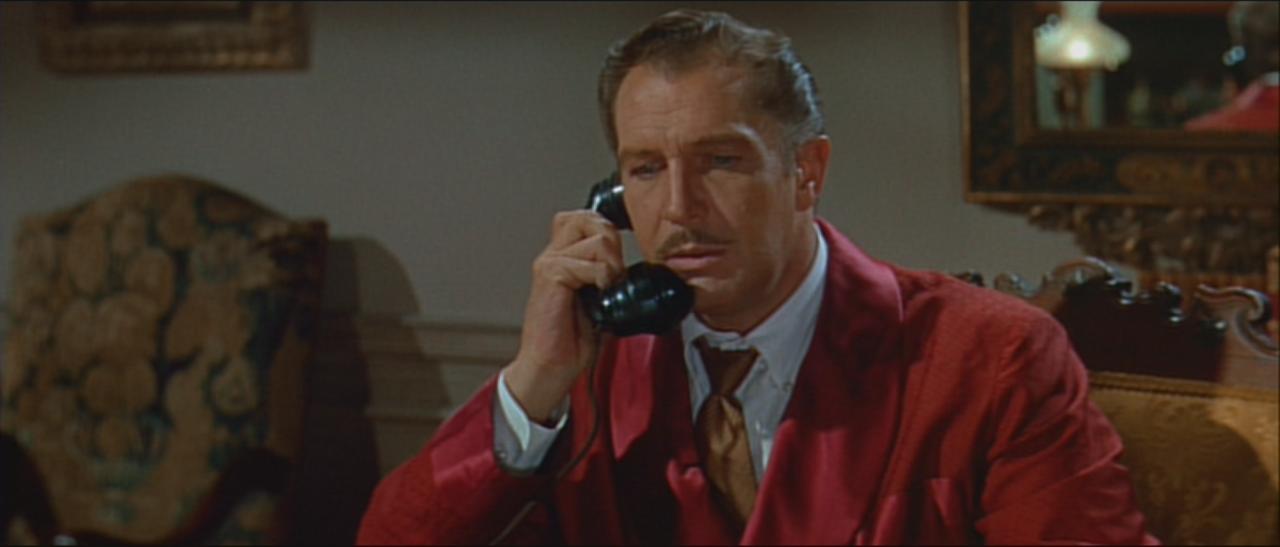
(By the way, check out Vincent's suave nightwear! It's after midnight, and he's sitting at home looking like that. Can you spell PIMP?)
Then the film, continuing to dance around the traditions of schlock that were prevalent in the '50s, goes into flashback mode and takes us back to the experiments of the now deceased husband. His name was Andre Delambre, and he's one of those dudes who's completely devoted to SCIENCE in all ways, because SCIENCE - not your annoying wife or your dweeb kid - is like totally what's gonna save the world. We see him experimenting with some sort of teleportation device, and everything is cool in his lab - until he randomly decides to test on the family cat. Which was really adorable, and now I'm mad at him.
Undeterred after his poor fluffy cat seems to become a ghost, Andre decides that it's a good idea to test on himself - and you know where things go from here. Suddenly we've got a half man/half fly in a lab and a half fly/half man in the garden, and poor Helene is left hunting the house and shouting orders about the "fly with a white head" that's on the loose. And the police - and 'The Penguin' - just stare at her like she's crazy. Not a fun predicament.
Unlike other sci-fi of its era - like, for example, The Blob - you can see that The Fly has a bit of a mean streak. I've already mentioned its initial dose of smashed scientist and its murder investigation, but some of the more interesting scenes in the film involve the fly-headed man in the lab trying to explain his predicament to his wife. The character's descent into madness - which was obviously the key to Cronenberg's remake - is handled quite well here. A scene in which the late Doctor types out his jumbled thoughts shows off his fading mental state, and the degeneration of the character continues even further. He becomes more violent in his motions and is a little creepy as the proceedings go on...except for the fact that he's a man with a fly's hand and head that looks kinda silly.
Also silly - but still creepy as all heck - is the ending. It's iconic now, and has stuck with me since I was a young Mike. Yet, upon this rewatch, I was taken aback once more by how mean the thing was. It's telling that the film's epilogue didn't stick with me at all, but the dark images from that final scene were embedded in my brain for a couple of decades. So the next time someone tells me that old-school horror and sci-fi doesn't have the edge that modern films could get, I might point them away from my beloved Blob and toward this version of The Fly. It's the rare film that wasn't content to fit into what was expected at the time, and the result is an inventive shocker that's still worth seeking out.
I'm not sure why I was more interested in the remake of Not of this Earth - which I reviewed HERE - than Roger Corman's original black-and-white drive-in feature. Oh, right. It's because a) the original wasn't available on DVD at the time and b) the remake was an '80s cheese fest with a notorious starlet in the oft-nude lead. Now where were we?
Though it originally played as the second half of a double bill with Corman's Attack of the Crab Monsters, Not of this Earth is a surprisingly impressive b-flick that balances the goofy fun we expect from Corman with some effective black-and-white cinematography and an imposing lead performance by the original 'Marlboro Man', Paul Birch.
Working backward, I was surprised to find that the plot of the remake is lifted almost directly from Corman's original film, with the only differences coming from the overuse of T & A in the remake. (Though Jim Wynorski's big-haired update is no epic, it actually runs 14 minutes longer than Corman's 67 minute original.) Full scenes are presented almost word for word in the remake, but the charm of the original shines through over the remake in almost every way.
Birch stars as the intergalactic creature in search of adequate blood, and a young Beverly Garland plays the nurse role that Traci Lords inhabited in the '80s. Garland does a fine job of being the woman we'd expect to see in a b-movie of this era, but it's Birch's hammy performance in the lead that won me over. With his deep voice, stilted movement, and dark sunglasses, Birch comes off as sufficiently inhuman. He's never quite terrifying - though there are a few wonderfully creepy moments - but there's a definite unease surrounding the character.
As with most of Corman's films, there's plenty of light-hearted schlock to go around. A cameo by Dick Miller as the ill-fated vacuum salesman provides some good chuckles, and the interactions between Garland's Nurse Nadine and her police officer beau are a good example of the unintentionally hilarious presenation of men and women in genre films of the '50s. The reveal of the villain's laser eyes and his vampiric flying octopus creature are on par with some of the great silly sci-fi gags of the decade, but the operative word there is still "silly".
Still, I found a bit more substance in Corman's version of Not of this Earth than I expected to. It's not a sci-fi classic by any means, but for a b-side at the drive-in it's kind of fantastic. It's quick, original, and just a little creepy, which makes it everything you'd expect from Corman and more. I've got a feeling this one will quickly become a b-movie favorite of mine, and leave that copy of the remake (there was also a second remake in 1997, but that one seems to have been swept away) dusty on my shelf.
If you're like me, you might have initially read the title of this movie and thought that it aimed to exploit the likes of George Washington Carver, Booker T. Washington, and Rosa Parks. If you're like me, you then would have read up on the film and learned that you were, in fact, a fool.
Actually, the "Black Museum" that this title mentions is a real place that exists within the confines of Scotland Yard in London. First established as a collection of seized property in 1874, what is formally known as the Crime Museum maintains almost every type of weapon - from "death masks" to nooses and shotgun umbrellas - that the British Police have ever encountered. Naturally, the collection exists for educational purposes, as an attempt at "getting inside the mind of the criminal". So, we've got a government sanctioned collection of everything macabre and evil thing the police can find...doesn't it sound like something that would come in handy in a horror movie?
That's the idea behind Horrors of the Black Museum, which was written and produced by b-movie mogul Herman Cohen. Though his productions range from 1955's I Was a Teenage Werewolf to 1970's Trog, Horrors of the Black Museum is significant for being both the first color film and the first Cinemascope film released by the young American International Pictures, who Cohen worked with often. (In fact, Cohen was offered the chance to be a partner at AIP by its founder, James H. Nicholson, but had to turn down the opportunity due to a previous contract.)
The film stars Michael Gough, the future Alfred Pennyworth, as a writer who wants to make sure his works are as realistic as possible. In his search for perfection, he insures that he's got material by manipulating an assistant to kill, using weapons from his own personal Black Museum (or, his own diabolical Batcave!) for each crime. The film includes inventive set pieces such as "the fantastic binocular murder" which opens the film, and (like future booby trap horrors such as Saw) the kills get more unique as the film goes on. The film packs a lot of destruction into only 78 minutes, but at times it feels like the film is advancing the plot abruptly just to get to the next kill.
Gough's performance in the lead is the most endearing part of the film, and makes up for a lot of the script's shortcomings. There is next to no suspense in the film's plot as the identity of the killer is known from early in the film, and Gough's Edmond Bancroft struggles to keep his actions private from even the film's most tertiary characters. But as Gough rambles about his plans and preaches about the dangers of women, the same charisma that made him the best part of any Batman movie makes him the kind of endearing villain that Vincent Price would have played. (On a side note, one could also argue that the film's plot about a writer who writes about their own murders parallels films such as Basic Instinct, which allows me to make what I hope is the internet's first comparison between Michael Gough and Sharon Stone.)
Horrors of the Black Museum struggles to go the distance with its script, which is full of one note characters who are introduced just to become victims. Though some of the kill scenes are effective (and pretty brutal for 1959) and Gough is a winner, the final product doesn't stand out among the AIP horrors of the era. Horrors of the Black Museum is a fun little horror film, but attempts to take it too seriously will probably result in disappointment.
If you have questions or suggestions not regarding a specific review, or would like to recommend a movie to The Mike, feel free to email him at frommidnightwithlove(at)gmail(dot)com!
Also, please leave feedback at the bottom of reviews by checking one of the boxes, or by leaving a comment! Any feedback that can help improve the site or reviews is much appreciated!




 Posts