Search this blog and The Mike's favorite blogs!

January 25, 2013

Midnight Movie of the Week #160 - The Brides of Dracula

Hammer Films' Dracula tales are most remembered as vehicles for Christopher Lee, so some people are surprised to find out that the first sequel to Horror of Dracula was a film in which Dracula is already dead, Lee did not appear, and a rather unintimidating little man named Baron Meinster serves as the main masculine vampire. Alas, it's all true. The film in question is Hammer's 1960 vampi-rama The Brides of Dracula, in which Peter Cushing picks up where the 1958 film left off and takes on a new vampire threat, none of whom are actually wed to the Count.
The film primarily follows the exploits of a French babe schoolteacher named Marianne (played by Yvonne Monlaur, who is actually the daughter of a Russian count), who takes a job in the Transylvanian countryside (because, well, WHO WOULDN'T?) and ends up spending the night in a big old castle where a mother has her son chained up by the ankle. To some that might seem like a relatively normal night in Transylvania - I've seen enough horror flicks to know someone is always chained up to something - but the pure and innocent Marianne is pretty freaked out and this, along with the craziness of the house's servant (Freda Jackson, getting to play what's basically a female version of Renfield!), convinces Marianne that she's safer booking it through the forest than staying the night.
And that's when the hero returns in the form of Doctor Van Helsing, as played by the great Peter Cushing. Cushing would play "Van Helsing" five times for Hammer, but it's worth noting that he actually portrayed three different characters in five different films in three different timelines during his time with Hammer. This is (at least in Hammer's universe) the only continuation of the "original" version of Cushing asVan Helsing, while his performances in the Dracula films of the 1970s are relatives of this character. So, next time someone tells you Cushing played Van Helsing five times, you can prove them wrong by saying he only played this Van Helsing twice. Isn't that a great feeling?
Now back to the film, which strikes me as one of Hammer's more beautiful vampire films.  The sets are pretty recognizable - we must remember that this was a relatively low budget studio and they did reuse plenty of their sets and props - but there's something vibrant and wonderful about their presentation by director Terence Fisher here.  Horror of Dracula was not a dull film from a visual standpoint, but it seems Fisher attempted to cover up some of this film's issues with a little more color and a lot of feminine beauty. That's not a bad choice for a film that loses Christopher Lee and gains a looker like Monlaur, and the director's vision of the film helps The Brides of Dracula keep our attention for 85 minutes.
The tone of the film loses much of the romanticism that carried Hammer's first Dracula endeavor, and The Brides of Dracula certainly feels like a cheesy spin-off at times. A few of the sequences with the vampire women - especially the ones in which they interact with Jackson's manic servant/familiar - play out in bizarre fashion, yet the film strides forward with confidence that the viewer will forgive some of the sillier bits.  There are moments when the film could have lost me - like an unconventional scene in which Van Helsing deals with a bite wound to his own neck - but there's something to be said for this film's slightly random, slightly nightmarish approach to Marianne and Van Helsing's battle against evil.
The Brides of Dracula isn't the most dramatic vampire film from Hammer studios, and it's not even close to being the most unique.  But it's an abstract vampire tale that hits me as a perfect diversion, a new chapter in a familiar story that enhances my appreciation of Fisher as a filmmaker, Cushing as an actor, and the whole of Hammer Studios as a titan of terror. The Brides of Dracula is widely forgotten, but it deserves more attention for its place in horror history and its unique relationship to the studio's other Dracula films.

January 23, 2013

Jack and Diane

(2012, Dir. by Bradley Rust Gray.)

A remake in name only of the John Cougar Mellencamp classic (OK, it's not related to the song, but you ALL were thinking it), Jack and Diane is one of those films that just left me shaking my head in confusion. That doesn't mean it's a bad movie, per say, it just means that it's one of those movies that made me stare at the screen and shout things like "WHO ARE YOU?" as I tried to figure out its intentions.

The title characters, despite your preconceived notions, are two teenage girls who quickly and abruptly fall in love during late summer in the city. It's all well and good, except for the disapproving families and the fact that Diane is going away to school in two weeks and - oh yeah - the fact that Diane might also be a werewolf.

Now, if you're like me, you just heard the word werewolf and got really excited. That happened to me when I heard about the movie, I admit it.  There was a time and a place - probably Italy in the early '70s - when abstract and surreal lesbian werewolves were probably a thing. But this one is a far, far cry from what that movie would have been like, because this is actually just one of those teens who are hip and different movies that indie filmmakers love to make these days.

(By the way, I was totally throwing crap against the wall on that "abstract and surreal lesbian werewolves in the '70s in Italy", but the good thing is that you can put "surreal", "lesbian" and "Italian" together with almost anything and throw it into a computer and you'll probably find a movie that actually existed. They're like RSTLNE on Wheel of Fortune when it comes to European horror.)

Anyway, back to Jack and Diane, which the viewer will quickly realize is not really a werewolf film by werewolf film standards.  It's a dramatic love story that does all those dramatic love story things - like making the characters madly in love even though they've said seven words to each other or showing how awkward it is for them to actually express themselves to their beloved even though they TOTALLY love them - while randomly flashing some genetic animations and some bloody noses and a few random attacks from a pop-up monster that never really matters in the plot. I'm probably being a little harsh as I lay this out there, but the folks that are reading this are generally the people like me who are going to jump at the word werewolf and get excited, but unfortunately for them this is a movie where you can't take the world werewolf literally.

Now, of course, the movie's not bad just because it's a slow moving infatuation love story.  Jack and Diane is kept afloat by a good performance by rising star Juno Temple - who rocked one out of the park when last seen in William Friedkin's bizarre Killer Joe - as the unsure and monstrously unstable Diane.  She carries the film as she weighs her desires against her innocence, even if her beau - the tomboy Jack, as played by Riley Keough - is a little more difficult for the viewer to relate to. All of the supporting performances - including a sexually charged cameo by former pop star Kylie Minogue (hey, if my choices are "former pop star" or "co-star of Bio-Dome" I'm going to use the least offensive one) - aren't noteworthy, which probably helps bring out Temple's star more. Unfortunately, she can't carry the whole film to great heights on her own.

Most disappointingly, Jack and Diane just never seems to muster up anything of importance in its plot or in its message. When you consider that the romance is as deep as a Twilight film and the monster metaphors are as hollow as a jack-o-lantern, you're left with the realization that Jack and Diane doesn't really muster up anything of relevance. A good lead performance, an adequate co-star, 12 seconds of monster action, and a hip indie soundtrack do not a movie make.  Jack and Diane is an interesting failure - but it's a failure nonetheless.

January 19, 2013

Midnight Movie of the Week #159 - In the Mouth of Madness

The last time I mentioned In the Mouth of Madness on this here site, I said something like "It's about time we recognize this as one of Carpenter's classics."  I'm not sure I wasn't talking myself there.  Carpenter's always been my favorite post-Hitchcock topic when it comes to genre cinema, and I've never denied the fact that this film is a fascinating piece of horror. But there's always been something about the film that's kept me from listing it alongside my favorite films by the director - and I have no idea what that something is or if that something should exist. So, since it was freakin' John Carpenter's BIRTHDAY(!) this week, let's investigate.
Released in 1994, In the Mouth of Madness was only Carpenter's second film of the 1990s (following the studio misfire Memoirs of an Invisible Man) and is probably the last pure horror film Carpenter made until 2010's The Ward sixteen years later.  And pure horror might be an understatement when it comes to In the Mouth of Madness, because the film manages to pay heed to the two most loved horror writers of all-time - H.P. Lovecraft and Stephen King - while creating an apocalyptic world that's all Carpenter's own.
Sam Neill stars as a skeptical insurance investigator who's hired (by Charlton Heston, BTW) to look into the disappearance of horror author Sutter Cane, an enigmatic writer whose fiction has caused a bit of psychosis in his "less stable readers." His job leads him to the fictional small town Hobb's End, in which strange things like mutant killer children and tentacled beasts are only some of the tricks that Cane - played by Jurgen Prochnow - has up his sleeve. What follows is a lot of Neill screaming and a lot of bizarre special effects. And that sounds like it could be a bad thing, but it is completely not.
This is one of the rare Carpenter films that doesn't have the director (or one of his pseudonyms) given a writing credit, but unlike Memoirs of an Invisible Man before it you can still feel the stamp of the director throughout the story. In fact, many have labeled this as the third installment in Carpenter's 'Apocalypse Trilogy' - following influence of The Thing and Prince of Darkness - thanks to the increasingly pessimistic tone of each film. Like the other two films, In the Mouth of Madness unleashes an evil force that can not easily be seen or classified; which is also a force of evil that has the power to take over the human mind.  Many of Carpenter's earlier/great films hide their evils behind "things" - a gang, a shape, some fog, a car, etc. - but you could probably argue that this is his most abstract representation of evil outside of The Thing.
In fact, it's the film's willingness to shift through different visions of evil that is most fascinating to me. The first major madness in the film comes from an ax toting maniac (who we later find out was Cane's agent), but the film then seems to allow terror to seep into all areas if the main character's life. Throughout his wonderfully hammy performance, we see Neill deal with everything from zomified nightmares to visual and auditory hallucinations, consistently blurring the line between reality and what can only be described as Hell. There are some truly random moments - like one involving the color blue - that wouldn't work in a lesser film. But Carpenter's ability to tell a story and Neill's approach to the skeptic-driven-crazy role go a long way toward making the film feel so full of evil.
There's a comic undertone throughout the film - supported by Neill's grandiose performance and the increasingly uncommon series of twists - that makes it hard to see In the Mouth of Madness as a truly "scary" piece of horror.  If anything, the film's tone probably endears the film more to horror fans than anyone else because, like many other horror successes of the 1990s, the film is a horror movie about horror stories. I think the tone might be a big part of why I've never loved this film as much as I do The Thing (which never stops being serious for a second) or Prince of Darkness (which compliments its own wacky plot with a straight face that never wavers).  And yet, every time I see the final scenes of In the Mouth of Madness I am reminded just how vast and terrible the film's idea would be in a real world society. No one will ever mistake this film for a cautionary tale about human horror, but a more open minded viewer who loves to speculate in "what if"s as much as the characters here do - should have a lot of fun with one of Carpenter's unsung successes.


January 11, 2013

Midnight Movie of the Week #158 - Venom

If you're like me, you've probably seen a lot of hammy performances in snake-centric horror movies. But there's a chance you haven't seen the most talented cast to ever ham their way through a snake flick, the cast assembled by maligned horror legend Tobe Hooper for Venom - a film that he quit directing early in production.  So, we can add this one to the list of horror films that Hooper "kind of" directed, can't we?
Pieced together by British director Piers Haggard in Hooper's absence, Venom is a film whose existence is completely bizarre.  You can probably recognize that thanks to the premise, in which a bunch of kidnappers (Klaus Kinski, Susan George, and Oliver Reed) take a young boy as a hostage without knowing that the boy happens to be carrying a deadly Black Mamba snake. That snake is soon released into the house where they are holding said hostage, and that's just the icing on the cake for how weird this movie can be.
For starters, there's the cast of wonderful European genre stars that has been thrown together haphazardly.  It's been reported that Kinski and Reed, known as two of the most volatile men in cinema history, feuded with each other throughout filming. Some of the arguments between their characters on screen feel a little too real, and stare downs between the sinister and cold Kinski and the loud and booming Reed often feel quite uncomfortable, even from the comfort of a distant living room.  Kinski may have had some reason to be angry during filming, as he took the lead here over an offer to play a villain role in Raiders of the Lost Ark. Most reports say this was a monetary choice by the actor, but Kinski also wrote in his autobiography that the script for Raiders was "moronically shitty." Most actors would probably want that choice back, especially when they instead chose a movie whose own trailer proclaims it to be about "the kidnap that became a murder that became a siege that became a deathtrap." (Seriously, click play on that trailer at the bottom here. Outstanding.)
Also appearing in the film, in his final big screen role, is Sterling Hayden as the kidnapped boy's grandfather. Hayden, a veteran of no less than The Godfather and Dr. Strangelove (and Kubrick's The Killing, my personal favorite of his films), kind of looks like that grandpa from Silent Night, Deadly Night who ended up being the face of Chessmaster at this point in his career. Still, he's a good actor who adds a bit of pathos to the film while playing the "cool" grandpa to our animal loving kid.  It's good to see him going toe to toe with the villains one last time; in fact, the film in general plays best when these powerful actors - also joined by Excalibur's Nicol Williamson as a police officer dealing with the kidnapping - are playing off each other. There's far more shouting than any movie deserves, and these actors seem to relish the opportunity to make the angriest kidnappers-and-a-snake movie of all-time.
You could argue that this cast and this kidnapping plot would be fascinating enough - though you can see that the production was a bit of a trainwreck at times - even without the real and deadly Black Mamba slithering about the set.  Haggard was actually quoted as saying that the snake was "the nicest person on set" - another damning comment on this production - but it's still the twist on the normal crime film recipe that makes Venom so random and unique.  You won't find a lot of chills thanks to the snake's presence, but the film's wacky personality creates plenty of tension as we realize a strike could at any moment make these angry men yell even more loudly at each other. (And its probably telling that the noted alcoholic Reed, who yells louder than anyone else in the film, gets his biggest scare when the snake is hiding in a liquor cabinet.)
Venom is more of a curio than a classic, but fans of the actors involved and animals run amok films for grown ups of the late '70s should have a lot of fun with it. If nothing else, it's an excuse to consider what it would have been like if Kinski was Dustin Hoffman in Dog Day Afternoon - and to wonder if the bizarre German actor would have called that script bad names too. Venom is the kind of "big talent in a little movie" production that I just love, and despite some obvious flaws it's still a blast to watch.

January 9, 2013

Crawlspace

(2013, Dir. by Justin Dix.)

A bizarre mixture of gore and the supernatural, Crawlspace is a film that wants to be profound without ever stepping off the gas pedal.  The film is packed full of screaming and gun shots and an oppressive musical score, and the whole thing just felt abrasive to me as it went on.  This is a real shame, considering the film's intriguing set up.

Crawlspace follows a group of soldiers who are sent in to a military base in the Australian desert, a base in which we find there are few survivors to be rescued and a mess of dead bodies in the (you guessed it) crawlspace between sciencey examination rooms.  The most important of the survivors is (naturally) a woman, and we soon learn that she's got some unique powers that are more than meets the eye.

The idea behind the film - that this government testing facility was a training ground for weapons of psychic warfare - is far more interesting than the bombastic method with which it's presented.  Though it's not based on any specific truth, the film's insinuation that governments may try to harness preternatural powers like mind control is no myth.  There are plenty of reports of "psychic warfare" in the real world, taking place everywhere from Nazi Germany to the modern United States.  You know that scene at the beginning of Ghostbusters where Bill Murray tries to get the nerd and the hot girl to guess shapes on cards? That stuff really happens, and the government spends millions on it so they can build a force of psychics to get an edge on the Russians or whoever else they don't like.  For serious.  Read The Dead Roam The Earth, which I just reviewed a bit ago, and there's a whole chapter on it.  Or just Google "psychic warfare" or "remote viewing" and look at some of the crazy stuff out there.  (And, if you're an American, remember that your taxes are paying for it.)

Crawlspace taps into this and goes a little further, as the woman at the center of the plot - Eve, played by Amber Clayton - is capable of a little more than just clairvoyance. The most interesting parts of the film come in the final act as Eve's abilities are tested and challenged, both by the overseeing scientists and the crew of soldiers that have come to save them, particularly one man who she may or may not have had a previous relationship with.  Clayton is a stand out when she's empowered in the role, and there are plenty of memorable moments dealing with her abilities as the film builds to its finale.

Unfortunately, most everything else in the film feels muddled. The crew of soldiers seems like a direct photocopy of the kind of characters we've seen in plenty of films since Aliens, and the science side of the plot offers little of interest outside of the ideas regarding psychic warfare.  The film is packed full of violence and there's rarely a lull in the action, but I got tired of this rather quickly. The film doesn't look like anything special either, with the crawlspace's lighting not creating any mood and some special effects failing to impress at all.

Crawlspace is a perfectly fine way to waste 90 minutes if you're looking for shouting, action, and a dose of science fiction, and I don't think the film does anything too poorly. But it also doesn't really seem to stand out much, aside from the few great moments in Clayton's performance. Crawlspace is a high concept genre hybrid that has plenty of great thoughts, I just wish it had done a little more with a few of them.

Crawlspace is currently available on VOD and in select theaters via our friends over at IFC Midnight. Feel free to check out more about the film over at their site or on Facebook, and don't forget to check out the trailer below.

January 4, 2013

Midnight Movie of the Week #157 - Night Tide

There's no better way to start the new year than with a love story. At least, that's what I might say if I was the sentimental sort. Nah, the best way to start the new year in The Mike's world would primarily involve good football and good nachos. But I didn't have those this year, which brings us back to the love story. Don't worry Mom, it's not my love story. It's a love story between a young Dennis Hopper and a mermaid.
Yes, you read that last sentence right.  A young sailor played Dennis Hopper falls in love with a sideshow mermaid in Night Tide, a brooding and mysterious melodrama from 1961.  Directed by Curtis Harrington, the film is a poetic black-and-white tale that feels a little like the original Carnival of Souls when it draws us into the quiet world of this lonely young soul. The film's setting also draws parallels to that horror classic - the love interest, Mora the Mermaid, lives in an apartment on top of a merry-go-round on the Santa Monica pier - but the tone of this film seems to be less aggressive than most horror films.  You know how the mediums in horror movies always can feel whether or not a spirit is malevolent or benevolent? This movie's the benevolent one.
Dennis Hopper wasn't quite the Dennis Hopper that movie buffs know and love yet - in fact, it would be a full TWENTY-FIVE YEARS before the role in Blue Velvet that he's probably most infamous for - and it's weird to see him as this young, normal, and (dare I say it) innocent man.  Hopper had been around, on both the big and little screen, for almost a decade (most notably appearing in two of James Dean's three films in supporting roles) when he took the lead role here, but there still isn't a lot here that would make someone guess that he would become the scenery chewing force of nature that built his Hollywood legacy. But when you look at the film as someone who knows Dennis Hopper's later works, it's easy to see why he adds to this film as the lovestruck lead. The whole film has a kind of taboo feeling to it, and it's easy to see Dennis Hopper as the guy who might be vulnerable to the bizarre.
Speaking of that bizarre plot, the film's story primarily deals with the young man's quest to determine if his love interest is our is not actually a mythical creature. As Hopper's character wanders around the film, we realize that the supporting characters seem to hold the keys to the film's mystery. They are led by the drunken captain who found Mora on a tropical island, a fortune teller who hangs out around the seaside carnival, and a mysterious woman in black who seems to haunt Mora and her new lover. The film is very meticulous as it shows us how each of these people may or may not have information on this mermaid woman, and each interaction between them and the sailor leaves us with questions about where the film will go next.
I've mostly talked around Mora instead of about her thus far, which kind of sums up her role in the film. The character is played well by Linda Lawson, who manages to give Mora the exotic beauty that is advertised at her show while also getting us to buy in to the idea that she is a tortured soul. The first hour of the film doesn't offer a lot of actions that would make us worry about Mora or her suitor, but the actress' tone of voice and dream-like manner of moving through scenes - paired with a musical score that seems to bleed drama into the film - had me caught up in their tale from the start.
The final half hour of the film ramps up the tension considerably, and it can be a little difficult to keep track of where the film is going.  The plot's developments remind a little bit of Hitchcock - there are moments that could be seen as twists on Vertigo and Psycho here - but it's also clear that Harrington wanted to ground his film in a macabre place when he references Edgar Allan Poe with an on-screen passage. The film never reaches the heights that these two legends of storytelling did - few filmmakers ever have - but the mood still makes it a unique and captivating film. I find myself unable to look away from Night Tide, and I think any patient viewer with a taste for cinematic oddities will have the same excellent problem.

December 31, 2012

From Midnight, With Love's Top 11 Horror Films of 2012

We're going to 11 once again (I swear to God, that reference will NEVER GET OLD to me) here at FMWL, but it's worth noting that there's been a change in my philosophy as I reach the end of 2012.  In previous years (like 2010 or 2011), I've listed my 11 favorite genre films of that year.  But this year, I felt like changing things up - thus, we'll only primarily be talking about horror films from 2012 today.

There are two reasons for this change, one honest and one not-so-honest.  For starters, I just felt like 2012 has been overly focused on horror for me.  This may have been a record low year for me getting outside the genre (and also out to the cinema), and I just felt like I'd be better off sticking to horror on this list.  The second reason is that I simply didn't know how to deal with The Avengers. I mean, it's technically a genre film, but at the same time I'd feel terrible placing it against some of the smaller scale films on this list that I truly loved.  Whedon kind of broke the game this year, and I didn't feel like it would be fair to just write a list that says "Oh, all this stuff is good, but it's not The effing Avengers."  So, to avoid that, I'm sticking to horror.

Now that my neurotic explanation for my switcheroo is out of the way, let's get some honorable mentions out of the way.  Since I don't want to be a total excluder, I've even included a short list of my favorite non-horror films of 2012 - and, yes, The Avengers is on it.

(Disclaimer: The following honorable mention/runner-up lists are all in alphabetical order.)

(One more disclaimer: A movie is considered for the list if a) it was given a wide theatrical release in 2012, b) if it was not given a wide release and then was released on DVD/Blu-ray in 2012, or c) it was a screener sent to me in 2012 for review. I live in Iowa, so I may be a year behind some people on some of these movies.)
The Mike's Favorite Non-Horror Films of 2012
The Avengers (Directed by Joss Whedon); Corman's World: Exploits of a Hollywood Rebel (Alex Stapleton); Extraterrestrial (Nacho Vigalando); Jack Reacher (Christopher McQuarrie); Looper (Rian Johnson), The Raid: Redemption (Gareth Evans); 21 Jump Street (Phil Lord & Chris Miller); Seven Psychopaths (Martin McDonagh); Sound of My Voice (Zal Batmanglij); Take Shelter (Jeff Nichols).  

(P.S. - I have not seen Django Unchained yet. Yes, that is killing me. Assume it would have made this list until I tell you otherwise.)

The Mike's Favorite Horror Films of 2012 - Honorable Mention
  • Abraham Lincoln, Vampire Hunter (Timur Bekmambetov) - It's fun and it's slick and it's better than it should have been. (Full Review)
  • Excision (Richard Bates Jr.) - Might have the year's best performance. Annalynne McCord elevates the film above several flaws. (Full Review)
  • Father's Day (Astron-6) - The year's most inappropriately gross film.  It's Troma doing what they do as well as they can. 
  • The Hole (Joe Dante) -  Kiddie horror done well. I imagine this is what an Are You Afraid of the Dark? movie would have looked like.
  • Low (Ross Shepherd): Micro-Budget flick out of the UK that's still looking for release is a gripping morality tale with beautiful cinematography. (Full Review)
  • Pretty Dead (Benjamin Wilkins): Found Footage zombie horror that's surprisingly interesting and offers a new twist on infection-based horror. (Full Review)
  • Silent House (Chris Kentis & Laura Lau): Flawed to the core, but Elizabeth Olsen is worth seeing. (Full Review)
  • The Sleeper (Justin Russell): Slasher throwback works almost too well; falls into the same problems that plagued "classic" slasher films.  Still, a neat time capsule of a film.
The Mike's Favorite Horror Films of 2012 - First Runners Up
  • Beyond the Black Rainbow (Panos Cosmatos) - Looks great, sounds great, is mad/crazy/weird. Does it make sense? I don't know.
  • It's in the Blood (Scooter Downey) - Lance Henriksen leads the year's most ambitious indie horror. A psychological tale of family demons that should find an audience soon. (Full Review)
  • The Loved Ones (Sean Byrne) - Brutal Aussie horror has a nice mixture of torture and high school prom drama. Really.
  • Paranormal Activity 4 (Henry Joost & Ariel Schulman) - I'm still a sucker for this series. The cracks in the armor are starting to show, but the finale here is one of the best moments they've produced yet. (Full Review)
  • Sinister (Scott Derrickson) - I find myself debating whether I loved this movie or was disappointed by it. A lot. But some of the scares are really great. (Full Review)
  • V/H/S (a bunch of directors) - Anthology by horror whiz kids is a love it or hate it flick, but I had a ton of fun. A couple of dynamite segments lift the whole film. (Full Review)
Is that enough yet? Let's get to the actual list!
From Midnight, With Love's Top 11 Horror Films of 2012
Number 11 - Rabies
(Diected by Aharon Keshales & Navot Papushado.)

Billed as "Israel's first slasher film", Rabies is less like Friday the 13th or The Burning than I expected it to be.  Instead, we get a random series of bizarre and violent events that arise from the human drama between a bizarre cast of characters.  A lot of good laughs are mixed in with the brutal plot, and the film had me glued to the screen looking for whatever bizarre twist would come next. The whole thing is played for dark comedy, but at the same time it's a tragedy that would make most dramatic filmmakers proud.

Number 10 - [REC] 3: Genesis
(Directed by Paco Plaza.)

A departure from the strict one-setting found footage nature of the first two films, which also makes the film a little less effective as a pure scare machine.  At the same time, [REC] 3 takes the series in an entertaining new direction and provides an Army of Darkness style approach to horror comedy that is more than welcome.  Shedding the handheld format also allows the cast to polish there work off a little more, which allows star Leticia Dolera to look good and kick infected butt in a wedding dress. The [REC] series is scheduled to get back to being more serious in the next installment, but I don't feel like this light-hearted chapter was a misstep for the filmmakers. 

Number 9 - Midnight Son
(Directed by Scott Leberecht.)

A romantic vampire drama for adults, Midnight Son is a fascinating approach to the time-tested vampire legend. It's a genuine and heartfelt character study with two fine performances from Zak Kilberg and Maya Parish leading the way, but it also manages to have some real tension while dealing with the characters' difficulties due to the vampire condition.  Fans of serious vamp tales like Near Dark or The Addiction should feel at home with this one.

Number 8 - Kill List
(Directed by Ben Wheatley.)

The final act of Kill List might just blow your mind. The film starts out as a drama about an abusive and unhinged professional killer, but it ends up in an entirely different place.  Neil Maskell probably gives the best male performance in a horror film this year as the brutal assassin who is the centerpiece of the film, and his journey from Point A to Point B is always fascinating.  I didn't find the twist to be as shocking as advertised, but there's no denying that Kill List is a perfectly constructed horror film.

Number 7 - I Am A Ghost
(Directed by H.P. Mendoza.)

A haunting unlike any you've ever seen is at the forefront of I Am A Ghost, a film that I'm expecting to turn a lot of heads in 2013.  Anna Ishida carries what is almost a one-person show, and the structure of director H.P. Mendoza's film moves from confusing to rewarding as more is revealed to the viewer.  I Am A Ghost also gets bonus points for sending shivers up my spine by telling a scary story that we just know is going to come into play later on - and then sending more chills up my spine when it reveals exactly what it warned us about. This is one to watch out for.

Number 6 - Exit Humanity
(Directed by John Geddes.)

An epic zombie film set against nineteenth century frontier and the lingering effects of the Civil War, John Geddes' Exit Humanity is the rare "gimmick" horror film that rises above the premise and becomes something worthy of praise.  Horror veterans like Bill Moseley, Dee Wallace and Stephen McHattie assist strong newcomer Mark Gibson and help the film feel legitimate, and the zombie side of the film features some dynamite practical effects. Most impessive is the film's narrative, anchored by narration from Brian Cox, which comes off as a grand tale worth telling.  The result is one of the most impressive zombie dramas in years.
(Full Review)

Number 5 - The Pact
(Directed by Nicholas McCarthy.)

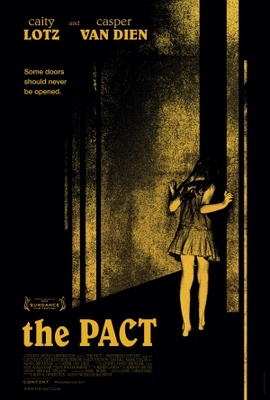
Another horror film that works because it starts out as one thing and then surprises us by becoming something different. A modern haunting story with plenty of secrets to share with us, The Pact offers up a ton of tension and builds to a eye-popping final act that completely threw me for a loop.  In fact, it took me a second viewing before I was really able to wrap my head around what The Pact was implying - not because the film was confusing, simply because the film was so unique and new to me that I had to make sure what I saw was real.  This reminds me a lot of Ti West's The House of the Devil, and that's my favorite horror movie of the last decade - so that's a good thing.

Number 4 - The Aggression Scale
(Directed by Steven C. Miller.)

There's probably only one other film on this list - and it's coming up at number one - that has as much fun with brutal violence as The Aggression Scale does.  Comparisons to Home Alone (seriously!) are inevitable, but this wacky flick in which a mute psycho kid faces off with a team of criminals on a country estate is a lot more than a R-rated Tom & Jerry film.  Dana Ashbrook and Derek Mears lead the film as two of the baddies, and young Ryan Hartwig's turn as the aggressive teen would make Rambo jealous.  This is the guys' night horror film of the year.  Director Steven C. Miller followed this up with the recent remake Silent Night, cementing himself as a director to watch out for in the future.

Number 3 - Lovely Molly
(Directed by Eduardo Sanchez.)

The most haunting film of the year has to be Lovely Molly, in which newcomer Gretchen Lodge sets the screen on fire with a fantastic performance. (Side Note: There's no questioning the fact that 2012 was won, hands down, by women in horror films. Lodge, Annalynne McCord, Elizabeth Olsen, and Anna Ishida all gave performances that are among the best I've seen in modern horror.  Neil Maskell did too, but he's outnumbered by the ladies.)  Director Eduardo Sanchez, who helped create The Blair Witch Project, balances a lot of different elements and builds to a finale that shook me up and stuck with me for several nights after I saw the film. Play this one as a double feature with The Pact and try to sleep - I dare you.

Number 2 - Some Guy Who Kills People
(Directed by Jack Perez.)

Written by Ryan Levin, a veteran of TV's comedy/drama Scrubs, Some Guy Who Kills People feels to me like a slasher movie by way of Wes Anderson. I kind of want to hug this movie, because it manages to go all serial killery while still making me both laugh at and relate to the characters that I'm watching.  A marvelous cast - from star Kevin Corrigan to comic supports Barry Bostwick and Karen Black to child star Ariel Gade - does the script justice, and a late film twist establishes the film as a story with a worthwhile message. This might not be the "hardcore" horror film you'd expect from the title, but it's one of the most rewarding movies I've seen in a while.

Number 1 - The Cabin in the Woods
(Directed by Drew Goddard.)
I legitimately feel bad for the other films on this list. I really think most of them are great and I wished some of them could be number one - but that's just not an option this year. To me, The Cabin in the Woods is a truly one-of-a-kind addition to the horror genre; a film that actually supports everything horror fans love about the genre while shaking our expectations and pointing out all the flaws in the horror system. There's simply nothing I could say to convince myself that The Cabin in the Woods wasn't head and shoulders above everything else the horror genre had to offer this year, as great as much of it was.
(Full Review)
-------------------------------------------------------------
I've had a few debates about whether or not 2012 was a banner year for horror as the year wound to a close, but now that I see this list...I'm a little stoked about the films of 2012 and what they offered horror fans.  There have been a lot of different horror movies for a lot of different crowds, and a lot of them offered new and entertaining stories to horror fans.

Agree with the list? Have favorites you wish were mentioned? There's a comment section below; you know what to do.

December 28, 2012

Midnight Movie of the Week #156 - Stephen King's The Night Flier

When the discussion turns to Stephen King's best pieces of writing, The Night Flier is not generally a title that gets mentioned.  I've never read the short story, which was originally published in 1988 as part of one of the authors' many anthology books, yet the 1997 film adaptation of the story has long stuck in my mind as a chilling example of King's ability to tell a scary story.
Like many King tales, The Night Flier focuses as much on its flawed human characters as it does on any supernatural force. In the film, cynical tabloid reporter Richard Dees (a character who briefly appeared in King's novel The Dead Zone) sets out to chase down a serial killer who flies around the Northeast in a black Cessna plane and leaves a bloody trail that suggests vampiric tendencies. The cape-wearing aggressor - who goes by the name Dwight Renfield, which is called out as a reference to Dracula - is the instrument that sets everything into motion, but the slimy reporter is what really draws me in to the film.
Dees is played by Miguel Ferrer, an actor who has done reprehensible and narcissistic a few times in films like Robocop and Traffic.  The character isn't that much different from what we've seen from him in other films; what is different is that we're stuck with him.  This is a man who will manipulate any situation to fit his needs - whether that means defacing a grave or trapping a competing reporter in a closet - but he's also the closest thing to a hero the story will offer us.  We've seen King do this before - Jack Torrence from The Shining is probably the most famous example, though Dees' character arc seems closer to that of the lead character in Thinner - and once again he doesn't seem to care whether or not the audience likes the guy who may or may not get eaten by an aviator vampire.  King's universe is not a place where a story needs a good guy, and Ferrer is a perfect bit of casting in that universe.
Another thing working in the favor of The Night Flier is the source material. King's prose may be best when the author is allowed to go on for hundreds and hundreds of pages, but it's hard not to argue that the best film adaptations of his work come from some of his shorter tales. The Night Flier is an incredibly simple story, and there's a part of me that's surprised it wasn't whittled down to a half hour for something like Tales from the Crypt.  The film gets to 90 minutes by adding a female character who serves partially as a competitor and primarily as a sounding board for Dees' cynical rants, but it doesn't feel like this is just padding to the film. This is a tight horror film that really doesn't waste a moment as it shows us Dees' investigation and leads us toward the answer to his questions.
When The Night Flier answers those questions it makes sure that everyone is glued to the screen. In fact, I might argue that the sequence that starts with Dees finally catching up to the title character is one of the most gripping pieces of horror filmed in the 1990s. The last 20 minutes of the film feature gory moments that make us cringe - including the reveal of some awesome creature effects - and at the same time offers a chilling black-and-white sequence that feels like something out of a moody horror film from decades gone by.  Some King stories feel like they lose their way as they try to finish up their story - when they end with a random giant spider, for example - but Night Flier feels like everything wrapped up perfectly in this final sequence.
King may be best known for his epic tales of horror and fantasy, and it's hard to argue against that when it comes to his writing. But when I look at the film version of The Night Flier, despite the fact that it's a film with one interesting character and very little action before things go off the rails in the final act, it seems to me that this is a great example of how King's smaller works can make effective 90 minute horror films.  The Night Flier is entertaining because it's such a simple story and because it isn't as ambitious as some King epics. This is the story of one cynical man and one serial killing vampire, which means that the acting of Ferrer and some wonderful special effects are all it really needs to make the film work. It doesn't compare to reading Needful Things, but it's a fun horror flick that should make the author proud.

December 21, 2012

Midnight Movie of the Week #155 - Black Christmas

As Samuel L. Jackson would say, "When you absolutely, positively, have to have a Christmas themed horror film where a creeper kills every mother in the whole damn sorority house...accept no substitutes."

There are arguments to be made against Black Christmas. I know, I've made plenty of them before. Us horror fans find a lot of ways to get our knickers in a twist, and one of our favorite arguments is about whether or not John Carpenter "ripped off" this film when he made Halloween. If you know me - or if you just read things I write - you probably know that I'm mad in love with Halloween. So when people start to accuse it of stuff, I start to point out every little thing I can to prove them wrong. Is it juvenile? Probably. But it's fun too.
Since Halloween has been first and foremost in my horror lovin' heart for a long, long time, I've always approached Black Christmas with a skeptic's eye.  While I'll never admit that it's a better piece of work than Halloween, I have to say that each viewing has shown me more and more about how effective Bob Clark's proto-slasher can be. 
Capitalizing on a fantastic setting - a sorority house full of the kind of coeds you only found in the 1970s - Black Christmas could also be seen as an precursor of the 1978 horror hit When A Stranger Calls.  The few girls left in the house, led by the oft-drunk Margot Kidder and the timid-but-also-knocked-up Olivia Hussey, are harassed by an increasingly vile prank caller - who (unbeknownst to them) is inside the house, killing people. Like Halloween (I introduced the comparison, might as well roll with it) the characters run through the film unaware of the danger around them.
That's a big part of the twisted fun that can be had with Black Christmas. We see the actions of the killer and learn more about him than the main characters do, but we're still left in the dark about the who and why of the situation.  In the meantime, we follow Hussey around as she whines and talks to her angry boyfriend about a potential abortion and then spends the rest of the film answering the phone and being scared. Hussey's performance might be my biggest problem with the film, because her whiny performance just doesn't draw me in as well as, for example (and since we're already talkin' 'bout it) Jamie Lee Curtis' work in Halloween does.
Black Christmas' lead character might be its biggest problem, but that's a small piece of the bigger picture.  For me, Black Christmas is best viewed as an exercise in tension. Clark toys with the viewer wonderfully throughout the film, specifically when he puts the camera in the eyes of our killer. This would become common practice in horror in the years to come, but there's something very natural and gripping about the viewpoint we have as this killer stalks through the house. We know how sleazy and unhinged this killer is, thanks to the phone calls, and that makes the moments when we see potential victims through his eyes that much more uncomfortable.
I'm not one of those people who think Black Christmas is one of the best horror films of all-time - the only characters who are any fun to watch are the comic relief ones (Kidder, the house mother, the stupid deputy) and there are a few lulls thanks to the police investigation that goes on - but, like Samuel L. said in the opening, you simply can not match this film when it comes to Christmas-based chills.  And for that reason - plus one of the creepiest killers out there and an unhinged and hilarious Margot Kidder - Black Christmas is still worth seeking out when the holiday season rolls and you need your horror fix.