Search this blog and The Mike's favorite blogs!

Showing posts with label Action. Show all posts

September 20, 2013

Midnight Movie of the Week #194 - The Warriors

Any list of the coolest movies ever made is invalid if it does not mention The Warriors. There are few times when I will say that a movie is unquestionably worthy of praise, that the movie's brilliance is an actual fact, but The Warriors is simply cool. There can be no question, from the pulsating montage that opens the film to the final shot that hangs out behind the end credits, that Walter Hill and company made a gangland epic that is without equal.
The trick to understanding just how cool The Warriors, however, is realizing that it's more than just a gang movie. A short sighted viewer with strict morals might look at the film as an excuse to show gang violence and a glorification of the lifestyle. It's hard to argue against that to an extent - the fact is that everyone in the movie is a member of a criminal organization (unless they're a cop) - but it's more important to look at the film's reality instead of our reality. In the film's world, where the late night hours in New York City seem to belong only to the gangs, the only thing that matters is survival. And in that reality, it's easy to start seeing that The Warriors has its heart in a much less sinister place.
If you're unfamiliar with The Warriors - and I'm incredibly sorry if you are - the basic set-up is very simple. All of the "major league" gangs in New York City have agreed to send nine delegates to a meeting in the city where Cyrus, president of the top gang in the city, has something to say. It's supposed to be a peaceful discussion, with Cyrus giving one of the all-time most iconic speeches on film, except that one ornery gang decides they don't like it and shoots Cyrus dead. The ensuing scuffles sees the title gang, a rather vanilla outfit in red leather vests from Coney Island, accused of the murder and having their "warlord" slain, leaving the eight remaining members to try and get home while every gang in the city is ordered to hunt them down by Cyrus' disciples.
If this idea was pitched today, it's hard to see it being made as a film and not a video game. The set up is almost perfect for that medium; starting with a short intro and a crisis that puts the heroes in peril and then allowing waves of opponents of varying skill and difficulty to challenge them on their way to their goal. It makes perfect sense that The Warriors was adapted for consoles by video game giant Rockstar Games in 2005 (it's actually one of the better film-to-video-game adaptations out there), and looking at the film after seeing that game makes it almost impossible for me to not look at the film as a video game movie that was made in advance.
With such a simple premise, it's everything else in the film that Hill manages to make so cool. That really begins with Cyrus, the idealistic Jesus figure whose "Can you dig it?" exclamation has become a pop culture mainstay. The actor who plays Cyrus, Roger Hill, is just one of the relatively unknown actors in the film (there are a few recognizable faces, but the biggest star of the film is probably Where in the World is Carmen Sandiego? hostess Lynne Thigpen as the mostly unseen disc-jokey who advances the plot a few times), but his one-scene performance perfectly makes us accept the film's conflict. Other performances vary in quality - lead Michael Beck seems to spend most of his time standing very still and looking concerned-but-chill, while seedy David Patrick Kelly is perfectly unhinged as the unhinged little gangster who is responsible for The Warriors' plight - but everyone seems to be adequate for their part in the film.
By traditional standards The Warriors probably doesn't measure up to most filmmaking standards, and it's easy to see why critics in its time primarily wrote it off as a failure. But the intangibles that make The Warriors such a memorable and enjoyable film have maintained for nearly 35 years, and now we're at the point where the film is certainly one of the most loved cult films out there. Forget the plot, forget the gang affiliation, forget that the lead is there because of his abs - just sit back and experience The Warriors. You'll be glad you did.

February 1, 2013

Midnight Movie of the Week #161 - The Driver

There are about two things in the world cooler than a '70s car chase movie. I'm not sure what those two things are, but there can't be more than two of them.  Among the coolest of those cool things is an early effort from Walter Hill - the man behind The Warriors, Streets of Fire, and plenty of other totally tubular flicks that I love - known simply as The Driver.  This thing is somewhere between Hitchcock and Fast and the Furious on the continuum of action cinema, working on one hand as a twisty high concept thriller and on the other as a showcase for car stunts and high-speed pursuits.  Most interestingly, at least to me, is that it's also a film with no names.
Ryan O'Neal stars as the title character, which is exactly how his character is credited.  He plays that brand of anti-hero/criminal who doesn't hurt good people that we've seen plenty of times in these kind of movies - the most obvious comparison for most modern viewers is to that flick Drive with Ryan Gosling - a guy who also doesn't ask for details and doesn't fall for a trap easily. He's more of a construct than a character, like the cowboy heroes of pulp westerns gone by, because he operates by a set of principles in everything he does.
The film is meticulous as it reminds us of the character's nameless purity, never stooping to self-referential lows like many modern action flicks do.  You know how a Jason Statham character likes to spout off pre-rehearsed quips about his rules and what he never does? That's not The Driver's game.  Sure, the idea branches off of what Hill's script established here (though this is in no way the first film to pull the detached control monger as hero card), but The Driver is notable because it doesn't allow the lead to preach his code of ethics to the viewer.  O'Neal was apparently a big deal in the '70s, but I wasn't there and I don't really "get" his appeal as an actor.  I'm tempted to say that the actor can be one of the film's biggest flaws during the moments that might suggest character development and require him to speak or emote, but at the same time the actor's skill for monotone and ability to hold a vapid expression while the character is in the middle of high risk situations is one of the film's greatest strengths. You could assume that the casting decision was made for this benefit, and that makes it feel like a slightly genius move by Hill and company.
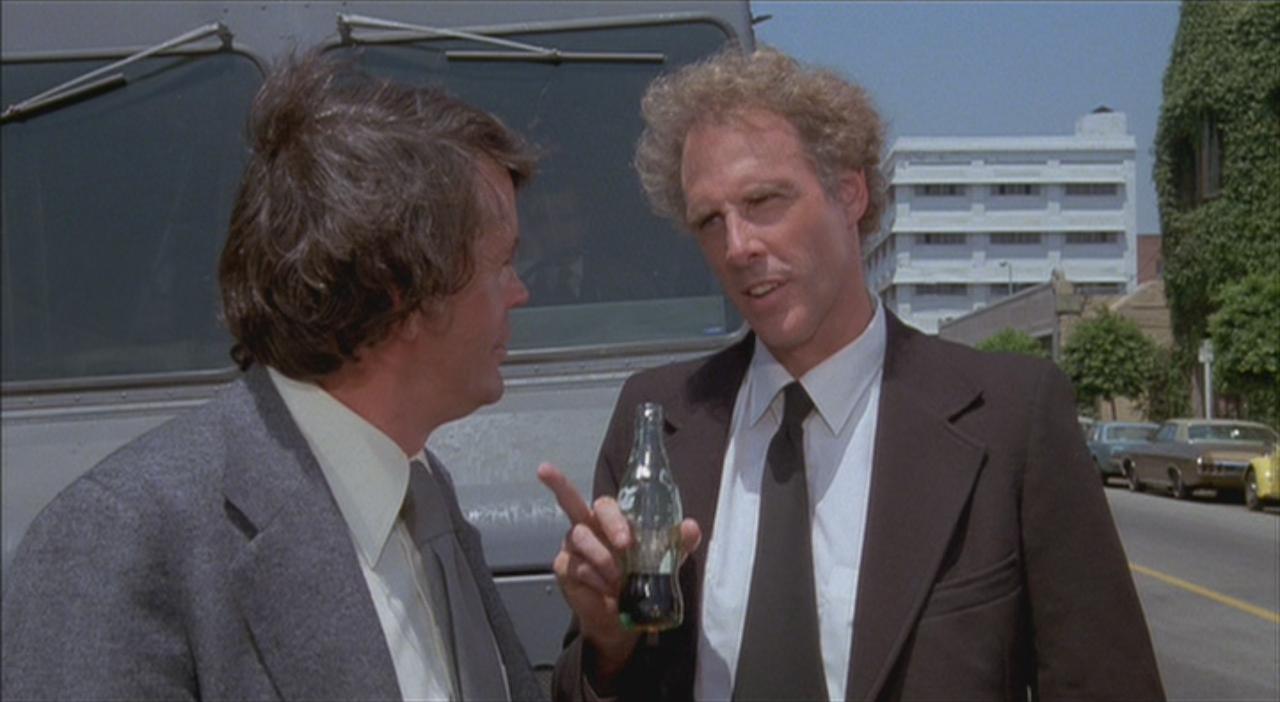
While O'Neal's driver is kept to few words and fewer emotions, the film draws us in completely with the always enjoyable Bruce Dern as The Detective, the primary adversary to the driver.  While dialogue is very limited for our criminal - in fact, a fantastic opening sequence runs over 15 minutes before he speaks - Dern's work as the cop is quite the opposite.  He spouts out his knowledge - mostly from those kind of assumptions that cops always seem to get right in these movies - about the driver often, most effectively when the characters meet.  Dern has always had that kind of sly angst mixed with his everyday appearance, and hearing him tell the driver things like "sad songs ain't sellin' this year" is more than enough to advance their feud through the film. Dern can do pissed-off but in control as well as anyone can, and it's safe to say that the film's conflict would go nowhere without his wonderful performance.
Of course, there always needs to be a girl in these situations, and Hill manages to put two of the most attention grabbing female performers of the era into the mix here.  The stunning Isabelle Adjani, with her dark hair and eyes the size of Kansas, is what the credits refer to as The Player, while Ronee Blakely - known to most horror fans for her drunkenly fascinating performance in A Nightmare on Elm Street - is The Connection.  Adjani gets plenty of screen time as the kind of yin to the driver's kind of yang, while Blakely's supporting turn is key to the film's final heist and leads to one of the film's most artistic and grabbing moments at the end of her final scene.  These characters seem like they walked right out of a '50s film noir offering, and they team up with the rest of the bit players to give the film a poetic depth that pushes the film above simple car chases and cops-and-robbers cliches. Nothing here is groundbreaking or unique - the fact that all of the characters can be summed up by their role in the plot is not a joke, it's a truth - but there's a good chance the viewer will be impressed with how well the parts of the puzzle all fit together.
The Driver is one of Hill's most abstract and cinematic works, the kind of straightforward, no frills action film that only could have existed in the 1970s.  It would make a fantastic double bill with John Carpenter's second film - the gang war epic Assault on Precinct 13, because both films seem like a case of a director showing off how much he can do with the simplest of ideas.  Hill would rise to greater commercial success in the following years - The Warriors opened a year later, and he soon was behind the camera for bigger projects - but The Driver remains as a cool piece of the '70s that's worth revisiting. In cinema, less is often more, and The Driver reminds us of how true that statement can be.

January 9, 2013

Crawlspace

(2013, Dir. by Justin Dix.)

A bizarre mixture of gore and the supernatural, Crawlspace is a film that wants to be profound without ever stepping off the gas pedal.  The film is packed full of screaming and gun shots and an oppressive musical score, and the whole thing just felt abrasive to me as it went on.  This is a real shame, considering the film's intriguing set up.

Crawlspace follows a group of soldiers who are sent in to a military base in the Australian desert, a base in which we find there are few survivors to be rescued and a mess of dead bodies in the (you guessed it) crawlspace between sciencey examination rooms.  The most important of the survivors is (naturally) a woman, and we soon learn that she's got some unique powers that are more than meets the eye.

The idea behind the film - that this government testing facility was a training ground for weapons of psychic warfare - is far more interesting than the bombastic method with which it's presented.  Though it's not based on any specific truth, the film's insinuation that governments may try to harness preternatural powers like mind control is no myth.  There are plenty of reports of "psychic warfare" in the real world, taking place everywhere from Nazi Germany to the modern United States.  You know that scene at the beginning of Ghostbusters where Bill Murray tries to get the nerd and the hot girl to guess shapes on cards? That stuff really happens, and the government spends millions on it so they can build a force of psychics to get an edge on the Russians or whoever else they don't like.  For serious.  Read The Dead Roam The Earth, which I just reviewed a bit ago, and there's a whole chapter on it.  Or just Google "psychic warfare" or "remote viewing" and look at some of the crazy stuff out there.  (And, if you're an American, remember that your taxes are paying for it.)

Crawlspace taps into this and goes a little further, as the woman at the center of the plot - Eve, played by Amber Clayton - is capable of a little more than just clairvoyance. The most interesting parts of the film come in the final act as Eve's abilities are tested and challenged, both by the overseeing scientists and the crew of soldiers that have come to save them, particularly one man who she may or may not have had a previous relationship with.  Clayton is a stand out when she's empowered in the role, and there are plenty of memorable moments dealing with her abilities as the film builds to its finale.

Unfortunately, most everything else in the film feels muddled. The crew of soldiers seems like a direct photocopy of the kind of characters we've seen in plenty of films since Aliens, and the science side of the plot offers little of interest outside of the ideas regarding psychic warfare.  The film is packed full of violence and there's rarely a lull in the action, but I got tired of this rather quickly. The film doesn't look like anything special either, with the crawlspace's lighting not creating any mood and some special effects failing to impress at all.

Crawlspace is a perfectly fine way to waste 90 minutes if you're looking for shouting, action, and a dose of science fiction, and I don't think the film does anything too poorly. But it also doesn't really seem to stand out much, aside from the few great moments in Clayton's performance. Crawlspace is a high concept genre hybrid that has plenty of great thoughts, I just wish it had done a little more with a few of them.

Crawlspace is currently available on VOD and in select theaters via our friends over at IFC Midnight. Feel free to check out more about the film over at their site or on Facebook, and don't forget to check out the trailer below.

September 28, 2012

Midnight Movie of the Week #143 - Runaway

If you have a thing for robot bugs and mustaches, then there's never been a better movie for you than Runaway.  Fresh out of the Tom Selleck era of the 1980s, this is the tale of one cop, one terrorist, and a rogue's gallery of defective - or, as the title says, runaway - robots.  It's the kind of film that only the '80s could produce - complete with bad hairstyles, surprised topless women, and a hero who is unflappable in every way - that also borrows heavily from things like Alfred Hitchcock's Vertigo and The Jetsons.
Magnum P.I. The Guy Who Passed on Indiana Jones Tom Selleck stars as an incredibly manly police officer with a mustache Jack Ramsey, who knows more about robots than anyone else.  He used to be a normal manly cop, until he developed vertigo (and you gotta wonder if that's gonna come in to play later on....) which led him to embrace the challenges of dealing with robots that go awry in cornfields and construction sites and other harmless places.  But fate has its eyes on Jack and his new partner/love interest (played by the future Mrs. Richard Marx, Cynthia Rhodes), who soon find themselves dealing with the first homicide committed by a robot. Apparently somebody didn't teach Asimov's three laws.
That somebody comes in the form of criminal Charles Luther, played by a bare-faced Gene Simmons, who's both a) incredibly smart and b) cheesy enough to claim he's with 'Acme Robot Repairs' at one point.  The KISS legend is certainly trying to distance himself from his well-known persona here in his first big screen role.  The musician would go full terrorist later in the '80s, when he co-starred with Rutger Hauer in Wanted: Dead or Alive, but here he plays a little more like something out of a cartoon, complete with his army of robots that includes some six legged metal freaks.
The set up sounds pretty comical, and as I look at the film now - compared to the way I looked at it in the late '80s when I was a kid - it's easy to see how silly Runaway is.  Writer/director Michael Crichton - yes, that Michael Crichton - would direct only one more feature after this one, and comparisons between this and his debut masterwork Westworld show that time wasn't too kind to Crichton as a director.  While that film worked sly comedy into its gripping tension, this one feels a little more like a running inside joke on the audience than a tense thriller.
Of course, the thing any child of the '80s who experienced the film will first mention about Runaway is Luther's army of killer robot spiders. Even though they clearly have six legs, the film repeatedly refers to them as spiders.  I never noticed this until tonight, and I have to admit that it really bugs me right now. (And I apologize for that unintentional pun.)  But when I get past that realization, I can still see just how much those robo-spiders made my skin crawl when I was a kid.  A sequence in a public restroom has one of the metal creepers sneaking under a bathroom stall, and that image always kind of made me queasy.  And then there's the finale, which involves a construction site and an elevator and several of the metal buggers, which is still pretty tense thanks to the ominous robo-spiders.
Runaway won't win a lot of awards for depth or power, but it's still a pretty cool piece of '80s action with a goofy sci-fi kick thrown in.  Do you have to be from the '80s to get it? Maybe you do.  I mean, you probably don't have to be Marty McFly and actually travel from the '80s, but maybe you had to be there for Magnum P.I. and grizzled cop movies and that robot from Rocky IV.  You probably have to be younger than those old people who watch Selleck in those Jesse Stone movies too.  But there's a niche that should appreciate Runaway, and I'm glad I can be a part of it.  Because robot spiders are awesome.

September 24, 2012

Dredd

(2012, Dir. by Pete Travis.)

When I heard that a new Judge Dredd film was on the way a while back, my initial reaction was something along the lines of "That's freakin' weird, man!"  The British comic icon has been around since 1977, but remains relatively unknown to most.  In America, the character is most recognizable from a poorly received film from 1995, in which Sylvester Stallone took on the lead role and growled about being the law.  To be honest, there are some people who were teenagers in the mid-90s (myself included) who will argue that the Stallone film is a blast for all the wrong reasons.  But fans of the character wanted more, and now they have it.

A new story with no ties to the previous film, Dredd lets Karl Urban - whose face would be recognizable from The Lord of the Rings and Star Trek if the film would show it - put on the trademark uniform of the Judge and re-introduce viewers to the world of Mega-City One.  Opening narration explains how most of the United States has been eradicated and now exists only as "The Cursed Earth", while hundreds of millions of people are literally stacked into these mega-cities.  Dredd and a rookie Judge - the less scary-named Anderson, played by Juno's Olivia Thirlby - end up traveling into one of the mega-structures in the mega-city when some drugged-up bodies get thrown down 200 stories and splatter in a courtyard, and the fun picks up from there.

(I suppose this is the point where I should point out that the premise is eerily similar to this year's new action sensation, The Raid: Redemption.  Many have cried foul - or harsher things - as they see two movies about high rise buildings and a gauntlet of battles released months apart, but there's no rip off here in my eyes.  I loved The Raid, but I'm not going to let that stop me from enjoying a movie that happens to have a similar set. OK?)

Inside the building we find a pretty standard future gang, filled with miscreants and dirty faced people (at least by sci-fi movie standards) and led by a disfigured ex-prostitute/drug lord known simply as Ma-Ma.  She's played by Lena Headey, of 300 and The Sarah Conner Chronicles, and her drug of choice is a new future concoction called "Slo-Mo".  This drug, administered through a simple inhaler, slows the user's body down to 1% of real-time - that's not a joke, the movie actually says it - which allows for several annoying shots of things moving really slow and sparkling and looking incredibly goofy when compared to the rest of the gritty action film.  These slow-motion scenes are overused early in the story and hurt the film's charm, but the director smartly pumps the brakes on this until the right moment in the final act.  In fact, that final moment of Slo-Mo action kind of made the whole thing worthwhile.

The rest of the film is Urban and Thirlby making their way through the 200 story tower, which means a lot of Urban growling one word sentences from beneath his trademark helmet - unlike Stallone, the actor stays true to Dredd lore and never removes his headpiece - and a lot of Thirlby being the unsure and human piece of the puzzle. The rookie judge - helmetless due to some psychic "powers" that the film uses to escape from plot holes - doesn't feel like an add-on, and actually overshadows the mostly-silent title character in regard to the film's plot.  The performance won't win many awards, but it's noteworthy that this miniature girl stands tall in a brutal movie about the future's Dirty Harry.

If you're just here to see a guy dressed as Judge Dredd being snarky and blowing people up, you're going to get that too.  Urban never wavers as he portrays the antihero with a one-note tone of cynicism. He also carries his Lawgiver weapon - a cool future tool that the film plays with wonderfully - with poise, and he fills the costume quite well.  This isn't the most demanding role from a physical standpoint - unlike many modern action films, hand-to-hand combat is almost nonexistent - but Dredd still looks and acts like someone I'd be scared to meet in a back alley if I'd done something naughty.  And it's nice to see a film that still relies on good old fashioned guns instead of choreographed dance fighting.

Fans of blood splatter should find everything they desire when it comes to the action.  Shot in 3D - though I, out of spite for the gimmick, watched the 2D version - there's plenty of computer generated arterial spray that is designed for a full "in your face" effect.  There's still plenty to see without the 3D, with the most impressive sequence coming near the finale as Anderson and Dredd shoot their way through a lot of nameless assailants.  The film moves at a manic pace, and if you blink you might miss some of the carnage. I commented after the film that it felt like the shortest movie I've ever seen, and I was surprised to find that it ran 95 minutes when I checked after the showing.

Dredd meets its simple goals, staying true to the established character while providing a modern edge to the gritty action plot.  I wished that there was more of a focus on the science fiction aspects of the story, but at the same time I realize that more exposition would have killed the pace the film was going for.  While the story could have focused on being an origin story, like we've seen so many times before in the comic adaptation world, it seems like director Pete Travis and writer Alex Garland decided to throw caution to the wind and put everything on the line for one high-octane bullet storm.  It worked for me, and I think anyone looking for a bit of popcorn violence should enjoy this Judge Dredd tale.

July 12, 2012

Midnight Movie of the Week #132 - Emperor of the North

Sometimes, the measure of a great actor is how well he or she can play against our expectations.  Like, when a guy we know as a comedic buffoon plays a sensitive poet or when a romantic comedy veteran plays an angry stripper.  Taking roles that are against type doesn't automatically make you awesome - if that's how it worked, Elizabeth Berkley would have all the Oscars for shedding her Saved by the Bell image (and all her clothing) for Showgirls.  Extenuating circumstances stopped that scenario from happening - plus she was never exactly Meryl Streep Jr. in the first place.
If we're talking about times when great actors (i.e. - not Elizabeth Berkley) surprised us with their range, we might talk about Emperor of the North.  Or at least I might.  In fact, I've been meaning to talk about this movie for a long time, and it's with a heavy heart that I finally bring it up now, just days after the death of its star, Ernest Borgnine, who has long been one of my favorite actors.
I first took notice of Borgnine, like many genre fans, when he appeared as the endlessly lovable Cabbie in John Carpenter's Escape From New York.  I was certainly late to the party, as Borgnine had been working in TV and film for thirty years when that film was made and closer to fifty years by the time I saw the film.  I'm positive it wasn't the first film I saw that featured the man, but it's definitely the first time I remember taking notice of how good the actor was at his craft.  And as I looked into his earlier films - including true classics like Marty, for which he won the Best Actor Oscar in 1955.

(Fun Fact: To win that Oscar, Borgnine beat a field of competitors that included no less than James Cagney, Charlie Chaplin, Frank Sinatra, and Spencer Tracy. An impressive - and well deserved - feat.)
Borgnine took on several villainous roles - in fact, he opposed Tracy in Bad Day at Black Rock the same year he won his Oscar - but I still generally saw him as a charming grandfather figure who makes me smile when he shows up in any film.  Which makes his work on Emperor of the North that much more impressive.

The film, set in 1933 and the height of the Great Depression, features Borgnine as a sadistic train conductor, known only as "Shack" to both his colleagues and the hobos who fear him.  No punches are pulled in creating this character, as the script calls for Borgnine to brutally beat a man with a large railroad hammer before the opening credits make their way to the screen.  Several of the down-on-their-luck types who populate the film speak of Shack as a mythical villain.  One of the characters even opines with fear that "Shack'd rather kill a man than give him a free ride", as if the character is completely devoid of a soul.
And that's where the surprise I mentioned earlier comes into the film. The script can say whatever it wants about Shack, but only the right actor can make us believe what we learn about Shack.  And - as you can probably guess by now - Borgnine does not disappoint.  There's an intensity behind the man's eyes that comes from a scary place.  It's kind of like that first time a kid sees their parent really angry, and feels like they're seeing an entirely new person, or like that scene from Monsters, Inc. when Boo sees Sully in scary mode.  Borgnine smirks and sneers and almost seems to get a rise from the violent attitude he shows on screen, and it's a complete change from what I used to expect from the jovial actor.
The performance works even better opposite granite faced tough guy Lee Marvin, who does not play against type in this role.  Another past Oscar winner, Marvin plays the cagiest 'bo (that's Shack-speak for hobo, naturally) on the rails, who makes it his goal to ride Shack's train despite the legends of cruelty that precede the railman.  Marvin, covered in dirt and sporting impressive whiskers, is the perfect foil to our snarling madman who has no real motivation for being so vicious.
In fact, it's that lack of motivation (along with some fun asides and a bit of perspective on the culture of that time period) for both characters that really pushes Emperor of the North into a special place.  Shack and his opponent are driven by little more than a desire to be the best at what they are.  Some would say that the hobo is riding for his survival - an idea that is referred to on an opening text that explains the railroad hopping hobo of 1933 - but most scenes that show Marvin's character off the train present a man who is relaxed and care-free in the moment.  My interpretation of the film has always been that this is a battle for supremacy, pure and simple - especially when you realize how little Shack really has on the line in regards to one stinkin' hobo and his tagalong (a young and raw Keith Carradine, who misses a few notes) catching a ride to Portland.
Emperor of the North has all the makings of a fun '70s flick, balancing the line between drama and grindhouse expertly.  But it's these performances that really make it something unique.  I've never seen Ernest Borgnine like he is in Emperor of the North Pole, and this brutal outlier serves as a great example of how seriously the man took his craft.  Shack is a bad, bad man - and Ernest Borgnine isn't going to let the fact that we all think he's the sweetest old man on the block stop him from becoming one of the era's most deadly villains.
R.I.P, Ernest Borgnine. Thank you for the memories, and know that I - and many others - have found great joy in your works. We will miss you.

May 5, 2012

The Avengers

(2012, Dir. by Joss Whedon.)

My mission, should I choose to accept it, is to convince you that you should see The Avengers.  It's one of the easiest missions I've ever had, and one of the most difficult missions I've ever accepted.  I'm sure most folks out there see ads for a movie that throws a bunch of super heroes who have won big screen acclaim into a blockbuster-building-blender and think something to the effect of "Well, duh, I'll see that." Those people have my eternal respect.  But there are some other folks out there who look at The Avengers and see a comic book cinema vending machine and think something like "Man, there can't be anything substantial in such a convoluted concept". I dig those folks too - the skeptic always has something good to say, no matter how crazy - but I aim to convince them that they are dead wrong.

I have to admit, I was almost one of them skeptics.  I adore comic book mythology to a fault, and have dug at least 87% of the Marvel adaptations to come down the pipeline in the past decade. (Even Daredevil. I regret nothing.)  But I was really unsure that The Avengers could hold the weight of Iron Man, Captain America, Thor, The Hulk, and friends without falling apart and slipping away from the filmmakers.  Really, the whole project needed its own hero. When cult icon Joss Whedon - the dude behind Buffy The Vampire Slayer, Firefly, and plenty of other nerdy favorites (Like The Cabin in the Woods, which is now my second favorite thing I've seen in theater this year) - took over the project, I should have put my doubts to bed.  But I had to see it to believe it.

Now that I have seen it, it is certain in my mind that Joss Whedon is the true hero of The Avengers.  His script, which is filled to the brim with scenes that are honestly hilarious, is also incredibly faithful to the heroes as they've appeared in the comics and films that led to this point.  I really didn't know how someone could make all these characters fit together in one place - you are mixing Asgardian demi-god with 1940s soldiers and billionaires with fancy toys, after all - and anyone with a passing knowledge of Avengers comics knows that personality clashes are par for the course with Earth's greatest heroes.  Whedon deftly handled each character with this in mind, using the differing personalities to create a lot of humorous interactions that build the characters while keeping the audience engaged in a lighthearted manner.  In a great way, Whedon even manages to turn some jokes, like a modern SHIELD agent's "fanboy" love of Captain America, into dramatic events that advance the plot.  And he does all this comedic styling - I honestly can't remember the last time I've laughed so much in a theater - while keeping the action going and making a 140 minute film fly by the viewer's eyes in a flash.

Whedon's masterful ability to bring a bunch of legendary heroes together in one film wouldn't work if the cast didn't meet or exceed the viewers expectations, and pretty much everyone in the film is on top of their game.  Robert Downey, Jr., Chris Evans, Chris Hemsworth and Scarlett Johansson all reprise the roles they held in Marvel's latest wave of superhero films (Iron Man 2, Thor, Captain America: the First Avenger), as does Jeremy Renner, who expands his Thor cameo as Clint Barton (Does the film ever actually call him Hawkeye? I don't think it did.) into a pivotal role in the plot here.  Samuel L. Jackson and Clark Gregg return on the SHIELD side, alongside newcomer Cobie Smulders of How I Met Your Mother, on the side of SHIELD, the agency who brings the group of heroes together.  Everyone is right back on track, picking up where they left off in the previous films, which means Downey chews up the scenery, Evans looks heroic, Hemsworth hams it up with a chiseled jaw, and so on.  But none of them are the most impressive returning cast member.

That honor has to go to Tom Hiddleston, who returns as Loki to play villain to not just his half-brother Thor - but to all six Avengers.  It's a gigantic task that worried me as I watched the film coming from a distance.  I wasn't that impressed by Hiddleston's Loki in Thor - the best thing I had to say about him in my Thor review was that he was "serviceable" - but his power-hungry turn as the man who may destroy Earth here is really fantastic.  The London born actor manages to be physically imposing, despite his diminutive stature, and it's pretty easy to buy into him as the God of Mischief (with a Zod complex) from his first appearance in the opening scenes.  He's aided by an alien force - make sure you stay through the end credits for more info, as is common for Marvel films - but the film doesn't feel like it needs anything more than this one well-drawn villain to make us feel like the world needs heroes.

The biggest winner in the film, however, is the hero who's played by a new face to the Marvel universe.  Dr. Bruce Banner and The Hulk - formerly represented by Eric Bana and Edward Norton and a bunch of CGI creations - are now represented by Mark Ruffalo (and some more CGI) and are better than we've ever seen them on the big screen.  Ruffalo plays the scientist Banner with a nerdy charm that's kinda pitiful, but kinda charming, and interacts very well with his peers, particularly in some science lab interactions with Downey's Tony Stark.  Though Ruffalo's banner is sufficiently nerdy - this is the closest anyone's been to recreating the beloved/pathetic Banner character that Bill Bixby portrayed on the famous TV show of the late '70s (I so wanted to hear the lonely man theme with Ruffalo's character) - it's his Hulk form that really steals the film.  Once "the other guy" is released in this universe there is no turning back, and a combination of breathtaking choreography and fantastic special effects make this Hulk the best visualization of the character that's ever been seen.  Though the film's final battle sequence showcases all of these heroes, everything really boils down to Hulk smashing things - and he does so in an incredible manner.  This is his movie, the rest of our heroes are just living in it.  (Also living in it, and making my nerd face smile? Harry Dean Stanton.  You'll see why.)

With very few missteps - I wanted a little more Thor because I didn't feel he was used as well as he was in his own film, that's about the only quibble I had with the film - and so much humor and action and so many general awe-inspiring moments, I can't complain at all about The Avengers.  Heck, I want to see it again right now.  It's the prototype for what a summer blockbuster should be, because it's written for nerds by nerds and is still incredibly accessible to any filmgoer.  Heck, this is more than what summer movies should be....this is what movies should be.  Don't miss it.

April 15, 2012

Lockout

(2012, Dir. by James Mather & Stephen St. Leger.)

I'm willing to bet that Lockout will not be one of those sci-fi movies whose DVD comes with a bunch of comments from scientists and "experts" about how they made the science "real".  It's pretty evident throughout the film that filmmakers James Mather & Stephen St. Leger - who were working on their first feature from a story by action maestro Luc Besson - didn't care much for bringing scientific realism into their film.

Astrophysical properties and things like the law of gravity are just some of the real world concepts that are thrown out the window in Lockout, a rather thoughtless action film that takes "check your mind at the door" and runs with it.  Y'all should know by now that I'm far from the most discriminating viewer in the world, so it's little surprise that I'm cool with that mindset.

Lockout takes on the Snake Plissken formula, sending a badass dude named Snow - played in a surprising turn by generally serious thespian Guy Pearce - to a maximum security space prison where the President of the United States' daughter (Lost's Maggie Grace) has become a hostage to a rioting prison populace of killers and madmen.  Unlike Plissken, we get a lot of background into just why Snow is a fugitive and how he's getting to Space Station Shawshank (my name, not theirs), though Snow's background is really never developed outside of a title card that conveniently lists him as "Ex-C.I.A."

Pearce's dialogue consists entirely of one-liners and sarcastic quips, all of which he delivers in an exceedingly dry manner.  It's slightly tedious, but it fits with the ridiculous premise and fast-paced story.  The hero's tone is a departure from silent heroes (think Jason Statham in the Transporter films) or mature professionals (Liam Neeson in Taken) that have filled other Besson-scripted works of the last half decade, and I think some audience members will be put off by the smug hero.  The rest of the cast is pretty standard: Grace does damsel in distress with an edge, European dudes with tattoos and scars do villains, and Snatch's Lennie James and Fargo's Peter Stormare play the cops dealing with Snow.  None really stand out in positive or negative ways.

The biggest problem with Lockout is probably how carefree the whole thing feels, bouncing from one plot turn to another with ease and never really taking any kind of time to make the film feel like something anyone should be invested in.  It's not violent or bloody enough to hit a cult cinema home run either - this film absolutely must have been neutered down to a PG-13 by the studio, even leaving an exploding head on the cutting room floor.  It's about 100 minutes of Pearce being smug, people getting punched and shot, and ridiculous set pieces that involve space battles and people going out airlocks. That's all it is. 

When I look back on that last sentence, it's easy to see why I had fun with Lockout.  It's a mindless action flick with a successful lead that looks really good.  It has absolutely no depth and will drive people who judge movies based on whether or not they could happen in the real world mad with anger, but it's a formula film that achieves its goals.  I don't recommend going out of your way for Lockout, but it's probably worth a rental. 

March 24, 2012

Midnight Movie of the Week #116 - The Most Dangerous Game

I'm willing to bet you had to read this story when you were in school.  And, if you were like me, you probably thought it was pretty awesome.  I mean, when you're 15, who doesn't think having a private island where you can hunt your enemies and have servants is an awesome idea?  I know I did.
Even better, the "Language Arts" textbook had pictures along with the story, which I later found came from a 1932 film adaptation of the story.  Produced by the mega-duo of Cooper & Schoedesack - the same dudes who were behind a little flick called King Kong a year later - this brief vision of Richard Connell's fantastic story is one of the most perfect examples of early Hollywood adventure done right.
Tall and heroic leading man Joel McCrea takes the lead as a famed big game hunter who is shipwrecked off of a secluded island.  Once he arrives on that island, he meets an eccentric fellow with wacky hair and a piercing stare, who goes by the name of General Zaroff.  During conversation with Zaroff and his other shipwrecked house guests - a brother and sister played by future Kong co-stars Robert Montgomery and Fay Wray - Zaroff hints about the "Most Dangerous Game" that has fulfilled his thrill-seeking ways.  Soon enough the reveal comes - Zaroff has set traps for ships so he can hunt men on his own private island.
Hunting people has become a common topic in fiction over the years - usually sensationalized with a social message by things like The Running Man or Battle Royale or that Hunger Games thing that's so hot right now - but it's worth noting that The Most Dangerous Game speaks more about human nature than it does about society.  General Zaroff is what we would call a madman, but there's no society to be found at his private resort, unless you count his impressively hairy staff of servants.  When Montgomery's alcohol-enhanced character asks the count to play the piano, he requests that the count doesn't "do one of those highbrow numbers" - and it's as if the character is speaking about the film/story itself.
While future tales about killing as a sport point a finger at cultures, The Most Dangerous Game is more than content to let us know that the man on our screen is quite simply mad.  As Zaroff, Leslie Banks is deliciously sinister, giving the kind of performance that seems like a template for cartoon villains that would come later. (I can't be the only one to think there's a common thread between Zaroff and Dick Dastardly, can I?)  There's a wonderful parallel drawn between Zaroff and McCrea's character - whose motivation for hunting must have simply been that he was a big manly man - because the General seems to hunt for intellectual reasons.
In the meantime, The Most Dangerous Game is also notable because it gives my favorite scream queen, the unforgettable Fay Wray, a chance to do her thing while running around elaborate sets island terrain with McCrea while trying to evade Zaroff, his servants, and their packs of hunting dogs.  There's not a lot of great material for Wray here - she's far more memorable in Kong or Doctor X - but it's pretty easy to see just why she was considered for her most famous role after the producers saw her in action here.  The connections it made a year before Kong was born might be the film's longest lasting legacy, though I don't think it's fair to dismiss this as just a set up for the producer's biggest success.
The film version of The Most Dangerous Game will turn 80 years old this September, but it's still an easy viewing that keeps me smiling and involved.  The action is brisk (for the era), particularly in the second half of the film, and the discussion of morals and battle of wits between Banks and McCrea still works.  It's not one of those highbrow things, but it's still worth my time from an entertainment standpoint.  It's also an interesting picture on many historical levels due to its connections with the story and King Kong, and all these factors work together to keep me coming back to The Most Dangerous Game often.

February 25, 2012

Midnight Movie of the Week #112 - From Dusk Till Dawn

The majority of discussions about From Dusk Till Dawn probably start with what can only be described as "the shift".  The shift occurs about half way through the film, and is primarily attributed to the fact that both director Robert Rodriguez and director Quentin Tarantino had their hands all over the production.  Each of the dudes only had two films under their belt at the time, but their trademarks (like Rodriguez' use of Mexicans and Tarantino's foot worship) are evident throughout the film - both before and after the shift.
The shift I keep referring to is that moment when the movie goes from what it is to what it wants to be.  A lot of people have speculated that Tarantino oversaw the first half of the film - which resembles his previous two "guys in suits commit crimes" films of the early '90s - and Rodriguez took over for the blood-soaked, up-tempo second half of the film, in which (I suppose I should say "spoiler alert", but 16 years have passed, dudes) the whole movie becomes a vampire infested siege pictures.  (And you all know The Mike LOVES siege movies.  Seriously, there's nothing better than a good "hanker down and take on waves of bad muddafuggahs" flick.)  I'm not sure how much I believe that the shift was orchestrated in that manner - my money's on the two dudes working together throughout the picture - but it's an interesting way to look at what some could argue is actually an anthology film.
The bigger thing to consider about the shift is how it actually works.  A vocal section of those who talk about the shift just hate the heck out of the split.  They say the movie was so good for the first half and not as interesting in the second.  Or, they say that the second half was so cool and gory and fun, and the first half took to long to get there.  There are people who don't like the film for other reasons - maybe some hate Juliette Lewis as much as I do, maybe some are mad the vampires don't sparkle, maybe there are even some who can't get over how creepy the vampire version of Quentin Tarantino looks - but I choose to ignore them.  Because my theory is that everything boils down to the shift.
Did I mention that the post-shift segment of the film occurs here?
I gotta admit that, even though the second half has water pistols filled with holy water and crossbows and George Clooney making a stakehammer (it's like a jackhammer with a stake on it, which is AWESOME), I'm slightly partial to the pre-shift segment of the film.  A lot of that is due to the awesome opening sequence, which establishes the criminal side of Clooney and Tarantino's characters while pitting them against a Texas Ranger and a liquor store clerk who is played fantastically by a young John Hawkes, who's awesome in a lot of things.  (Random tangent: The ranger, played by Michael Parks, dies in this scene - but goes on to appear in two more Tarantino/Rodriguez films. The Tarantino 'verse is one crazy, scary, interconnected logjam of dead people.)  It's one of the better opening scenes on film in my book, and it always has me ready for From Dusk Till Dawn's wild ride as soon as the first curse word is uttered and the first drops of blood are splattered.
BTW, remember that time when Clooney was just "That guy from ER"?  Yeah, me too.  Doesn't that seem weird in retrospect?  The thing is, I have some pretty vivid memories of it being weird when I saw Clooney - who I'd known as a dude on some snooty drama I'd never watch - in From Dusk Till Dawn in 1996.  From that opening scene through the final shots, Clooney is the alpha male of the movie, complete with gigantic full-arm tribal tattoo and suit jacket with undershirt and greasy hair.  I do recall this being one of those moments when I thought there might be something more to this actor, and I think it's safe to say he's proved himself a few times since.  The rest of the lead cast has mixed results - Harvey Keitel doesn't get enough good material, but plays the calm character well, Tarantino's better off on the other side of the camera, and Juliette Lewis is still the most annoying thing EVER - but the supporting cast provides a lot of help, with fun turns by genre favorites like Danny Trejo, Cheech Marin, Tom Savini and "The Hammer" Fred Williamson (who gives my favorite performance in the film).  Oh yeah, and Salma Hayak's here too (by my count, at least 6 members of the cast have been nominated for Oscars!), but I won't explain why. I'll let a picture do the talking.  You're welcome.
(BTW, despite her picture on the back of Mill Creeks' budget blu-ray of the film, Monica Bellucci is NOT in this film.  Mill Creek fail.)
I think that a lot of people expect more than they get from From Dusk Till Dawn, but I've always dug the film as a whole, the shift and all.  It's clear that Tarantino and Rodriguez are having fun, and there's a visible balance between their styles.  The film isn't allowed to turn into a 150 minute epic with Rodriguez at the helm, and the dialogue has a fantastic punch due to Tarantino's own skills.  The script also throws in a few fun twists on vampire lore, and the comments on vampire cinema is a small gift to horror fans in lieu of many scares.  Gore is also used as a substitute for chills, but there's a playful nature to it - particularly when The Hammer gets to use his mitts on some vampire strippers and an oversized Mexican bloodsucker.
I think it could have been a great crime movie or a decent vampire movie.  Some people think it could have been a action-packed vampire movie but was a boring crime movie.  Some people think other things too.  Dramatic shifts in tone do that to people.  But, for me, it all boils down to From Dusk Till Dawn being a blast to watch.  I can deal with the shift when everything else in the film is so much fun.  Thanks to all the talented folks involved (not to mention a fantastic soundtrack), From Dusk Till Dawn and I always get along - even if it is a little bipolar.

February 20, 2012

Ghost Rider: Spirit of Vengeance

(2012, Dir. by Neveldine/Taylor.)

In a sequel almost nobody - save Nic Cage and some dudes at Marvel who like money - wanted, Johnny Blaze returns to the big screen for another fiery ride.  This time it's called Ghost Rider: Spirit of Vengeance, and it's a sequel that wants nothing to do with its big budget predecessor.  It brings back Cage - mostly because Cage is the biggest Ghost Rider fan alive AND likes money because he has to pay for his burial pyramid - but cuts all other ties to Mark Steven Johnson's bland film.

This time the skullfire-on-wheels action is framed by the duo of Mark Neveldine and Brian Taylor, who previously brought their hyperactive flair to the Crank films and the muddled, yet strangely captivating Gamer (don't hate, I dig it!).   The filmmakers left their mark on those films by featuring "balls-to-the-wall" action that feature no restraint, which made nudity, blood, random psychedelic cutscenes, and other acts of depravity the norm in their worlds.  A lot of people didn't like that about them, but I thought it was a blast - their films are basically video games that were filmed instead of rendered - which makes it slightly frustrating when you realize that Ghost Rider 2 has been edited down for a PG-13 rating.

Without the ability to go all the way, Neveldine/Taylor's film feels a little neutered.  It's particularly baffling too, as this is the second film released under the Marvel Knights banner that previously accompanied the uberviolent, R-rated Punisher: War Zone - a film that featured more arterial spray than most horror movies made in the new millennium.  This Marvel Knights production features a lot more dark moments than the first film did, but there are moments when the film cuts away from what could have been a brutal moment.  Perhaps the studio was worried that the first film pandered to children - which is a strange truth despite the devil-based plot - but I don't think this sequel will sell as well to the young crowd.

There's certainly more grit to this film, as the Rider looks a bit darker and a lot less cartoon-y than he did in the 2007 film.  The action takes on a supernatural tone again - especially when that Ciaran Hinds dude turns one of the bad guys into a creepy undead thing who's supposed to find a kid that might become the Antichrist - and there's plenty of night time battling with the flaming headed antihero doing his thing.  Oh yeah, and you get to see Ghost Rider urinating a stream of flame - if you're in to that kind of thing.

If there's a reason to see Ghost Rider: Spirit of Vengeance, it's certainly the star.  A lot of people are down on the overdramatic Mr. Cage, but he's pretty much my favorite thing Hollywood could do to any movie.  Heck, I once kind of defended that piece of excrement Wicker Man remake because of Cage's overacting.  Truthfully, I was a little disappointed by the lack of Cage Rage in this film.  There was one glorious mid-film scene that allowed Cage to go fully crazy, but there weren't enough moments like it.  In fact, I kinda thought the film was a little backward - the early part of the film featured a lot of Rider and not enough Cage, while the final scenes feature a ton of subdued Cage and not enough Rider.

With the directors' hands tied and Cage somewhat restrained, the whole movie just seems kinda pointless.  It was a fun ride - I'll watch it again before I watch the first Ghost Rider film again - but it doesn't have much going for it outside of the good-looking Eastern European setting and a decent cast (Idris Elba is a fun addition in a pivotal side role, and Violante Placido is nice to look at).  I'm not sure if it will please fans of the comic - I know next to nothing about Ghost Rider, except that Cage loves him - but it's little more than a passable diversion in what is generally blockbuster cinema's offseason.  You shouldn't waste your money on a 3D ticket price, but if you're interested you might have fun with the film as a rental if you really dig Cage Rage.  Even then, you're probably better off watching the more violent and more ballistic Drive Angry anyway.

February 8, 2012

Midnight Top Five - The "Black Action Heroes (or, Blacktion Heroes) Who Deserve More Love" Edition

It's been a long time since I (rock and) rolled out a new Midnight Top Five.  But today I was thinking about some stuff, and - lo and behold - a list popped out of my brain.  Maybe it's because it's Black History Month, maybe it's because a certain film's theme song is permanently implanted in the brain of everyone who's ever heard it (you'll know who I'm talking about), or maybe it's just because this wasn't one of the days when I think about nacho cheese.  The point is it's happening.
Black action heroes (and I absolutely hate classifying people, even as "black" or "white", but for the purpose of this list I'm just gonna say black and apologize to myself and anyone who might be offended now) are pretty few and far between.  And while past decades - especially the '70s and partially the '80s - were full of excellent black actors in excellent roles in excellent films, when you go to Google and look for "black action heroes" you're gonna find boring lists with names like Halle Berry and Will Smith and maybe even Michael Clarke Duncan as an ape in Tim Burton's awful Planet of the Apes film.  Seriously, I saw that on a list of great black action heroes.  And I cried.

Is my list gonna blow the rook off the mothersucker? No, probably not.  But it ain't gonna be that boring.  So let's hit it.
Richard Roundtree - Shaft 
(1971, Dir. by Gordon Parks.)

I know what you're thinking.  Here I am, a dude saying these are blacktion heroes that need more love, and I'm starting with the most famous blaxploitation movie ever; the film that is widely believed to have started it all.  But hear me out on this one.

Shaft came out more than 40 years ago.  It was 1971, and it's still known as the year when Hollywood embraced violence.  Films like The French Connection, Dirty Harry and (to a lesser extent) Straw Dogs, took Hollywood heroes and let them carry guns, shoot the bad guys, and bend the rules of the law as they see fit.  And so did Shaft, the African-American companion to these stars.  
And here's what makes me mad.  Each of the films listed above have had countless releases on DVD and now are all on blu-ray disc, ready for consumption by the modern masses.  But what about Shaft?  Shaft was released on DVD in June of 2000 - because the remake was due in theaters that summer, no doubt - and (aside from two pan-and-scan combo packs with its sequels) it doesn't appear anything's been done to preserve this monumental film since.  Is that OK with you? Well it's not OK with me.  I want my Shaft blu-ray with bonus features NOW.  Heck, there's no reason Warner Brothers couldn't have given this one of their awesome 2-Disc Special Editions years ago.  But, for whatever reason, Shaft and Roundtree get no love from the company behind them.  Is The Man keeping them down? I cry foul.
Fred Williamson - Bucktown
(1975, Dir. by Arthur Marks.)

Fred "The Hammer" Williamson is also not an unknown quantity - his later work in films like From Dusk Till Dawn has certainly helped his star - but a lot of his films from the 1970s have kinda disappeared from the eyes of cinephiles.  

One such film is Bucktown, a simple tale of crime and corruption that puts The Hammer in the middle of a feud with an old friend over "territory" in the title town.  The film's got some neat little turns - the battle changes from Hammer against corrupt cops to Hammer against his oldest friend (played well by Thalmus Rasulala) and a bunch of thugs.  Hammer gets the chance to use all of his trademark skills - from his furious fists to his grinning smile - here, and the result is a film that needs to be seen by a lot more people. (Plus, Pam Grier's in it.  And we all love Pam Grier.  It's science.)
Tamara Dobson - Cleopatra Jones
(1973, Dir. by Jack Starrett.)

Speaking of Pam Grier, she's not the only bad lady who used to get down in the '70s.  In fact, many refer to Cleopatra Jones as the blueprint for female blaxploitation cinema.  It's an uneven film, but what Dobson brings to the screen is a unique presence and a style that's all her own - it's truly one of those things that you can look at and say "Wow, only in the '70s...."

Cleopatra Jones' journey through her film builds to a showdown with an angry Shelley Winters, which is really all you need to know about why you should give the movie a spin.  But Dobson's work can't be discounted, and now that I know that Cleopatra Jones and the Casino of Gold exists (Seriously, why didn't anyone tell me this?!?!) I'm excited to see what else the lady could do as this iconic femme.
Bill Duke - Commando/Predator
(1985/1987, Dir. by Mark L. Lester/John McTiernan.)

If you needed a heavy in the mid '80s and Schwarzenegger was your lead, you called Bill Duke.  And I love that about you.  

A man who's stayed busier as a director than an actor, Duke's roles in these Schwarzenegger epics allowed him to snarl like no one else ever had. He's crazy intense, yet at the same time he's kind of subdued.  He can go toe to toe with Arnold - don't act like that one-on-one battle in Commando isn't amazing - and the Predator, all while delivering manic monologues about his dead friend and chasing down a pig with a knife.  The point is that Bill Duke always makes me smile, and we don't talk about Bill Duke's baddassness enough.
Carl Weathers - Action Jackson
(1988, Dir. by Craig R. Baxley.)

Yeah, y'all know Carl Weathers too.  He was Apollo, he spoofed himself on Arrested Development, he even did this amazingly weird yet completely captivating sense of nonsensical ads that you absolutely can't not watch.  Seriously. Click on that link and behold.  I'll wait here.  Go.  I'm not typing any more until you watch them.  Go now.

......

OK.  Action Jackson.  People hate on Action Jackson, which basically killed Weathers' chances to be a major leading man in an era when he could have taken a place alongside his past co-stars.  But it's not as bad as people make it out to be.  It's got an evil Craig T. Nelson, it's got a young Sharon Stone, and it's got half the cast of Predator (Bill Duke's here too!).  But - most importantly - it's got Weathers chasing down a car on foot and then doing a flip over it.  And that means something.  I adore Weathers, and it friggin' kills me that he didn't get to lead more action movies.  

(Oh, and this one needs a new DVD too!  Pan & Scan is it? Eff you Warner Brothers. Give us a better Cleopatra Jones disc too.  Prove you're not racist.)
-------------------------------------
As you can see, I don't have to dig too deep to find black action heroes who deserve more than they've been given.  And if you're looking for some actiony goodness, you can't go wrong with these folks.  Not because of their race - because they're fantastic at what they do.  Which matters a lot more than skin color.

Plus they can leap over cars.