Search this blog and The Mike's favorite blogs!

Showing posts with label 1980s. Show all posts

December 12, 2013

Midnight Movie of the Week #206 - Dead Ringers

"I've often thought that there should be beauty contests for the insides of bodies." 
 (1988)
Starring: Jeremy Irons, Jeremy Irons, Genevieve Bujold, Heidi von Palleske.
Directed by David Cronenberg
Rated R for being a David Cronenberg movie and lots of vagina talk and implied vaginal mutilation.
Dead Ringers in Six Words:
Twin gynecologists invent tools, spiral downward.
Why You'll Love It:
By some standards, Dead Ringers might be one of David Cronenberg's least weird films of the '70s and '80s. I mean, it's nearly a drama about two unstable identical twins who lose their way in the rough and tumble world of feminine care. But, it's also a movie directed by David Cronenberg, which means that at some point there's going to be mutations of the body and skin eating and people losing their freaking minds. And when Cronenberg's control of that line between what is real and surreal combines with the lead performance(s) of Jeremy Irons as Eliot and Beverley Mantle, the end result is a surprisingly somber but entirely fascinating drama...with dreams about flesh eating and mutations and lots of pointy instruments.
The Highlights:
  • Irons is both the first and the second best reason to watch the film, and the range he shows as both brothers is quite impressive. It is at times hard to tell which brother is which, but that's due to Cronenberg's devious plot than and not a flaw of Irons' work.
  • The most macabre pieces of the film are probably the bizarre instruments that the brothers develop, which are sure to give anyone with lady parts a few shivers.
  • The relationship the brothers have with their first "mutant" lover, played by Genevieve Bujold, leads to the most Cronenberg moment of the film, a dream sequence that belongs right next to his most bizarre scenes from films like Videodrome and The Brood.
Also Worth Knowing:
  • The film was set to be titled Twins, but Cronenberg lost an arm-wrestling contest against Arnold Schwarzenegger (because he couldn't get Jeff Goldblum to arm-wrestle in his place) and the title went to Ivan Reitman for that comedy about Arnold and Devito being brothers.
  • That last point was not entirely true, as you might have guessed. The film was set to be called Twins, and the title did go to Reitman, but only because Cronenberg had worked with him before and sold him the title.
  • The film is based, partially, on a real life pair of twins and is a loose adaptation of a non-fiction book, which was also titled Twins.
Dead Ringers is for fans of...
Drug addiction and depression, codependent siblings who share everything, the terrors of surgery, the terrors of the vagina, mutations that don't make any kind of sense (which is what makes them mutations, naturally), and Jeremy Irons not having his Die Hard with a Vengeance accent.

If you like this, you might also like...
Sisters (1973)
Videodrome (1983)
Raising Cain (1992)
Adaptation. (2002)
American Mary (2013)

November 9, 2013

Midnight Movie of the Week #201 - Fortress

The prevailing message of most Australian horror films - or at least most of the ones I've seen - is that you're pretty much screwed if you're not safely in a big city. Many Aussie flicks, like '70s masterpieces Walkabout and Wake in Fright (a rather obscure little gem that y'all should find in its new blu-ray format), former Midnight Movie of the Week Roadgames, and modern torture flick Wolf Creek, warn us about traveling in less populous areas of that island continent, while others like Dead Calm and Rogue focus on watery dangers around the terrain. I'm not sure what it is about Australia that makes people so afraid of traveling around or being in rural areas, but there's definitely something there that they want people to be afraid of.
A newly found entry into the "dangers of Australia" subgenre is Fortress, in which a teacher (Rachel Ward of the Phil Collins-flavored '80s drama Against All Odds) and her students are abducted from a one-room school house by a group of men in masks who throw them in a cave and ask for a ransom. Naturally, the kids don't like this, but their teacher gets them pumped up and a little bit of a war for survival follows.
Fortress was originally released on HBO in late 1985, as the network put up half of the budget in exchange for debut rights. But no punches were pulled for the TV broadcast, and the result is a survival thriller that still feels as sleazy and violent as theatrical productions of the era. The film tiptoes around some of the violence due to the cast of young characters, but still offers a few surprisingly vicious moments, like a well placed severed head in the middle of the film.
More tension comes from the trio of kidnappers, whose appearance in various masks - one a duck, one a cat, and one as Santa Claus (or, to these Aussie kids, Father Christmas) - reminded me of the aggressors in recent horror favorite You're Next. The kidnappers are large men (one of them is played by the well-known Vernon Wells, who co-starred in The Road Warrior and Commando, and also appeared in Stuart Gordon's unrelated 1992 sci-fi film Fortress) who look even bigger next to the young children and their feminine teacher. There's a definite statement about male domination of women and children being made here, and director Arch Nicholson does a good job of building up the difference in size and strength between the kidnappers and their victims.
But the film gets most interesting when it puts power back in the hands of our teacher and her students, who adapt to their surroundings in attempts to first survive and later fight back.  Ward gives a solid performance in the lead, but all of the children around her do a fine job of keeping the film moving. By the time the teacher and her students are ready to take a stand the film has already created a large amount of empathy for the characters, which leads to a final act that wraps the film up in a manner that is both satisfying and chilling. And the end result leaves Fortress as a great piece of survival cinema and one more example of why you appear to be safer if you never go to less populous parts of Australia.

October 18, 2013

Midnight Movie of the Week #198 - Fright Night

I'm not entirely sure, but I think Fright Night was the first R-rated horror movie I ever saw. That probably makes me biased, but remembering the experience that 10 year old me had while watching people turn into vampires (and other monsters of the night) makes me think that it might be the perfect introduction to "adult" horror for a younger horror fan. I was old enough (or was I just smart enough?) to know that the things I was seeing were both not real and really cool, and that helped make a big difference in my path toward horror fandom.
Today, Fright Night still seems like the pinnacle of '80s vampire films thanks to its respect for the past and its secure footing in horror's most excessive decade. William Ragsdale stars as ordinary teenager Charlie Brewster, who likes horror movies, his girlfriend (future Married With Children... co-star Amanda Bearse) and trying to have sex. So when he catches a view of his new neighbor Jerry (Chris Sarandon) with an attractive topless woman, he stares like most ordinary teenagers would. And then he sees fangs, and then Fright Night becomes a glorious vampire story.
If the set up sounds simple, it's because Fright Night is heavily a horror update of Alfred Hitchcock's Rear Window (my favorite film of all-time, if we're sharing), but it doesn't settle for just being a play on Hitchcock. Writer/Director Tom Holland (who also directed previous Midnight Movies of the Week Child's Play and Thinner) adds something of a horror-movie-superhero to the proceedings in Peter Vincent, an aging star of Hammer-esque vampire films who now hosts the late night spook show for the local TV station.
I've long held the belief that the portrayal of Vincent by Roddy McDowell might be the finest performance given by an actor in a horror film. I realize that there's a bit of hyperbole to that statement - not to mention a bit of an insult toward Anthony Perkins and Psycho - but McDowell it has to be said that his performance is more than just a parody of actors like Peter Cushing and Vincent Price who gave him his name. The real treat in McDowell's performance is his emotional range as Vincent, perfectly presenting as both the aged actor who doesn't believe in real world evil and the confused old man who is forced into vampire hunting duty...for real.  The moments where McDowell is able to change his presentation in an instant - the scene in which he first meets Charlie, for example - push the performance further toward greatness, and the moments when the great Peter Vincent suddenly seems shocked and saddened by what he sees feel incredibly genuine.
The film's villains are another highlight, as our lead vampire is surrounded by a lot of bizarre and surprising creatures. Sarandon is the centerpiece of the conflict as the suave but devious Jerry Dandridge, and he seems to always have a smirk on his face that lets us know he's got something evil going on in his mind. The film refuses to rely on him only, and the final battles hold a few great surprises as the minions assisting our lead vampire reveal themselves in different ways. There are some special effects that still look fantastic on display as numerous transformations occur, and the battle that Charlie and Peter have to take part in feels deadly and exciting because they make us wonder where the film could be going next at every turn.
Though it's not the most serious take on the mythology and suffers from a few post-'80s side effects, Fright Night stands up on multiple viewings as one of my favorite vampire films of all-time. Maybe I'm biased again, thanks to my early connection to this film, but it's one of the most fun and endlessly watchable horror films I've ever seen. With great performances, fantastic monsters, and an A+ premise, Fright Night simply is one of the best horror films ever made.


September 27, 2013

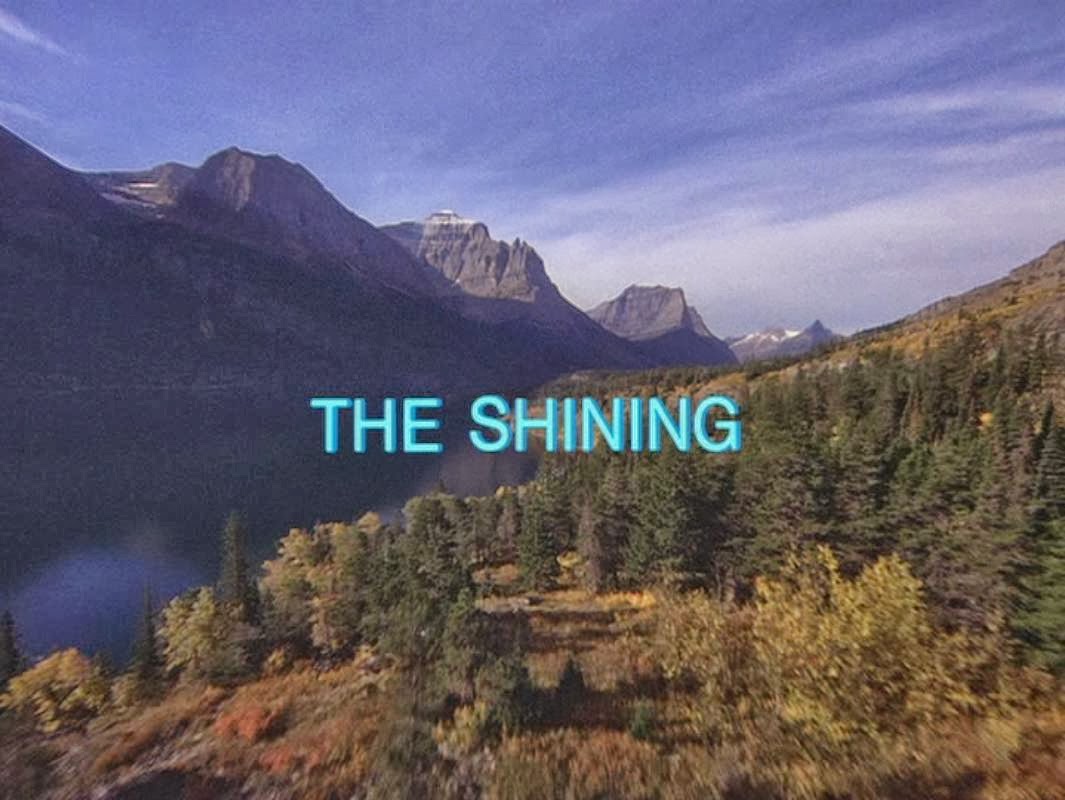
Midnight Movie of the Week #195 - The Shining

One of the biggest challenges I face as a guy who writes these kind of things is coming up with something new to say about movies that have been dissected for ages by smarter and wiser folks than I. I get excited when I have the chance to share my love for an obscure and/or less-respected film, because it's easier for me to develop a personal connection with that movie and I feel like I'm accomplishing something when I start to talk about that movie. But, when I start talking about a movie I love that everyone else loves I can sometimes get intimidated. Some movies are so widely loved that it really does feel like there's nothing left to discuss about them.
One such movie is The Shining, which I've wanted to add to the Midnight Movie of the Week pile for ages yet have always been afraid to write about. And when I sat down with the newly released documentary Room 237 this week, I became completely aware of something I'd always assumed to be true - The Shining has been devoured by more intellectuals than any other horror movie ever made.
The good thing is that Room 237 gave me something of a cheat sheet for thinking about The Shining, though the effect it had on me is not the effect that was intended by many of the contributors to that film. For those who are not familiar with the documentary, Room 237 is explained in subtitle as "Being an inquiry into THE SHINING in 9 parts" and is in actuality filmmaker Rodney Ascher's mash-up of theories about Stanley Kubrick's horror film. That sounds like a boring idea for a movie - until you realize just how entertaining some of the crazy theories about The Shining that are floating around out there are.
Ascher took a very simple approach to making his film - he went out and found a few well-spoken, intelligent people who had spent too much time analyzing The Shining, and then he let them share their opinions and theories. The results are as wildly entertaining as Kubrick's film itself, because these commentators turn The Shining into everything from a metaphor for the destruction of native American races (which seems slightly plausible) to an admission that Kubrick helped fake the moon landing (which seems bat-stuff crazy). The ideas expressed within Room 237 can seem very ridiculous, which is exactly why the film becomes so engrossing, even when it seems that the "proof" behind most of the theories is "Kubrick was really smart and there's no way he didn't mean something with every detail."  (I don't buy in to that mindset, but I like that people have it.)
While the ideas of the people in Room 237 seem like poppycock, the fact that people actually spent the time thinking about them and have convinced themselves to believe in them is terrifically exciting. As a film nerd I've always believed there's a great value in being able to come up with your own ideas about the movie you're watching, and that any movie that will inspire you to reconsider its reality is a movie worth talking about. And that matters, even if you're wrong about the movie. As a writer, I admit to often pitching my own perceptions of a movie and making assumptions about a film's meaning - that's essentially what film commentary is - and I love the idea that these people are out there obsessing this strongly over a film like The Shining.
Room 237 does not explain The Shining. I want that to be clear and - judging by the disclaimer at the beginning of the film and twice on the DVD packaging - Ascher wants that to be clear too. But Room 237 does perfectly explain why The Shining is such a memorable film. Kubrick turned Stephen King's novel into a nightmare, and the result is the kind of lucid dream that someone might have after they read the novel. It isn't true to the page and it doesn't always make sense and - just like a great nightmare - it leaves itself open to interpretation.
I've seen The Shining dozens of times, and I'm still not sure what my interpretation of the film is. Maybe Jack Torrance was just a crazy guy and the final shot was Kubrick's way of messing with the audience. Maybe it was just a parable about being stuck in purgatory and how parents drag their children to Hell with them. Maybe it's just an excuse to axe Scatman Crothers in the gut. I don't know. But, like the people in Room 237, I love thinking about it. I love talking about it. And now, thanks to Room 237, I'm excited to watch it one more time and to re-live that impossible nightmare known as The Shining.

September 14, 2013

Midnight Movie of the Week #193 - Re-Animator

Nearly thirty years later, Re-Animator still feels like one of the most surprising horror movies anyone's ever seen. Almost every horror movie from the '80s was repackaged and retooled into dozens of successful knockoffs, but Re-Animator still manages to stand alone as one-of-a-kind, even if it did lead to two sequels. It's a rare feat that a movie from this time period can actively make you want to not compare it to any of its contemporaries, and that's just one of the great things about Re-Animator.
A modern adaptation of H.P. Lovecraft's Frankensteinian tale Herbert West-Reanimator, Re-Animator is first and foremost a chance for the great Jeffrey Combs to make his mark as one of the most talented actors in horror cinema. There was a hole to be filled after Vincent Price, Christopher Lee and Peter Cushing faded away from leading man status, and Re-Animator certainly works as a jumping off point for its star. As West, Combs evokes memories of Colin Clive and Frankenstein while seamlessly fitting in to a post-Ghostbusters world of horror cinema. Though many point out the changes in horror through the '70s and '80s - first the gritty and decidedly un-gothic tales of the '70s and then the slice-and-dice slashers of the '80s - Combs' turn as Herbert West is one of the best examples of how "classic" horror could still live in the changing climate of the horror scene.
The story doesn't work with just the mad doctor - though it's arguable whether West really ever goes all the way to "mad", I might say that at his worst he's just delusional - which allows for the film's other stars to fit in to the script. Bruce Abbot gets top billing as the straight-laced medical student who gets caught up helping with West's experiments, much to the dismay of his girlfriend Megan - who also happens to be the dean of his college's daughter. Megan is played by the great Barbara Crampton, who is probably the best actress ever when it comes to just being shocked by all the disgusting things happening around her. The things she is asked to do in this film had to a bit uncomfortable for the actress - particularly when the film gets to its infamous climax - but she takes it all like a champ. Abbott and Crampton seem like they have the easier roles in the film - though it can't be easy to scream as loud and as often as she does - but it's imperative that they make simple characters feel unique as they play off of Combs' West and David Gale's creepy Dr. Hill, who becomes the film's biggest menace as it goes on.
It's important to note that none of these characters are portrayed as secondary to the film's gory sequences, but it's just as important to point out how well director Stuart Gordon uses gore throughout his film. The film is deceptively gory these days, because it spends so much time building up West's ideas and the way it effects the characters around him that my memory of the film always starts with images like the sequence where the two doctors re-animate their pet cat - a comical but gross sequence punctuated by Combs' sly "Don't expect her to tango" quip - and makes me forget the chaotic and bloody (and mostly naked) final sequence.  I'm not sure if Gordon's intent was to make us think Frankenstein and then surprise us with something out of Fulci, but if it was he did a darn good job of it.
Re-Animator's plot spirals out of control so quickly in the final act that it's hard to keep up. I've seen the film many times, and as I found myself looking at it again tonight I still lost track of where it was going next. There's something perfectly manic about the last 10 to 15 minutes of Gordon's film, and the pace at which things escalate only makes the film that much more fun to revisit. Everything builds to a final sequence that is perfectly morbid in the way it mixes chaos with human drama, which is probably the biggest lasting impression the film has on me. Gordon and company managed to turn Lovecraft's tale of terror into a gory masterpiece that makes us forget that it's gory, and few horror films out there engage the viewer as well as this one does.


August 29, 2013

Midnight Movie of the Week #191 - Hellraiser

When I'm asked to explain how I can watch horror movies - usually by someone who insists that they just can't (not won't) watch them - I often state that seeing unthinkable acts and disgusting images on screen is something that can make me feel stronger in my day-to-day life. Some people have trouble seeing the line between art and reality - look at all those silly arguments about violence or sex in movies causing real life violence or sex - but I've survived a lifetime as a horror fan because I always remember that the screen I'm watching the movie on is quite literally an impermeable barrier. I'm on one side of it, whatever I see or experience is on the other side, and there is no damage that the things on the other side can do to me.
This is a rather simple theory - I'm sure that if I watched footage of real people being murdered all day it would probably test my sanity, and filmmakers have done an increasingly good job of mimicking reality over the years - but I'm a rather simple man. Drawing that line in the sand allows me to push myself to view the strangest and most intense things on film, and as long as I remember that I'm in control of my side of the screen I am safe. That doesn't mean I'm putting up a wall to what the movie has to offer - I have to let some of what I see effect me if I really want to get the most out of it - it just means that I am aware enough to keep myself grounded while I experience the film.
It's funny to me that the first movie I think of when I discuss this belief is one that revolves around a device that opens the barrier between reality and depravity. But that film, Hellraiser, is a film that always makes me think about how important it is to maintain a distance between myself and whatever evils might be on the other side.
It would be easy to talk about the evil in Hellraiser by looking at the Cenobites, the group of disfigured demons who exist in the film's version of hell and make their way into reality by the film's conclusion, but that's a short sighted view of what Hellraiser has to offer. Evil is present in Hellraiser from the very beginning of the film, and Barker makes sure that we are at least slightly uncomfortable with everyone and everything in the film.
After the film establishes the infamous puzzle box (known to us horror purists as The Lament Configuration, though I'm not sure that phrase is used in the first film) and what it can do in the opening scenes, Barker introduces the family at the center of his story - and it's really easy to dislike them. Andrew Robinson, who is most recognizable as the Zodiac Scorpio killer from Dirty Harry, plays Larry, the husband/father at the center of the story, and his actions are actually those of a decent guy - he's a loyal husband, he loves his daughter, and he's trying to make the most out of this crappy old house he's inherited. At the same time, he just seems slimy. I'm sure this is part of why Robinson was cast - especially with what he's asked to do late in the film - but even when he's playing the nice guy early in the film it's difficult to trust him.

It's possible we feel that way about him because he's married to Julia, played by Clare Higgins, who is established immediately as a frigid creature who had a torrid affair with her husband's brother, Frank.  Barker takes the time to show us how this affair began - to me it appears that Frank forces the issue and Julia develops an addiction to his dominance - which develops Frank as a hedonistic pleasure seeker and Julia as someone who will also give her self willingly to fulfill her needs. Julia also has Larry in her pocket, and there's a recurring theme of him offering to do things for her while she reciprocates nothing toward him.  Barker perfectly sums this up when she seems repulsed by the religious icons their inherited home, and Larry instantly discards them with the trash - almost inviting evil into this home.
The most innocent character in the film is Larry's daughter Kirsty, played by Ashley Laurence, but she seems more like a lost puppy than a strong character in the film. She is the first to confront the evil forces in the film - both the resurrected Frank and the Cenobites - and nothing about her reaction to them makes her seem like someone who has the ability to stand against evil. Most horror films that provide an escape from reality are based around a force who can stand against evil, but the only thing Kirsty can do when she is faced with the Cenobites is to be an informant and offer her evil Uncle in exchange for her own life. When I look at Kirsty against other final girls of the era - Nancy Thompson from A Nightmare on Elm Street comes to mind - there's not a lot to like about her.
Most people scoff at a film where none of the characters seem to be a force for good, but to me this is a key part of Barker's attempt to make Hellraiser uncomfortable from start to finish. These characters are surrounded by grimy and gross images, with the camera focusing in on things like dirt-filled fingernails and bowls of rotten food and maggots, throughout the film. These images set the tone for the blood splatter that will follow, and when we do see hooks rip the flesh of the Lament Configuration's victims the camera is as close to the action as possible. I've seen Hellraiser more times than I'd like to admit, and I still find that it has more moments - both gory and just plain gross - that make me look away from the screen than almost any horror movie out there.
So, to sum it up, we've got a film about people who do evil things in grimy places that features multiple grisly murders, one hedonist who is bloodily reanimated from the inside out, and a force of demons that are disfigured and modified for maximum grossness.  There's nothing to like about the characters, it's hard to watch without experience physical discomfort, and the only thing it accomplishes is that it unleashes hell on the people who deserve it. (OK, it also has one of the best musical scores of any horror movie ever made. That's a real redeeming quality of it) And somewhere inside that film, I find peace.
The short version of what I was saying just then is that Hellraiser is a story about people who don't recognize the figurative barrier between good and evil. And that leads to them crossing the literal barrier between their reality and a pure, evil reality. Whenever I watch Hellraiser, I realize that I am strong enough to know the difference between good and evil. Is it bad that it takes this much depravity to help me see that? Maybe, but that's a different story for a different day. At the end of this day Hellraiser strikes me as an inspiring work of art, because there's a beautiful feeling that I get after I sink deep into its world and come out safe on the other side. Pinhead might tell me it's "a waste of good suffering", but he's on the other side of that screen. He has no power over me.

August 22, 2013

Midnight Movie of the Week #190 - X-Ray

Whenever I think I have the slasher genre figured out, something like X-Ray comes along and reminds me what I reluctantly love about these little pieces of horror trash. It's a formula that was abused and recycled so much in the first half of the 1980s, and yet once in a while the pieces just come together right and something ridiculous just becomes that perfect diversion.  This one, originally titled Hospital Massacre, fits that description perfectly.
Playing off several of the slasher's staples - childhood trauma that sets up adult madness, focusing the events around a holiday or major event, characters who don't believe anything's wrong and die for their ignorance, etc. - X-Ray tells the story of a woman named Susan who goes to the hospital for a check up and becomes the target of a madman in surgical scrubs who is killing anyone who might let her leave the hospital.  It's a silly premise, even by slasher standards, but it really sets up some entertaining carnage.
 Like any good slasher film, we learn there's a killer long before the lead character does, which allows the film to mix splatter and plot development early on. The opening sequence, set around young Susan (played by little Elizabeth Hoy, who also starred in the sleazy MMOTW pick Bloody Birthday) and an angry/murderous classmate, lays some pretty big clues out regarding what will happen next and ends with one of the most unique deaths from the slasher movement. And, like most flashbacks to childhood that open slasher films of the early '80s (there are more of them than you think), it's forgotten for most of the film once time jumps forward.
The adult version of Susan is played by former Playboy Playmate and Hee Haw co-star Barbi Benton, who is a surprisingly adept final girl. I'm not saying Benton should win Oscars or even some of those less prestigious film festival awards for her performance, but the weight of the film is on her and she manages to look the part of a terrified victim throughout. She is given a character who makes some pretty bad decisions and is allowed to do some pretty stupid things - at one point she reveals her hiding place by obviously knocking a file off of a file cabinet and at another moment she frantically struggles with a door that reads "Please Open Slowly"- but this is a slasher film and thus such things are needed to push the plot forward. Nitpickers might find fault with the performance and the film's logic, but I'm not sure why such nitpickers would hunt down a film like X-Ray in the first place.
Keeping up with slasher standards also requires some blood splatter, and director Boaz Davidson (who would go on to become a pretty successful producer on films like The Expendables series, Drive Angry and The Iceman) doesn't disappoint. The film isn't a wall-to-wall bloodbath like some of its contemporaries, but it does have some well-timed kills and plenty of splatter. There are also a few too-graphic-for-The-Mike scenes involving needles - my personal cinematic kryptonite - including one during Susan's initial examination that almost made me throw up. If you're afraid of needles like I am, this film will give you fits.
X-Ray is far from being a great horror movie, but it's such a frantic and entertaining little film that I can't help but smile at it. Everyone is a potential victim - especially because every character seems to have no real personality - and the film manages to keep providing fresh ways to dispose of them while Benton runs through this hospital in fear. The hospital setting made me think a lot about Halloween II, and X-Ray's uptempo pace and over-the-top performances make it a cheesier alternative to that fine slasher sequel. Davidson knows how to provide pulpy entertainment to a viewer who just wants to have fun, and though X-Ray doesn't reach the ludicrous heights of something like Pieces it still manages to be a ridiculously fun slasher movie.

July 27, 2013

Midnight Movie of the Week #186 - Child's Play

It is impossible for anyone to be scared of Chucky like children of the early '80s are scared of Chucky. I'm not going to sit here and argue that the killer from the Child's Play series isn't universally creepy, because the idea of a happy-go-lucky looking doll who's a psychotic madman on the inside is pretty timeless. But those of you who didn't watch Saturday morning and/or after school cartoons at the time just don't know why us late '80s kids were so terrified when little Chucky started killing and swearing and being evil.  Ladies and gentlemen, I present to you: My Buddy and Kid Sister.
If you were a kid of the era, the My Buddy/Kid Sister ad was the real world equivalent of the Silver Shamrock ad from Halloween III. That commercial was everywhere kids wanted to be, and the idea of owning a My Buddy doll that would be my best friend in the world was addictive in all the commercially wrong '80s ways.  Granted, the advertising was never enough to make me actually GET the My Buddy doll - Transformers and G.I. Joe figures were so much cheaper and awesomer! (Plus, us monster kids lucked out when we got My Pet Monster instead.) - but that didn't mean that I wouldn't see that ad three times an hour for what seemed like a lifetime and freak out about how awesome it would be to have a plush best friend in overalls. Every. Single. Time.
Which brings us to Chucky, and the realization that some sick bastard (in this case, Don Mancini) sat at home one day and said "I'm gonna turn that brainwashing commercial for kids into a giant nightmare" and cackled all the way to a hit horror franchise that has spanned nearly 30 years. Mancini actually has stated that his inspiration for Child's Play came from another doll of the '80s, the Cabbage Patch Kids, but it is still impossible for me to see an image of Chucky and not imagine My Buddy tenaciously chasing me around the house with a knife. (Because, as the jingle says, "wherever I go, heeeeee goes.")
Taking a look at the other side of the coin, you have to wonder how a movie could manage to make My Buddy scary - and the answer is the fantastic talent of Brad Dourif. I've seen Dourif in plenty of movies - both very good and very bad - but I only need two of them to convince myself that he's a talented man. This is obviously one of the two roles that defines him in my eyes, and the other is his turn as one of the patients in the true Hollywood classic One Flew Over the Cuckoo's Nest. It's a simplistic way of looking at things, but I'm convinced that any man who can go from bumbling mental patient with a heart of gold to cold-blooded killer in the body of a doll has to have some pretty incredible range as an actor.
Chucky is remembered as a wisecracking killer, much like Freddy Krueger, and like Krueger's films it's sometimes hard to remember that Chucky was birthed from a pretty serious horror film. There's a bit of humor that comes naturally throughout the movie - a lot of it due to the innocent performance by young Alex Vincent as the child who owns Chucky, a lot of it because it's hard to take a 3 foot doll in overalls too seriously - but Mancini and director/co-writer Tom Holland do good work to keep this film tense and serious. The change in tone for the sequels makes sense - less talent involved would lead to a heavier reliance on the simple charms of a killer doll who spews one-liners - but the original film focuses in on the voodoo origins of the possessed doll and lets the child's mother (Catherine Hicks) and the detective on the case (Chris Sarandon) push the movie forward as a (mostly) serious piece of murderous horror.
I'm not sure Child's Play really stands up as "scary" - I like to think of it as a fun-filled horror film that belongs with the likes of Tremors and Gremlins - but Holland and Mancini's film is consistently entertaining schlock. But the thing that's always pushed Child's Play to a special place in my mind is my memory of being indoctrinated by that darned My Buddy jingle, and I have a somewhat twisted respect for Mancini and company for turning out something like Chucky. One of the great skills any horror storyteller has to have is the ability to take the normal and make the audience reconsider it, and few movies have ever destroyed something peaceful in the name of killing as well as Child's Play does.