Search this blog and The Mike's favorite blogs!

Showing posts with label 1990s. Show all posts

November 30, 2013

Midnight Movie of the Week #204 - Se7en

"If we catch John Doe and he turns out to be the devil, I mean if he's Satan himself, that might live up to our expectations, but he's not the devil. He's just a man."
(1995) 
Starring: Brad Pitt, Morgan Freeman, Gwyneth Paltrow, Kevin Spacey.
Directed by David Fincher.
Rated R for some seriously sick stuff, including creepy fat corpse, nearly dead dude with no tongue, knife rape, and Brad Pitt saying the F word a lot.

Seven in Six Words:
Serial killer makes world seem doomed.
Why You'll Love It:
Less than twenty years after its release, Seven (I can only type that number in place of the V so many times before I go crazy) is one of the more well known serial killer films ever made. It spawned a sea of imitators, in both plot and style, but none of them matched the bleak outlook of Fincher's film or its vivid message about society's evils. Most impressive to me is how the director turns an unnamed metropolis (it feels like New York, but the script intentionally avoids labeling it as such) into a kind of purgatory, with Freeman's character often summing up the despair that lives in this place perfectly. 

The Highlights:
  • It's probably not too soon to reveal the plot's surprises, but for the sake of anyone who might not have seen it I'll tread lightly. But it's safe to say that the reveal of the killer and the final step in his plan is what gives this film its initial power over the viewer.
  • After the film's been seen and the surprise has been revealed, the film takes on added meaning upon repeat viewings. References to literature about hell and the deadly sins that provide the killer's gimmick are obvious clues to the filmmaker's intentions, and for me they've seemed to improve with age.
  • Pitt was dismissed by many as the average "hot" young star around the time of release, but his performance here deserves more praise than it has received. There are moments where he's in tune with his Oscar nominated performance from 12 Monkeys during the same year, and his character's chaotic mindset is perfect opposite those who accept the fate that surrounds them in this bleak setting. 
Also Worth Knowing:
  • Pitt only got the part in the film after Denzel Washington turned the role down, saying the film was "dark and evil." He regretted his decision after he saw the film, which may be why he starred in Seven imitator Fallen shortly after.
  • As noted earlier, the location of the film is intentionally not revealed. Screenwriter Andrew Kevin Walker has noted that he was inspired by his time in New York City, but did not want to saddle the film with any specific location that would mute the setting's power.
  • Dreamers, take note: Walker was relatively unknown at the time of production and had written his script while working at a Tower Records store.
Seven is for fans of...
A-list stars doing dark things, serial killer mind games on film, surprise cameos, religious allegories, Morgan Freeman's soothing vocal patterns, and rain.

If You Like This, You Might Also Like...
Theatre of Blood (1973)
Taxi Driver (1976)
Copycat (1995)
Primal Fear (1996)
Arlington Road (1999)
Mr. Brooks (2007)

October 25, 2013

Midnight Movie of the Week #199 - Cemetery Man

Most horror fans I know are quick to point out how lackluster the genre output of the 1990s was.  As with any time and any genre, there were several very good films released during that time span. (A few years back I listed these as my favorites.)  But, with fond memories of the 1980s in our minds and several impressive serious horror films hitting audiences in the new millennium, it's easy to see why the '90s are held in such contempt.
The horror subculture that might have taken the biggest hit in the 1990s was the Italian horror scene, which peaked with Argento, Fulci, and Bava through the '60s and early '80s but produced very few horror hits after the '80s ended. The biggest outlier to this train of thought is certainly Cemetery Man (originally titled Dellamorte Dellamore in its native tongue), which stands out to me as one of the most interesting horror films of its time and place due to its bizarre tone and chaotic plot.
British actor Rupert Everett, who would go on to much success starring romantic comedies like My Best Friend's Wedding and doing vocal work for Shrek movies, is at Cemetery Man's center as Francesco Dellamorte, the caretaker of an unholy cemetery where the dead often rise and walk seven days after their demise.  Many horror films would present a man in this position as an empowered hero, but Dellamorte just seems kind of annoyed by his predicament, sulking through much of the film and struggling to put much effort into sending the dead back to their graves. Cemetery Man uses his indifferent attitude as a platform to great things and Everett is a perfect fit for the moody and disinterested role.
There is one thing that inspires Dellamorte to feel passion, and that - of course - is a woman with huge breasts. She's played by Anna Falchi, who might be the most perfectly endowed woman in horror history, and her place in the caretaker's life drives the film toward the darkly comic tone that pushes it to surprising heights as a star-crossed romance and as an existential fantasy. Falchi first appears and captures the caretaker's heart as a widow who is turned on by the dead, and later shows up in two more roles to throw more salt on the wounds of Dellamorte's tortured love life.  The sexual encounters between the two leads are presented in ridiculously humorous ways - think of that awkwardly hilarious sex scene from Watchmen and you'll start to get the idea of what the director does here - but the caretaker's obsession with this woman through all of her different incarnations is always presented as a serious and somewhat deadly affliction for him.
While this sad sack is wondering what he has to do to hold on to the most beautiful pair of breasts woman he's ever seen, everything around him is increasingly bizarre and wild. His assistant and closest friend is a large bald man named Gnaghi who can only grunt and who also develops an obsessive love for the young daughter of the mayor after he vomits on her. Everyone around the cemetery seems rather uninterested in the fact that these "returners" continue to come back from the grave so Dellamorte can shoot them in the head, and the personification of Death even shows up to warn the caretaker that he should "stop killing the dead."
Everything in the film could be played for straight up laughs, and if that didn't work the story could also have been taken to gory extremes for the horror crowd. But director Michele Soavi seems to have an almost Shakespearean approach to the material, and the spirit that he gives Cemetery Man might be the biggest key to establishing the film as one of the most fascinating horror films of its era. A tonal comparison could be made to Peter Jackson's much loved Dead Alive, but the more human and less slapstick approach gives Cemetery Man a more tragic, thought-provoking edge over other splatter films like it.
Initial viewings of Cemetery Man may puzzle viewers - especially after the abstract ending - but returns to the film have really made me appreciate just how much this quirky horror film has to offer. It pushes the boundaries where many horror films stand pat, and never really suffers from its more abstract and existential choices. It's a movie that you don't want to look away from, and not just because you might see Falchi's God-given gifts at any moment. (Seriously, when she has a shirt on it looks like she's smuggling tetherballs.) The dark comedy, the ill-fated romance, and the zombie splatter all fit together perfectly here, establishing Cemetery man as a one-of-a-kind winner.

August 2, 2013

Midnight Movie of the Week #187 - Red Rock West

I know what my film history professors in college taught me. (Well, I know most parts of it. I wasn't buying all they had to offer.) I know that, according to them and an article by Paul Schrader, film noir was a movement and not a genre. It lasted from The Maltese Falcon through Touch of Evil, and then it was done. According to them, nothing else is noir.
I don't mean to quibble with a professor who had a hand fetish and the writer of Taxi Driver, but there a few movies I've seen since then that make me think of Sam Spade or a Mexican Charlton Heston; movies that make me think I should never trust attractive women and movies that make me assume there's at least one sociopathic killer in every bar. The trendy thing to say about these movies is that they're "neo-noir" - which implies to me that they're inferior knock offs of film noir - but every once in a while one of these films hits all the right notes and makes me reconsider what I was once taught. (Which, of course, is something we should always do anyway. Hooray for contrarianism!)

(Is contrarianism even a word? If not, I call dibs on inventing it.)
Which brings us to today's film, Red Rock West. Directed by John Dahl (who also co-wrote the film with his brother Rick), it's a deadly game between an honest man, a deadly man, a corrupt man, and...a woman. Being noir (or at the least noiresque), it's not fair for me to put a qualifier on the woman character. Is she honest? Is she deadly? Is she corrupt? You could shake a Magic 8 Ball and get a more consistent answer than I could give you about the women of noir.  There's like five books I could write about them and I'd probably still miss several key points.
Nicolas Cage stars as Michael Williams, an ex-marine who is roaming the Wyoming countryside looking for work and stumbles into the middle of a murder scheme. Cage plays the character with his trademark twitch, but also stays true to that unhinged-yet-pure-hearted persona that he seemed to hit so well in the mid '90s. He gets caught up in that unrewarding cycle of trying to do the right thing, with his biggest mistake being that he accidentally accepts a gig as a professional killer. He thought the guy needed a bartender, but instead the guy needed someone whacked. I'm sure this happens all the time. So remember: Don't forget to ask what the job you're accepting is before you accept it.
The man who mistakenly hires Michael is played by the late J.T. Walsh, one of the '90s sleaziest character actors, and his wife is played seductively by a young Lara Flynn Boyle, who embraces the role of femme fatale with ease. Their dynamic with Cage's character allows for plenty of great interactions as the drifter tries to find the easiest exit from the small town of Red Rock that is left for him. The plot survives thanks to Michael's extreme string of bad luck, particularly when he stumbles into the film's most unhinged character - Lyle from Dallas, the hitman who Michael accidentally impersonated who is played by no less than Dennis Hopper.
By this point in his career anyone who loves dark cinema had seen what Hopper is capable of, and his turn as the killer here steals scenes throughout the film. He's not as crazy as he was in films like Blue Velvet, instead making Lyle seem like a relatively smart guy who just really enjoys money and killing. While all four of the film's stars are excellent - this is one of the most fantastic casting jobs I can think of in a movie - it's Hopper's energy in his scenes that really keeps Red Rock West feeling dangerous and exciting. Thanks to him we feel even more sympathy for our down on his luck hero, and at times he even makes us feel a little sympathy for Wayne and Suzanne, despite their attempts to kill each other.

Red Rock West doesn't look like the traditional noir - or the traditional midnight movie, to be honest - but it's so well-plotted by Dahl and so well acted by the cast that it overcomes all the cliches with ease. It's a little-movie-that-could, one that was even sold to HBO and premiered on cable before getting picked up and distributed theatrically, but it has always jumped off the screen at me as a truly special pulp thriller. Above all else, it's my favorite argument toward the idea that maybe noir didn't die off for good in 1958. The rain and the overcoats are (mostly) gone, but Red Rock West still feels like it belongs next to some of Hollywood's darkest crime stories.

July 12, 2013

Midnight Movie of the Week #184 - Mute Witness

I love being able to call a movie "Hitchcokian" almost as much as I love Hitchcock. Heck, saying a movie is Hitchcockian - which means "feels like a movie Hitchcock would approve of or make himself" in my mind - is my way of saying a movie has made it in this world. In my mind it's like Hitchcock is Roy Hobbs at the end of The Natural and I'm Bobby Savoy and the movie I get to call Hitchcockian is the Savoy Special. That's how awesome I feel when I can say it and mean it, and I don't care if that reference is nearly thirty years old and doesn't fit my blog and may be a little obscure. "Go pick me out a winner, Bobby" is one of the most uplifting movie moments of EVER, and that's how I feel about great Hitchcock clones.
Which brings us to Mute Witness, a 1994 thriller that's full of holes but has this wonderful manic energy that teams with a devilishly playful script to create something twisted that you just know would make Hitch smile. The plot revolves around a young, mute woman who is working as a special effects artist on a Russian horror film and just happens to stumble upon the filming of a snuff film. I don't want to explain what a snuff film is to you innocent readers - I didn't learn about them until I was 17 and my mom took me to see 8mm - but I don't really want you to google it either. So, I'll just go ahead and say that you need to prepare for a sex scene with a murder at the end and leave it at that. Is it uncomfortable to see that? You betcha. Does it ramp up the tension for everything that's going to follow it? Absolutely.
Considering the plot, the film could also draw a viewer's mind to Hitchcock homages made by Brian De Palma like Blow Out and Body Double. Writer/director Anthony Waller doesn't shy away from brutality and bloodletting, but at the same time the film always has that sinister charm that keeps you feeling safe while watching it. If there's one thing that sets a Hitchcock thriller apart from most other films is that there's this perfect balance where you feel in danger while also feeling like you're having fun. It's what I call the roller coaster principle, and Waller - like Hitchcock and De Palma before him - understands that principle.
The key to any good roller coaster movie is that the pace can't follow a formula. There are always going to be ups and downs, but if we get into a rhythm and start to expect them they lose their power over us. Mute Witness gets this. It starts off with a bang - the snuff filming happens way earlier than you would expect to see snuff filming in a movie - and there are a few moments after that shock where the viewer is left wondering if there are any more thrills to be had. Patience will pay off for the viewer, as the film always seems to have something new coming with the next twist.
Russian actress Marina Zudina takes the lead as Billie, the mute special effects girl, and is fantastic throughout the film. Considering the fact that her Wikipedia page discusses her aspirations to be an opera singer and her musical background, I'm going to go ahead and assume she's not mute in real life. But I would never have believed that based on the film - in fact, I've seen it 3 or 4 times and I just now made the connection that she might not be mute and now I feel kind of in shock and it's derailing this whole paragraph. Thanks to Zudina's performance - by far the most polished in the film - Billie is a fun character to be stuck in a mystery with as she comes up with some very unique (and R-rated) ways to interact with her surroundings while not speaking.
The film is also slightly infamous thanks to a cameo from a "Mystery Guest Star" who agreed to speak a handful of lines for the film as long as he wasn't mentioned in the film's advertising. As such, I have chosen not to list his name here - but I will tell you he once built a bridge and at another time used Force. You can look it up on IMDB, but to do so might spoil one of the most overly dramatic reveals in the history of movies. To say that Waller milks this star's presence for all it's worth would be a huge understatement. As the music swells around him and the camera lingers as his faces peeks out from a darkly lit car I half expected Humphrey Bogart to show up as an evil mastermind. (SPOILER ALERT: It's not Humphrey Bogart.)
Mute Witness has some problems - bad acting from the supports and a few lulls between shocks are the biggest of them - but then that sly Hitchcockian/De Palmaesque attitude shows up on the screen and it's nearly impossible to avoid being hooked. This is a high concept thriller full of surprises, a crowd pleasing film that should keep anyone who can find the fun in murder smiling. If nothing else, it should do the same thing a good roller coaster does - distract you from reality and keep you anticipating the next thrill.

May 2, 2013

Today's Things: The "Manborgs, Vampires, and Twins" Edition

You guys, I'm tired of being boring. I feel like 2013 has been one big long boring year here at FMWL. And that sucks. I could make a bunch of excuses - work sucks, writing about horror movies four days a week exhausts a lot of topics, I'm just lazy - but none of them would actually matter. It's not why I don't do things that's important, it's that I do something about it.
Totally unrelated, yet important, checklist.
When thinking about my own writing and what the heck I'm doing, I came to a realization. I love writing reviews and being as serious as I can be (which isn't that serious, but that's beside the point), but the most fun I've ever had writing about movies - save a few of my favorite posts here at FMWL - was more than ten years ago when a friend asked me to write a DVD column on his site and I turned it into a random series of thoughts that I slapped together off the top of my head while doing what I call "winging it." It wasn't high art and it wasn't always important, but it was carefree and fun and it always put a smile on my face. And, as you might have guessed, that's what I'm doing right now.

That's not to say I plan on getting rid of reviews or the Midnight Movie of the Week or any of the other stuff I do when I'm feeling inspired. But there are so many times when I just want to put some thoughts out there and I get caught up in the how and the what and then I'm like HEY THE MIKE JUST FREAKING TYPE IT. So that will be what I do every once in a while in posts like this one, which will carry the simple title "Today's Things."

(Yes, I thought of that name all by myself. I'm a gosh darn Einstein.)

(Oh, and I might ramble on a bit here. Just roll with it. Or go read something else. Your move, creep.)

Thing I'm Loving on Blu-Ray
I'm not sure if I've said it enough over the last year, but Shout Factory's horror centric new wing, Scream Factory, is one of the best things to happen to horror fans in ages.  Case in point: This week's release of the R-rated Hammer Films offering The Vampire Lovers. Released in 1970, this Dracula-less film is a showcase for the voluptuous and talented Ingrid Pitt, a horror star who must be seen by all fans of romantic vampire tales.
While the film itself is not one of Hammer's best offerings, it stands up as a nice adaptation of the classic tale of Carmilla, which predated Bram Stoker's Dracula and pretty much invented the lesbian vampire stereotype that became a staple of European horror in this era. Pitt is the primary reason to check the film out, and its use of nudity and sexuality - while mild by modern standards - is out of character and risque for hammer. Advertising for the film that has been reproduced (twice on the blu-ray packaging and once as an on-disc disclaimer) boldly states "Not for the mentally immature!", which to me seems like a reminder that there's artful desires behind this surprising film.

(By the way, I always give a movie extra kudos if a villain uses a fake name that is an acronym of their infamous name. Here we get Carmilla pretending to be someone named Mircalla, and me smiling a lot due to this fact.)

As has been the case for most of their releases, Scream Factory put a lot of effort into this release.  The blu-ray package (unlike many of their releases, this is NOT a blu/DVD combo pack) offers plenty of extras - I'm stoked to see the commentary by director Roy Ward Baker, even though I'm pretty sure it's carried over from the old DVD release - and the price is even a bit lower than most of the other Scream Factory titles. Fans of Hammer or European vampire flicks of the '70s should definitely find this one.

Thing That's Not Horror That I'm Watching While Writing
Broken Arrow. Look, I know there's a good John Woo and a bad John Woo, and I know that this is bad John Woo. But I still find a lot of enjoyment in just how ridiculously macho this showdown between John Travolta and Christian Slater - neither of whom are often charged with being ridiculously macho - is. There was a place and a time in the '90s when this was comfort cinema to me, and it's still welcome now - it's just not welcome as often
Bonus points for Samantha Mathis. Redheads, man.
 (By the way, I dog on the '90s all the time - but I gotta admit they've grown on me. I even like a lot of '90s music now! And I even hated '90s music then. Today a teenager I know called Pearl Jam classic rock and it took every ounce of my being to stop me from shouting "WHOA YOU JUST BACK THE FRAK UP!" and going on a rant. Restraint - Thy name is Mike.)

So yeah, Bad John Woo still has its moments. Unless it's Mission Impossible II. Then it just makes me sad.

Thing I'm Not Sure About Yet, But Which Makes Me Chuckle
When a movie's called Manborg, I take notice. And production crew Astron-6 already had my attention thanks to Father's Day, one of the most obscene and ridiculous (and also fun) movies released in 2012.  But Father's Day was one of those movies that I never managed to write a review of, because it's just kind of difficult to piece together a legitimate commentary on such a random movie. You know how sometimes you see something bizarre and you're like "Well...that happened." and you know you had fun but all attempts to explain why you had fun don't make sense?  That's where I was at when I saw Father's Day.

That's kind of where I'm at after Manborg too, although it's a different kind of feeling this time. Manborg - the tale of a man who is reincarnated as a cyborg, naturally - is a more cartoonish and less vulgar animal than Astron-6's first film. It's still bloody and gory and inappropriate in its own ways, but it's more playful and maybe even more fun than Father's Day was. Maybe. I'm not really sure. Father's Day was more...ummmm....artistic? Maybe? Heck, I don't know. The point is that explanations of Astron-6 films are really pointless - if you like low-budget retro/grindhouse goofiness, these movies are for you. If you don't, you'll hate 'em. Regardless of your opinion, in ten years we'll be talking about Astron-6 the same way we talk about Troma films now.
Back to Manborg - I might review it soon, but I'm not sure that review will make much sense. I will say that Mina - the blue-haired anime-inspired heroine - and #1 Man - the poorly dubbed martial arts expert who's presumably from the far east - had me cackling all the time and made the 72 minute film worthwhile. That might be all I need to say for a review, actually. Let's move on...or you could watch the Manborg trailer and catch up with me in a minute.

Thing That's A Random Rant
Those of you who know me or follow me into the social media world probably know that I'm a pretty big sports fan at times. And I was randomly thinking about horror movies today and how lots of horror movies promote lots of stereotypes and I was surprised by how I never thought a lot about athletes in horror movies.

The catch, of course, is that horror movies don't often give us much to think about when a character is written as an athlete. For starters, "idiot male who womanizes often" is often synonymous with "football player" in horror scripts, a distinction that is occasionally deserved but a bit of an oversimplification. I mean, I was a teenage football player, but I still learned how to read and write and how to not treat women like objects and how to never have a girlfriend - all of which are completely the opposite of what we see from "athletes" in horror movies.  I am not the norm, and I'm proud of that, but I really don't think that the type of football guy shown in these movies is the norm either.
I always assumed this guy died because of his hairstyle.
But hey, let's leave football out of this right now. Why is that always the example? Where's the hockey players and the basketball players and the golfers? And where are all the female athletes? American schools have laws which require equal amounts of sports programs for males and females, but how often does a female character in a horror movie mention their sports experience? Now, there are naturally some outliers - would you believe that PIECES, which features a character who's a female tennis star, is one of the more progressive horror movies in this regard???? - but I'm struggling to pull them off the top of my head.  In fact, this topic might require more thought and its own post.

What say you, dear readers? Got any examples of athletes in horror that stick out to you? Have similar complaints about this stereotype or similar stereotypes in horror films? I know it's one of the least important ones out there - we should probably deal with how terrible women get treated in slasher films before we focus on football stars - but it's something that caught my attention and inspired me to ponder.  What do you think?

Thing That's A Random Shout Out
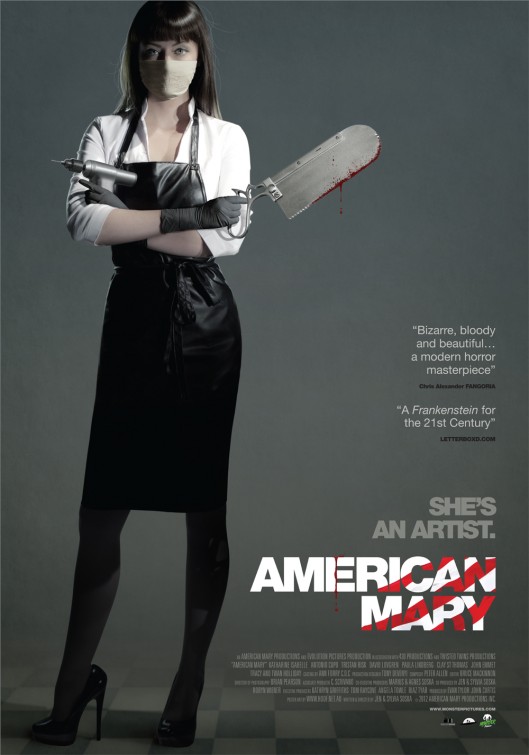
Belated happy birthday to Jen and Sylvia Soska, better known as the Twisted Twins, who celebrated a birthday on Monday. They were the team behind Dead Hooker in a Trunk, which was one of the first indie horror films I reviewed for this site and a goofy favorite that still makes me laugh.  Their follow-up, American Mary, will make its US debut on home video in June, and if you don't think I've got that pre-ordered than you don't think my name is The Mike. Can't wait to see what these talented ladies have up their sleeve next!
Thing At The End
Coming soon to FMWL - William Friedkin's new memoir, a yet-to-be-named Midnight Movie of the Week, and a review of the Guillermo Del Toro produced Mama on blu-ray. Plus I've got a stack of Pam Grier DVDs sitting next to me that are just begging for some one on one time.  So, until next time, here's a thing from YouTube. Be well, Midnight Warriors!

January 19, 2013

Midnight Movie of the Week #159 - In the Mouth of Madness

The last time I mentioned In the Mouth of Madness on this here site, I said something like "It's about time we recognize this as one of Carpenter's classics."  I'm not sure I wasn't talking myself there.  Carpenter's always been my favorite post-Hitchcock topic when it comes to genre cinema, and I've never denied the fact that this film is a fascinating piece of horror. But there's always been something about the film that's kept me from listing it alongside my favorite films by the director - and I have no idea what that something is or if that something should exist. So, since it was freakin' John Carpenter's BIRTHDAY(!) this week, let's investigate.
Released in 1994, In the Mouth of Madness was only Carpenter's second film of the 1990s (following the studio misfire Memoirs of an Invisible Man) and is probably the last pure horror film Carpenter made until 2010's The Ward sixteen years later.  And pure horror might be an understatement when it comes to In the Mouth of Madness, because the film manages to pay heed to the two most loved horror writers of all-time - H.P. Lovecraft and Stephen King - while creating an apocalyptic world that's all Carpenter's own.
Sam Neill stars as a skeptical insurance investigator who's hired (by Charlton Heston, BTW) to look into the disappearance of horror author Sutter Cane, an enigmatic writer whose fiction has caused a bit of psychosis in his "less stable readers." His job leads him to the fictional small town Hobb's End, in which strange things like mutant killer children and tentacled beasts are only some of the tricks that Cane - played by Jurgen Prochnow - has up his sleeve. What follows is a lot of Neill screaming and a lot of bizarre special effects. And that sounds like it could be a bad thing, but it is completely not.
This is one of the rare Carpenter films that doesn't have the director (or one of his pseudonyms) given a writing credit, but unlike Memoirs of an Invisible Man before it you can still feel the stamp of the director throughout the story. In fact, many have labeled this as the third installment in Carpenter's 'Apocalypse Trilogy' - following influence of The Thing and Prince of Darkness - thanks to the increasingly pessimistic tone of each film. Like the other two films, In the Mouth of Madness unleashes an evil force that can not easily be seen or classified; which is also a force of evil that has the power to take over the human mind.  Many of Carpenter's earlier/great films hide their evils behind "things" - a gang, a shape, some fog, a car, etc. - but you could probably argue that this is his most abstract representation of evil outside of The Thing.
In fact, it's the film's willingness to shift through different visions of evil that is most fascinating to me. The first major madness in the film comes from an ax toting maniac (who we later find out was Cane's agent), but the film then seems to allow terror to seep into all areas if the main character's life. Throughout his wonderfully hammy performance, we see Neill deal with everything from zomified nightmares to visual and auditory hallucinations, consistently blurring the line between reality and what can only be described as Hell. There are some truly random moments - like one involving the color blue - that wouldn't work in a lesser film. But Carpenter's ability to tell a story and Neill's approach to the skeptic-driven-crazy role go a long way toward making the film feel so full of evil.
There's a comic undertone throughout the film - supported by Neill's grandiose performance and the increasingly uncommon series of twists - that makes it hard to see In the Mouth of Madness as a truly "scary" piece of horror.  If anything, the film's tone probably endears the film more to horror fans than anyone else because, like many other horror successes of the 1990s, the film is a horror movie about horror stories. I think the tone might be a big part of why I've never loved this film as much as I do The Thing (which never stops being serious for a second) or Prince of Darkness (which compliments its own wacky plot with a straight face that never wavers).  And yet, every time I see the final scenes of In the Mouth of Madness I am reminded just how vast and terrible the film's idea would be in a real world society. No one will ever mistake this film for a cautionary tale about human horror, but a more open minded viewer who loves to speculate in "what if"s as much as the characters here do - should have a lot of fun with one of Carpenter's unsung successes.


December 28, 2012

Midnight Movie of the Week #156 - Stephen King's The Night Flier

When the discussion turns to Stephen King's best pieces of writing, The Night Flier is not generally a title that gets mentioned.  I've never read the short story, which was originally published in 1988 as part of one of the authors' many anthology books, yet the 1997 film adaptation of the story has long stuck in my mind as a chilling example of King's ability to tell a scary story.
Like many King tales, The Night Flier focuses as much on its flawed human characters as it does on any supernatural force. In the film, cynical tabloid reporter Richard Dees (a character who briefly appeared in King's novel The Dead Zone) sets out to chase down a serial killer who flies around the Northeast in a black Cessna plane and leaves a bloody trail that suggests vampiric tendencies. The cape-wearing aggressor - who goes by the name Dwight Renfield, which is called out as a reference to Dracula - is the instrument that sets everything into motion, but the slimy reporter is what really draws me in to the film.
Dees is played by Miguel Ferrer, an actor who has done reprehensible and narcissistic a few times in films like Robocop and Traffic.  The character isn't that much different from what we've seen from him in other films; what is different is that we're stuck with him.  This is a man who will manipulate any situation to fit his needs - whether that means defacing a grave or trapping a competing reporter in a closet - but he's also the closest thing to a hero the story will offer us.  We've seen King do this before - Jack Torrence from The Shining is probably the most famous example, though Dees' character arc seems closer to that of the lead character in Thinner - and once again he doesn't seem to care whether or not the audience likes the guy who may or may not get eaten by an aviator vampire.  King's universe is not a place where a story needs a good guy, and Ferrer is a perfect bit of casting in that universe.
Another thing working in the favor of The Night Flier is the source material. King's prose may be best when the author is allowed to go on for hundreds and hundreds of pages, but it's hard not to argue that the best film adaptations of his work come from some of his shorter tales. The Night Flier is an incredibly simple story, and there's a part of me that's surprised it wasn't whittled down to a half hour for something like Tales from the Crypt.  The film gets to 90 minutes by adding a female character who serves partially as a competitor and primarily as a sounding board for Dees' cynical rants, but it doesn't feel like this is just padding to the film. This is a tight horror film that really doesn't waste a moment as it shows us Dees' investigation and leads us toward the answer to his questions.
When The Night Flier answers those questions it makes sure that everyone is glued to the screen. In fact, I might argue that the sequence that starts with Dees finally catching up to the title character is one of the most gripping pieces of horror filmed in the 1990s. The last 20 minutes of the film feature gory moments that make us cringe - including the reveal of some awesome creature effects - and at the same time offers a chilling black-and-white sequence that feels like something out of a moody horror film from decades gone by.  Some King stories feel like they lose their way as they try to finish up their story - when they end with a random giant spider, for example - but Night Flier feels like everything wrapped up perfectly in this final sequence.
King may be best known for his epic tales of horror and fantasy, and it's hard to argue against that when it comes to his writing. But when I look at the film version of The Night Flier, despite the fact that it's a film with one interesting character and very little action before things go off the rails in the final act, it seems to me that this is a great example of how King's smaller works can make effective 90 minute horror films.  The Night Flier is entertaining because it's such a simple story and because it isn't as ambitious as some King epics. This is the story of one cynical man and one serial killing vampire, which means that the acting of Ferrer and some wonderful special effects are all it really needs to make the film work. It doesn't compare to reading Needful Things, but it's a fun horror flick that should make the author proud.

December 12, 2012

Midnight Movie of the Week #154 - Body Snatchers

Y'all probably know by know that a remake can be a dangerous thing. The minute you start making one is the minute someone starts getting mad about it.  You can prove them wrong once in a while - more often than most people think, I'd argue - but there's always gonna be people mad about it.  You have to be a little insane to remake something that's widely called a classic - but you have to be even more insane to remake a classic that's already been remade and remade well.
That insanity can work in your favor sometimes.  Case in point: Body Snatchers, the 1993 update of Invasion of the Body Snatchers.  This version started with a story co-written by Larry Cohen (The Stuff, It's Alive), moved on to a script co-written by Re-Animator power duo Stuart Gordon and Dennis Paoli and was directed by Abel Ferrera, who's most known for gritty crime flicks like King of New York and Bad Lieutenant.  It seems like a random assortment of talent to the casual observer, which is part of what makes this Body Snatchers tale unique.
Don Siegel's 1955 original film - adapted from Jack Finney's novel, which is credited as the source material here - used the idea of identity-stealing pod-people as a commentary on the communist scare of that time period.  The first remake, by Philip Kaufman in 1978, is updated for that time period (with struggling artists and empowered women!) and maintains the main premise and California setting.  Ferrera and company, however, decided to take the film in a different direction - moving the action to a military base in the southern United States.
While previous versions of the story focused on strong male leads trying to make sense of the invasion, Ferrara's film puts most of the drama on the shoulders of a teenage girl, played by the talented Gabrielle Anwar.  Through her turn as the daughter of an environmentalist who is stationed on the base, the film spends less time trying to figure out who the invaders are and how they work than those that came before it.  The teenager is dealing with her own issues - she's very emotional, if not fully "emo" - well before she stumbles into an aliens-who-take-over-our-identities-and-show-no-emotions fiesta.  This means that a) she's not one of them overly scientific people that try to solve the what and the why of the situation, and b) she does the natural thing we'd expect a teenager to do in this situation - runs away.
Anwar's Marti, along with her little brother Andy, can't be blamed for their fear as they deal with the escalating "hive mind" situation that they are a part of.  One of the film's most haunting scenes has young Andy realizing he's not like the other children in the day care center on base, thanks to some repetitive and tentacle-y finger paintings.  Subtlety is one thing this film definitely lacks - a lot of scenes like this are telegraphed and almost too easy for folks who know the story to predict - but the film still manages to be patient and artistic as it quietly shows us the snatchers' hold on the community.  This sequence works perfectly because it's framed delicately and given a chance to really sink into the viewer's mind. To put the film's approach in simple terms, it's as if Ferrara shows us that there's a monster running at us and then makes us patiently watch as the monster gets closer and our vision of it becomes clearer. We aren't surprised by what we see, but the increasing clarity about the attack makes the tension grow within us.
The most perfect example of this film's blatant, yet slow-moving brand of horror is the performance given by Meg Tilly as the seemingly evil stepmother turned actually evil stepmother.  The monologue that allows an emotionless pod-Tilly to explain the scale of the attack to her scared family is one of the greatest crazy/calm scenes on film, and the silky voiced actress - who would later loan her talents to the Child's Play series - is the key to the film maintaining its power as a quieter version of the Body Snatchers tale.  As if her reminder that humanity is kind of screwed isn't enough, she gets to do what I call "the big scream" - a throwback to the '78 adaptation - which send chills all the way up my spine for what feels like infinity.
There's something pretty fantastic about the way Ferrara and company get these actors to sell the difference between themselves and their pod-selves, especially as he manages to still surprise us with a few turns in the final act. The first two Body Snatcher films feel like their primarily interested in stopping "them", while this take on the story is more about protecting "us" and our identities. The military setting is obviously not an accidental choice, and the film's commentary on the military's interest in squashing emotion and creating controllable soldiers is a nice parallel to the pod person problem.  But this military aspect is less interesting to me than how the film abandons the scientific focus of the other films and switches its focus entirely to the fight to maintain our individuality.
It's a neat switch, even if some of the supporting actors aren't as talented as Anwar, Tilly, and Forest Whitaker (whose performance as the on-base doctor allows for a bit of the paranoia that ran rampant in the other films) when the film needs them to help sell the.  I've spent much of this space commenting on how the film compares to those other films, but there are plenty of reasons to laud this surreal and haunting spin on Finney's novel as its own beast.  It works a lot better than most remakes do, and it holds up today as one of the most effective horror films of the 1990s.